

Unlock Your Home's Potential: Best Improvements to Increase Value
Why Smart Home Improvements Matter for Colorado Homeowners

Increase home value through strategic renovations and you'll unlock thousands of dollars in equity while making your property more attractive to buyers. The key is focusing on projects that deliver the highest return on investment.
Top ways to increase home value:
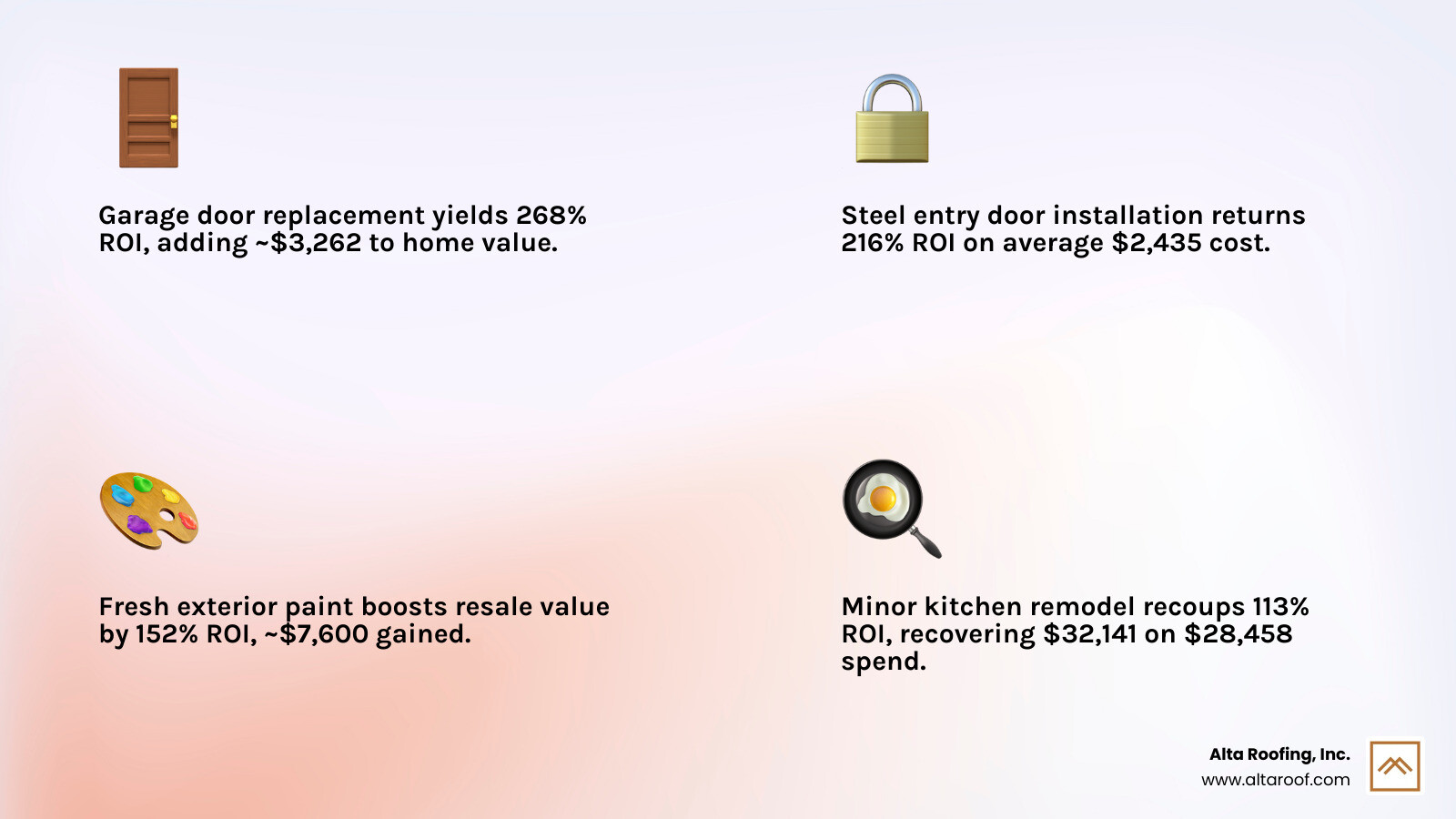
- Replace your garage door - 268% ROI (adds ~$3,262)
- Install a steel entry door - 216% ROI (average cost $2,435)
- Update with fresh paint - 152% ROI (~$7,600 in resale value)
- Reface kitchen cabinets - 80-90% ROI ($2,000-$5,000)
- Add stone veneer siding - 92.8% ROI (~$8,000 cost)
- Complete a minor kitchen remodel - 113% ROI ($28,458 cost, $32,141 recouped)
- Replace or repair your roof - Critical for curb appeal and "effective age"
- Improve energy efficiency - Lower bills, higher appeal
- Enhance curb appeal - Landscaping, exterior paint, updated fixtures
Your home is likely your biggest financial asset. While you can't control your location or overall market conditions, you can make strategic improvements that boost your property's worth. Some renovations—like garage door replacement—actually return more than they cost. Others, like upscale kitchen remodels, may only recoup 38% of their investment.
The smartest approach? Focus on modest upgrades that align with current buyer preferences in your local market. Prioritize exterior improvements, maintain major systems (especially your roof), and enhance energy efficiency. Colorado's harsh weather—including hailstorms and severe winds—makes roof condition particularly critical for both value and insurability.
I'm Barry Goers, founder of Alta Roofing, Inc., and I've spent years helping Colorado homeowners navigate complex restoration projects that significantly increase home value. My background in construction investing has taught me which improvements deliver real returns and which ones are just money pits.
High-ROI Projects to Increase Home Value
When we talk about getting the most bang for your buck, we have to look at the "face" of your home. First impressions are everything in the Colorado real estate market, from Denver down to Colorado Springs. If a buyer pulls up to your curb and sees a sagging garage door or peeling paint, they are already mentally deducting thousands of dollars from your asking price.

One of the most shocking statistics in home renovation is the power of the garage door. According to recent data, a garage door replacement recoups a staggering 268% of its cost at resale. For an average cost of $4,672, you aren't just making the house look better; you are literally putting money back in your pocket. Similarly, a steel entry door replacement recovers about 216% of its cost. It’s a simple security and aesthetic upgrade that pays for itself twice over.
If you want to take your curb appeal to the next level, consider adding stone veneer. Replacing a portion of your siding with stone veneer yields a 92.8% ROI. It gives your home that rugged, "Colorado-chic" look that buyers in Castle Rock and Monument absolutely love. These top 9 renovations to increase home value show that the exterior is where the real profit lives. For more on how to protect these investments, check out our guide on exterior home restoration.
Cost-Effective Ways to Increase Home Value Under $1,000
You don't need a massive home equity line of credit to make a difference. If you have a weekend and a few hundred dollars, you can still increase home value significantly.
- Neutral Paint: This is the undisputed king of low-cost upgrades. A fresh coat of "Agreeable Gray" or a soft white makes a home feel clean and new. While the average cost to hire a painter for a single room is between $380 and $790, doing it yourself can cost as little as $200-$300 in supplies.
- Decluttering: This costs $0 but adds thousands in perceived value. If a buyer can't see your countertops because of the toaster, air fryer, and mail pile, they think the kitchen is too small.
- Landscaping: Simple yard care—weeding, fresh mulch, and trimming overgrown bushes—can add up to 10% to your home's value.
- LED Lighting: Swap out those old yellow incandescent bulbs for bright, energy-efficient LEDs. It makes every room look larger and more modern.
- Hardware Updates: Replacing dated brass cabinet knobs and "builder-grade" door handles with matte black or brushed nickel fixtures is a quick win.
Using Smart Technology to Increase Home Value
In tech-heavy hubs like Boulder and Denver, buyers expect a home to be "smart." Technology upgrades are less about a 1:1 ROI and more about marketability—making your home the one that sells in two days instead of two months.
Smart thermostats (like Nest or Ecobee) are a favorite because they save the homeowner an average of 8% on energy bills. Security cameras and smart locks also rank high on buyer wishlists; 76% of recent buyers rate security cameras as essential.
In our semi-arid Colorado climate, smart irrigation controllers are a massive selling point. They adjust watering schedules based on local weather data, preventing you from watering the lawn during a Thornton thunderstorm. If you've recently dealt with weather damage and need professional help with these types of integrations, our storm restoration contractors can help coordinate the repairs.
Strategic Interior Upgrades for Modern Buyers
While the exterior gets them through the door, the interior—specifically the kitchen—closes the deal. However, we always caution our clients: don't over-improve. An upscale, "chef's kitchen" remodel might cost $150,000 but only recoup 38% of that cost.
Instead, we recommend a minor kitchen remodel. This usually involves cabinet refacing, replacing the oven and cooktop with stainless steel appliances, and perhaps updating the countertops to quartz or granite. A minor remodel (around $28,000) actually recoups 113% ROI on average. Buyers want "move-in ready," not "I need to spend six months picking out marble slabs."
Bathroom modernization is another high-impact area. You don't need to move plumbing. Simply replacing an old tub with a walk-in shower or updating a vanity to a double-sink model can make a world of difference.
| Project Type | Average Cost | ROI / Recoup % |
|---|---|---|
| Minor Kitchen Remodel | $28,458 | 113% |
| Midrange Bathroom Remodel | $24,000 | 74% |
| Upscale Kitchen Remodel | $150,000+ | 38% |
| Major Bathroom Remodel | $75,000 | 45% |
High-Impact Flooring and Paint Choices
Flooring is one of the first things a buyer notices. If you have stained carpet or scratched linoleum, it’s time for an upgrade. Luxury Vinyl Plank (LVP) has become the gold standard for Colorado homes. It’s durable enough for snowy boots and muddy paws, but it looks exactly like hardwood.
If you already have original hardwoods, hardwood refinishing is almost always worth the investment. It brings back the "soul" of an older home in neighborhoods like Park Hill or Old Colorado City.
When it comes to paint, color choice matters. Zillow research on paint colors found that homes with blue bathrooms (specifically light, watery blues) sold for $5,440 more than expected. Conversely, dark, "moody" colors might look great in a magazine, but they can make a room feel small to a potential buyer. Stick to a neutral palette to let the buyer visualize their own furniture in the space.
Adding Usable Square Footage
In real estate, more is almost always better. Homes are valued largely on their livable square footage. If you have an unfinished basement, you are sitting on a gold mine. Finishing a basement has a potential ROI of 70%, but more importantly, it can bump your home into a higher price bracket by adding a bedroom and a bathroom.
Other ways to add space include:
- Home Office Conversion: With remote work becoming a permanent fixture for many in the Denver metro area, a dedicated office is a high-demand feature.
- Attic Bedroom: If you have the head height, an attic conversion is a great way to add a "flex room."
- Open Floor Plans: Removing a non-load-bearing wall to connect the kitchen and living room doesn't add square footage, but it makes the existing space feel significantly larger.
The Critical Role of Maintenance and Roofing in Colorado
We cannot stress this enough: no amount of granite countertops will save a deal if the home has a failing roof. In Colorado, the roof is the most important component of your home's exterior. Between our 300 days of sunshine (UV damage) and our legendary hailstorms, your roof takes a beating.
A roof replacement doesn't just protect the structure; it drastically lowers the "effective age" of your home. Appraisers use this term to describe how old a house feels based on its condition. A 40-year-old house with a brand-new roof and fresh siding might have an effective age of only 10 years.
If your roof is over 20 years old, it’s likely at the end of its life. Many insurance companies in Colorado are now refusing to cover roofs older than 20 years, or they are switching policies to "Actual Cash Value" (ACV), which pays out significantly less. If you aren't sure where you stand, read our blog on how to know when it's time to replace your roof.
Navigating Insurance and Trade Coordination
This is where we at Alta Roofing, Inc. really shine. Most homeowners find the insurance claims process for storm damage to be a nightmare. You have to deal with adjusters, multiple contractors, and confusing paperwork.
We act as your single point of contact. We specialize in storm restoration and trade coordination. This means if a hailstorm hits your home in Aurora or Highlands Ranch, we don't just fix the roof. We coordinate the gutters, the siding, the window wraps, and the exterior paint. We ensure that everything is documented correctly for your insurance company so you get the full Replacement Cost Value (RCV) you are entitled to.
If you're preparing to sell, we recommend you find an appraiser to get an objective look at your home's value before and after these critical repairs.
Energy Efficiency and Sustainability
Colorado buyers are increasingly eco-conscious. Energy efficiency isn't just about saving the planet; it’s about saving money on those skyrocketing utility bills.
- Solar Panels: Do they increase home value? The data says yes. Homes with solar panels often sell faster and for more money, especially in sun-drenched areas like Colorado Springs. Does solar increase home value? Recent studies show a significant boost in perceived property value.
- Attic Insulation: This is one of the "unsexy" upgrades that offers a great return. Proper insulation keeps your home warmer in the winter and cooler in the summer, reducing the strain on your HVAC system.
- Energy Star Appliances: When it’s time to replace the dishwasher or fridge, always go for the Energy Star rating.
- LEED Certification: For high-end builds, pursuing green certifications can distinguish your home in a competitive market.
Frequently Asked Questions about Increasing Home Value
What factors determine a home's market value?
Market value is a combination of things you can control and things you can't.
- Location: Proximity to good schools, parks, and transit.
- Square Footage: Total livable space.
- Neighborhood Comps: What have similar houses nearby sold for in the last six months?
- Home Condition: This is the big one. The "effective age" of your systems (roof, HVAC, plumbing) plays a massive role. You can learn more about this in the Real Estate Valuation Glossary.
- Market Trends: Is it a "buyer's market" or a "seller's market"?
When is the best time to make value-boosting renovations?
Ideally, you should make improvements at least a year before you sell. This allows you to enjoy the upgrades yourself while ensuring everything is in top shape for the listing. However, if you've recently had a storm, the best time to renovate is immediately after the damage occurs to prevent secondary issues like mold or rot. Seasonal timing also matters; you might find better rates from some contractors during the winter "off-season," though roofing is often weather-dependent.
What mistakes should homeowners avoid when upgrading?
- Overbuilding: Don't put a $100,000 kitchen in a $300,000 neighborhood. You won't get that money back.
- DIY Errors: If you aren't a pro, don't try to do your own electrical or roofing. Poor workmanship is a red flag for inspectors.
- Ignoring Maintenance: Don't spend money on a home theater if your furnace is 30 years old and the roof is leaking.
- Ignoring Trends: Stay updated on REALTOR® Magazine trends to see what buyers actually want. For example, "tuxedo cabinets" and black front doors are currently trending for higher sale prices.
Conclusion
To truly increase home value, you need a balanced strategy. Start with the "must-haves"—a solid, weather-resistant roof and well-maintained exterior systems. Then, move to high-ROI cosmetic updates like garage doors, fresh paint, and minor kitchen refreshes.
At Alta Roofing, Inc., we’ve seen how a strategic exterior restoration can transform a property from "just another listing" to the most desirable home on the block. Whether you are in Centennial, Littleton, or Woodland Park, we are here to help you navigate the process, from the first shingle to the final insurance check.
Ready to see what we can do for your home? View our work to see real-world examples of our restorations, or contact Alta Roofing for a free inspection today. Let's make sure your home is ready to reach its full market potential!
The Top-Rated Roof Repair Companies in Colorado Springs
Why Colorado Springs Roof Repairs Are Critical for Your Home

Colorado Springs roof repairs are essential services for homeowners facing damage from the region's unique climate challenges. Whether you're dealing with hail damage, missing shingles, or leaks from snowmelt, finding a qualified local contractor quickly can prevent costly structural issues and protect your investment.
Top Reasons Homeowners Need Colorado Springs Roof Repairs:
- Hail storms - Frequent weather events that cause significant shingle and flashing damage
- Wind damage - Strong winds lifting or removing shingles entirely
- UV degradation - 300 days of sunshine annually breaking down roofing materials
- Ice dams and snowmelt - Winter conditions creating leaks and water damage
- Aging roofs - Asphalt shingles typically lasting 15-20 years in this climate
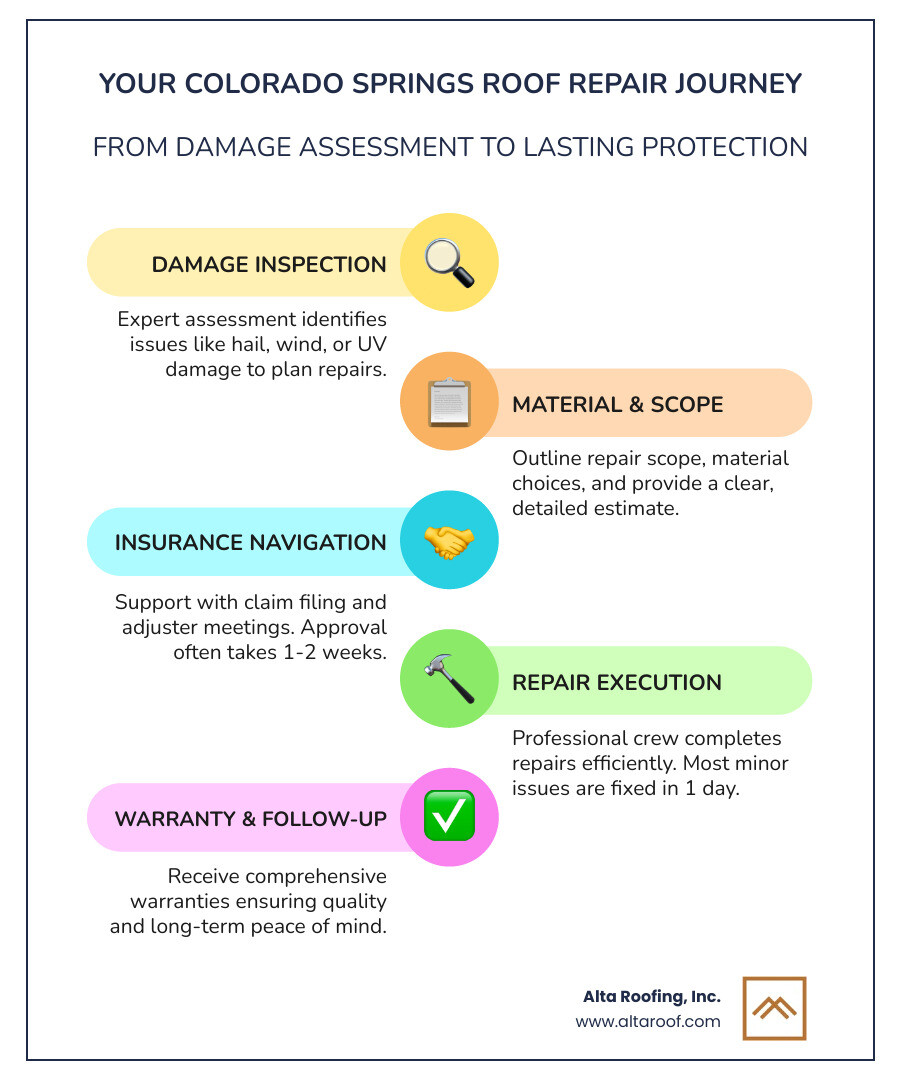
Average repair costs range from $300 to $1,500 depending on damage extent and materials. Most minor repairs complete within a single day, while insurance-covered storm damage may require a more involved process with adjuster meetings and documentation.
Colorado's challenging weather patterns make roof maintenance more than just a cosmetic concern. Hail storms alone drive thousands of repair requests annually in the Colorado Springs area. The combination of intense UV exposure, dramatic temperature swings, heavy snow loads, and severe wind events means your roof faces constant stress year-round.
I'm Barry Goers, founder of Tarben Ventures Ltd., with experience in the construction industry helping homeowners steer complex Colorado Springs roof repairs and insurance claims. Through my work, I've seen how proper roof maintenance and timely repairs protect families from devastating water damage and structural issues.
Common Causes for Colorado Springs Roof Repairs
In our beautiful corner of the Front Range, our roofs take a beating that would make a Florida hurricane look like a light breeze. We live in a "hail alley," where frozen projectiles can pummel a roof into submission in minutes. But hail isn't the only culprit.
High winds are a frequent guest in Colorado Springs, often reaching speeds of 80–100 mph. These gusts cause wind uplift, which can peel back shingles or snap them off entirely. Then there is the "Silent Killer": UV degradation. With over 300 days of sunshine a year, the intense high-altitude sun literally bakes the oils out of asphalt shingles, making them brittle and prone to cracking.
During the winter, we deal with the freeze-thaw cycle. Snowmelt runs down the roof and refreezes at the cold eaves, creating ice dams. These dams trap water, forcing it upward under the shingles and into your attic. Given these factors, the average lifespan of an asphalt shingle roof in Colorado Springs is often just 15–20 years, significantly shorter than the 30-year rating you might see on the package. To see how we tackle these specific issues, check out more info about our services.
Identifying Signs of Roof Damage
You don't always need to climb a ladder to know you need Colorado Springs roof repairs. In fact, we recommend staying on the ground and looking for these "tells":
- Water Stains: If your ceiling looks like a watercolor painting of a beige cloud, you have a leak.
- Granule Loss: Check your gutters. If they are filled with what looks like coarse sand, your shingles are losing their protective coating.
- Curling or Buckling: Shingles that turn upward at the edges are no longer shedding water effectively.
- High Energy Bills: A compromised roof often means compromised insulation and ventilation, forcing your AC to work overtime.
If you spot any of these, it's time to call in the experts. You can find more details on what to look for in our guide on Roofers in Colorado Springs, CO.
Preparing Your Roof for Extreme Weather
Prevention is the best medicine, especially when a May hailstorm is on the horizon. We always advise homeowners to keep their gutters clean; a clogged gutter leads to water backing up under the roof deck. Proper attic ventilation is also key to preventing ice dams and premature shingle aging.
If you are currently planning a repair, consider upgrading to Class 4 impact-rated shingles. These are designed to withstand larger hail without fracturing. Many insurance companies even offer premium discounts for these materials. You can see examples of these high-durability installs in our gallery of Our Work.
The Process of Professional Colorado Springs Roof Repairs
When we arrive at your home, the process begins with a comprehensive, free inspection. We don't just look at the shingles; we examine the flashing, vents, gutters, and even the attic space. This "full system" approach ensures we aren't just putting a band-aid on a deeper problem.

One of the biggest questions we get is: "Do I need a repair or a full replacement?" We generally follow the "20-year rule." If your roof is over 20 years old and has widespread issues, a repair is often throwing good money after bad. However, if the roof is young and the damage is localized (like a few blown-off shingles), a targeted repair is the way to go.
| Feature | Minor Repair | Major Repair | Full Replacement |
|---|---|---|---|
| Typical Cost | $300 - $600 | $600 - $1,500 | $10,000 - $20,000+ |
| Duration | 2 - 4 Hours | 1 Day | 1 - 2 Days |
| Best For | Missing shingles, small leaks | Localized storm damage | Aging roofs, widespread leaks |
| Insurance | Often below deductible | Likely a claim | Almost always a claim |
Navigating Insurance Claims for Colorado Springs Roof Repairs
Dealing with insurance adjusters can feel like trying to solve a Rubik's Cube in the dark. That’s where we come in. As a storm restoration specialist, we act as your single point of contact. We meet the adjuster on-site to ensure they see every bit of damage—including the stuff that's easy to miss.
We assist with the documentation and provide the necessary line-item estimates to ensure you get a fair settlement. If you're worried about the financial side, there are financing options for repairs available to help bridge the gap. For those who want an idea of the numbers right now, you can get an Instant Quote online.
Benefits of Choosing Locally-Owned Companies
Why go local? Because a "storm chaser" from out of state doesn't know the Pikes Peak Regional Building Department’s specific codes. Local companies like ours are licensed, bonded, and insured specifically for El Paso and Teller County.
We understand the local permitting process, which usually takes about two weeks, and we have established relationships with local suppliers. This means we can often get materials faster and handle the "Notice and Take Down" policies required by local municipalities. Most importantly, we’ll still be here next year if you have a question about your warranty. Supporting Local Roofing Contractors ensures your money stays in the community and your roof is built to local standards.
Factors Influencing the Cost and Duration of Repairs
Several factors will dictate whether your repair is a $300 quick fix or a $1,500 project. The material type is the biggest driver; asphalt is the most affordable, while metal, tile, or stone-coated steel require specialized labor and higher material costs.
The "pitch" or steepness of your roof also matters. A very steep roof requires extra safety equipment and more time for the crew to steer. Complexity—such as the number of skylights, chimneys, or dormers—can also add to the labor hours. Despite these variables, most Colorado Springs roof repairs are completed in a single day. To get on our calendar, you can book through our Appointments page.
Frequently Asked Questions about Colorado Springs Roof Repairs
How long does a typical roof repair take?
Most minor repairs, such as replacing a few shingles or fixing a leak around a vent pipe, take only a few hours. Even more significant storm damage repairs are usually completed within a single day. The main things that can slow us down are active weather (we can't roof in a blizzard!) or waiting for specific material deliveries.
When is it more cost-effective to replace a roof rather than repair it?
If your roof has reached the 15–20 year mark, has multiple layers of shingles, or has leaks in more than three distinct areas, replacement is usually more cost-effective. Repairing an old, brittle roof is difficult because the surrounding shingles often crack when you try to manipulate them to install new ones. Also, if insurance is covering a significant portion of the cost due to a hail claim, it’s almost always better to go for the full replacement.
What warranties are offered on repair services?
Standard industry practice for Colorado Springs roof repairs usually includes a 1-year workmanship warranty on the specific area repaired. However, at Alta Roofing, we emphasize quality that lasts. For full replacements, you can often get manufacturer lifetime guarantees on materials and extended workmanship warranties. Always ensure your contractor provides their warranty in writing!
Conclusion
Your roof is the "crown jewel" of your home—it protects everything and everyone you love. When it’s compromised, you need a partner who understands the unique demands of the Colorado climate. At Alta Roofing, Inc., we pride ourselves on being that partner. We aren't just contractors; we are storm restoration experts who handle the insurance headaches, coordinate the trades, and ensure your home is safer than we found it.
Don't wait for a small leak to become a major structural headache. Schedule your Colorado Springs roof repairs today and let us give you the peace of mind you deserve. Whether you are in Colorado Springs, Fountain, or Monument, we are ready to help you weather the next storm.
Detailed Guide to Hail Damage Roof Repair
Understanding Hail Damage Roof Repair

When a severe hailstorm hits, your roof is often the first line of defense, but it can also be the most vulnerable. Many homeowners find themselves needing hail damage roof repair after a storm. If you suspect your roof has been damaged by hail, here are the immediate steps to take:
- Ensure Safety: Check for immediate hazards around your home.
- Document Damage: Take clear photos and videos of any visible damage to your roof, gutters, siding, and other exterior elements.
- Contact a Professional: Schedule an inspection with a reputable roofing contractor.
- Review Insurance: Understand your homeowner's insurance policy regarding hail damage coverage.
- File a Claim: Submit your insurance claim promptly, as deadlines can apply.
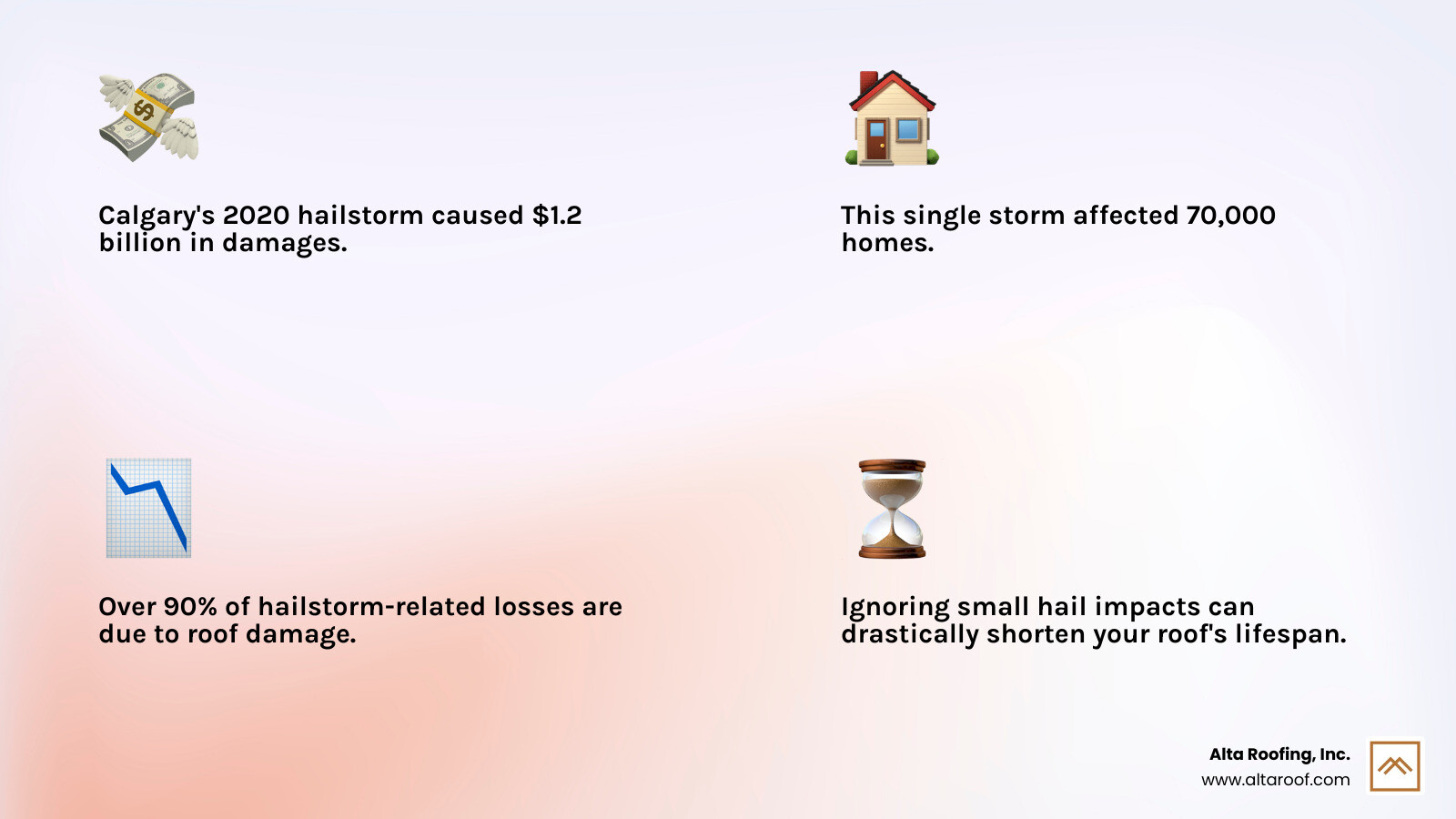
Hail can cause significant and costly damage. For instance, a single hailstorm in Calgary in 2020 resulted in at least $1.2 billion in damages, affecting 70,000 homes. Studies show that over 90 percent of losses from hailstorms are often due to roof damage alone. Ignoring even small impacts can shorten your roof's life and lead to much bigger problems later. This guide will walk you through everything you need to know to protect your home and steer the repair process.
As Barry Goers, an entrepreneur and investor deeply rooted in the construction industry, I've seen the critical need for effective hail damage roof repair. My experience has given me a unique perspective on managing and investing in solutions for these challenges.
Identifying Signs of Hail Damage Across Roofing Materials
Living in Colorado, we are no strangers to wild weather. From Denver to Colorado Springs, our roofs take a beating from ice balls that can range from the size of a pea to a grapefruit. But how do you know if you actually need hail damage roof repair? The signs vary wildly depending on what your roof is made of.
Asphalt Shingles
Asphalt shingles are the most common roofing material in our service areas like Aurora and Lakewood. When hail hits asphalt, it often knocks away the protective granules.
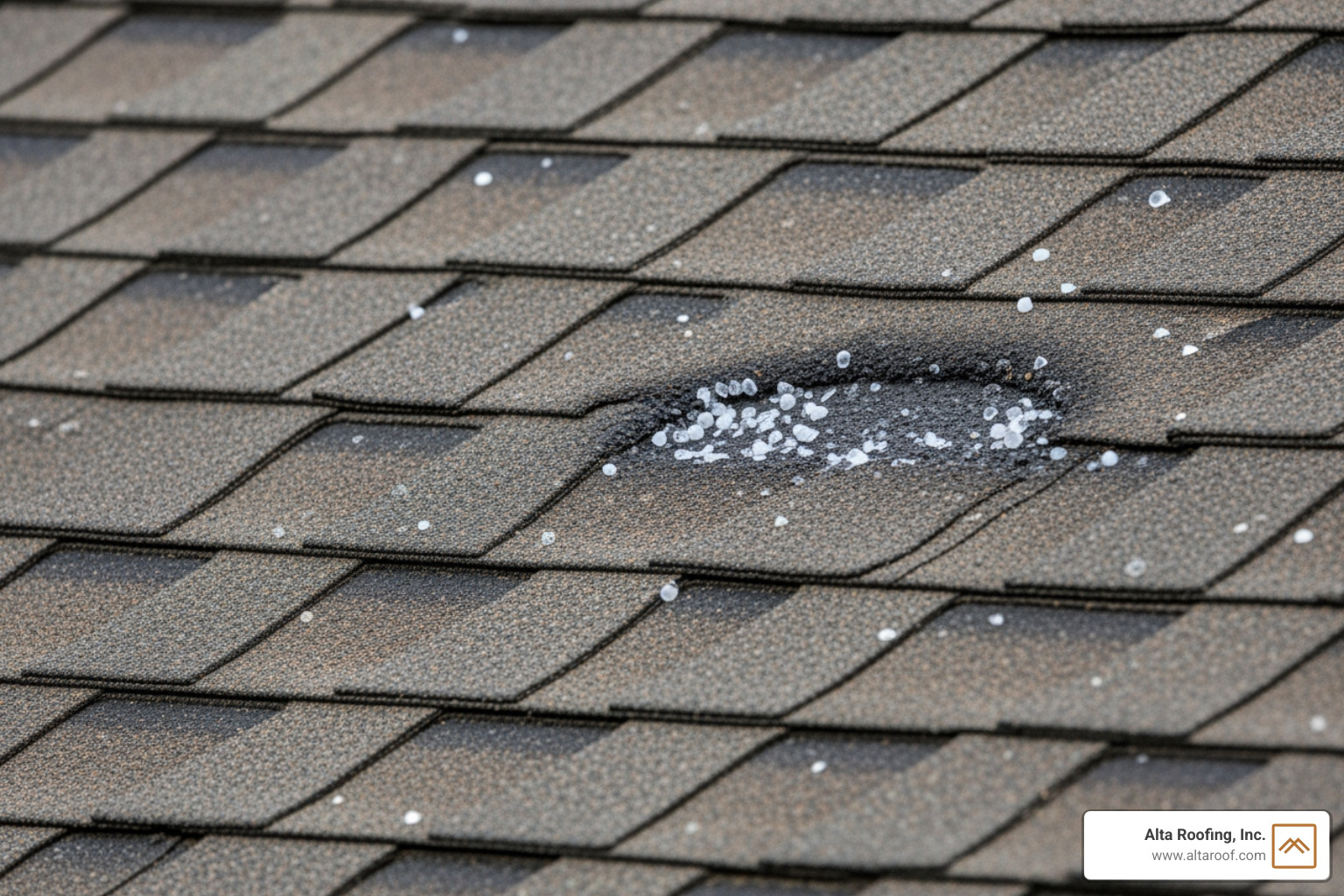
- Granule Loss: Look for "bald spots" where the black substrate is exposed.
- Bruising: This is a soft spot in the shingle, similar to a bruise on an apple. You might not see it, but you can feel it.
- Circular Cracks: High-velocity hail can create a "half-moon" or circular crack in the shingle mat.
Metal Roofing
Metal roofs are incredibly durable, but they aren't invincible. In places like Thornton and Arvada, we often see:
- Dents and Dings: While often cosmetic, large dents can weaken the metal’s integrity or damage the fasteners.
- Cracked Coating: If the paint or protective coating cracks, the metal can begin to rust.
Wood Shake Splits
Wood shakes are beautiful but susceptible to impact. Hail damage on wood usually looks like:
- Split Shakes: Look for brown or orange splits with sharp edges. If the split is gray or weathered, it’s likely old age, not storm damage.
- Punctures: Extremely large hail can punch straight through older wood shakes.
Tile Cracks
Whether you have clay or concrete tiles in Castle Rock or Highlands Ranch, hail is a major threat.
- Star Cracks: Impact points often radiate cracks outward.
- Chipped Edges: Hail can knock off the corners of tiles, which compromises the water-shedding ability of the roof.
To see what this looks like in the real world, check out our Hail Damage on Roof Pictures gallery. For more technical details, you can also read about identifying hail damage signs.
Identifying Damage from the Ground and Interior
You don't always have to climb a ladder to know you have a problem. In fact, we recommend staying on the ground for safety!
- Binocular Inspection: Grab a pair of binoculars and scan your roof for missing shingles or distorted textures.
- Gutter Granules: Check your downspouts. If you see piles of granules that look like coarse sand, your shingles are losing their protective layer.
- Attic Leaks: Head up to the attic with a flashlight during a rainstorm. Look for damp insulation, water stains on the rafters, or actual dripping.
- Soft Metal Damage: Look at your gutters, window sills, and AC units. If these "soft metals" are dented, there is a 99% chance your roof is dented too.
If you notice these signs, it might be time for Exterior Home Restoration to ensure your home remains watertight.
Professional Hail Damage Roof Repair Assessment
While a DIY scan is a great start, insurance companies require a professional touch. When we come out to your home in Monument or Fountain, we perform a "test square" assessment.
We mark off a 10x10 foot area on different slopes of your roof. We look for a specific number of "hits" within that square—usually 8 to 10. If the density of damage meets this threshold, it’s a strong indicator that the insurance company will approve a full replacement. We also check for "functional damage," which means the hail has actually compromised the roof's ability to keep water out. If you're ready to get an expert eye on your property, you can Find Local Pros or contact us directly.
Cosmetic vs. Functional Damage: The Long-Term Consequences
One of the biggest debates in the roofing world is the difference between cosmetic and functional damage. Insurance companies love the word "cosmetic" because it often means they don't have to pay. However, for a homeowner in Centennial or Englewood, "cosmetic" damage today can become a disaster tomorrow.
Functional damage is anything that affects the roof’s ability to shed water or shortens its expected lifespan. This includes:
- Exposed fiberglass mats.
- Fractured shingle substrates.
- Cracked tiles or split wood shakes.
Cosmetic damage refers to dings or dents that don't technically cause a leak. But here is the catch: even "cosmetic" dents on an asphalt shingle knock off granules. Those granules protect the asphalt from UV rays. Without them, the sun bakes the shingle, making it brittle and prone to cracking within just a few years.
How Hail Affects Roof Lifespan and Integrity
Ignoring hail damage is a recipe for trouble. With 5,392 recorded hail storms in 2019 alone, the cumulative effect is massive.
- Moisture Buildup: Small cracks allow water to seep under the shingles.
- Mold Growth: Trapped moisture in the decking leads to mold that can affect your family's health.
- Wood Rot: Your roof's structural plywood (the decking) can rot, making the roof "spongy" and dangerous to walk on.
- Structural Weakening: Over time, the constant freeze-thaw cycle in Colorado expands those tiny cracks, eventually leading to a full-scale structural failure.
This is why working with experienced Storm Restoration Contractors is vital. We don't just look for leaks; we look for the "latent" damage that will cost you ten times more down the road.
Navigating the Insurance Claim Process for Hail Damage
At Alta Roofing, our specialty is handling the insurance headache for you. We act as your single point of contact, coordinating everything so you don't have to play phone tag with adjusters.
Understanding Your Policy: RCV vs. ACV
Before you file, you need to know what kind of policy you have. This determines how much money you'll actually get.
| Feature | Replacement Cost Value (RCV) | Actual Cash Value (ACV) |
|---|---|---|
| Payout Basis | Cost to buy a new roof today | Value of the roof minus age/depreciation |
| Out-of-Pocket | Usually just your deductible | Deductible + the "lost" value from age |
| Best For | Most homeowners | Budget-conscious or older homes |
If you have an ACV policy and a 20-year-old roof, the insurance company might only pay for 25% of the replacement. If you have an RCV policy, they pay the whole bill (minus your deductible).
Immediate Steps for Hail Damage Roof Repair
If the clouds have cleared and you suspect damage in Parker or Elizabeth, do this:
- Take Photos: Capture the hail size next to a ruler or a coin. Photograph your dented gutters and any shingles you see on the lawn.
- Make Temporary Repairs: If you have an active leak, use a tarp. Insurance companies expect you to "mitigate" further damage.
- Review Your Policy: Check your deductible. Some Colorado policies have a specific "Hail Deductible" which is a percentage of your home's value (e.g., 1% or 2%).
- Mind the Deadlines: Most companies require you to file within 12 to 24 months of the storm.
For more guidance, GAF provides a great resource on What to do after a storm damages your roof. If you are looking for local experts, we are the premier Roofers in Colorado Springs CO.
Working with Adjusters and Contractors
When the insurance adjuster arrives, we like to be there. Why? Because adjusters are human—they miss things. We use the National Severe Storms Laboratory hail data to prove a storm occurred on a specific date, and we point out the subtle "bruising" that an adjuster might overlook.
We also handle "supplemental claims." If we start the hail damage roof repair and find rotten wood underneath that wasn't in the original estimate, we document it and bill the insurance company directly so you aren't stuck with the surprise cost.
The Real Cost of Hail Damage Roof Repair
Let’s talk numbers. We know that's what everyone wants to know.
- Inspection Costs: Many companies charge $75 to $800 for a formal inspection, though at Alta Roofing, we often provide assessments to help you decide if a claim is worth it.
- Minor Repair Averages: Small repairs (replacing a few shingles or fixing a vent) usually cost around $940.
- Full Replacement: For a standard home in Colorado, a full replacement averages between $9,000 and $15,000, though large custom homes can easily reach $20,000 to $40,000.
Factors that influence the price include the "pitch" (steepness) of your roof, the number of layers to be removed, and the material you choose. You can get a quick idea of your costs with our Instant Quote tool.
When to Repair vs. Replace Your Roof
Not every storm requires a brand-new roof.
- Repair if: The damage is localized to one area, the roof is less than 10 years old, and the shingles are still flexible.
- Replace if: Damage is spread across multiple slopes, the roof is over 15 years old, or the "10x10 test" shows significant hit density.
Choosing between the two is a big decision. We recommend talking to Local Roofing Contractors who understand the specific climate of the Front Range.
Preventative Measures and Hail-Resistant Materials
In Colorado, it's not a matter of if it will hail again, but when. If you are replacing your roof, consider upgrading to Class 4 Impact-Resistant Shingles.
These shingles are tested using the UL 2218 standard, where a steel ball is dropped on the shingle to see if it cracks the underside.
- Insurance Discounts: Many insurance companies in Colorado offer significant premium discounts (up to 20-30%) if you install Class 4 shingles.
- Durability: They can withstand much larger hail than standard shingles, potentially saving you from needing another hail damage roof repair next year.
Other tips for prevention:
- Tree Trimming: Keep branches at least 10 feet away from your roof. During a storm, wind can turn branches into saws that rip through your shingles.
- Regular Maintenance: Small issues like loose flashing make it easier for hail and wind to cause catastrophic failure.
- Metal Roofing: If you’re tired of the hail cycle, metal is a fantastic long-term investment.
For specific advice for Northern Colorado areas, see our guide on Hail Damage Fort Collins.
Frequently Asked Questions about Hail Damage Roof Repair
How much hail damage warrants a full roof replacement?
Generally, if a professional finds 8 to 10 significant hits within a 10x10 foot "test square" on at least two or three sides of the roof, insurance companies will typically approve a full replacement. If there are leaks or structural compromises, replacement is almost always necessary.
Does homeowners insurance cover hail damage repairs?
Yes, most standard homeowners insurance policies cover hail damage as a "peril." However, the amount they pay depends on whether you have an RCV or ACV policy and what your specific deductible is.
How long do I have to file a hail damage claim in Colorado?
While it varies by provider, most insurance companies in Colorado require you to file a claim within one year (12 months) of the date of the storm. Some policies allow up to two years, but acting quickly is always better to avoid "wear and tear" denials.
Conclusion
At Alta Roofing, Inc., we know that dealing with hail damage roof repair is stressful. Whether you are in Denver, Colorado Springs, or out in Woodland Park, our goal is to make the restoration process as smooth as possible. We don't just fix roofs; we restore your peace of mind by handling the insurance adjusters and ensuring every trade—from gutters to siding—is handled with expert care.
Don't wait for a leak to tell you there's a problem. If a storm just rolled through your neighborhood, reach out to us. We’ll give you an honest assessment and help you protect your biggest investment.
Explore our full range of Services or Contact Us today to schedule your professional inspection. Let's get your home back to its best condition together!
Getting a New Roof in Colorado Springs? Here's How to Make it Shine!
Why Roof Replacement Colorado Springs Requires Special Expertise

Roof replacement Colorado Springs is a critical investment that protects your home from the Front Range's extreme weather conditions—from intense hailstorms and heavy snow loads to high-altitude UV exposure and dramatic temperature swings. Here's what you need to know:
Quick Answer: When Do You Need Roof Replacement in Colorado Springs?
- Age: Most asphalt shingles last 15-30 years in Colorado's climate
- Storm Damage: Hail, wind, or snow damage that affects multiple areas
- Visible Signs: Missing shingles, granule loss, curling edges, or persistent leaks
- Timeline: Average projects take 1-3 days, weather permitting
- Best Materials: Class 4 impact-resistant shingles or metal roofing for hail protection
- Insurance: Often covers sudden storm damage (hail, wind) but not normal wear
Colorado Springs sits at over 6,000 feet elevation, where your roof faces challenges that most other regions never see. Heavy snow loads can exceed 40 pounds per square foot. Hailstorms strike frequently during spring and summer. The intense high-altitude sun accelerates UV deterioration. And freeze-thaw cycles stress every component of your roofing system.
Getting a new roof here isn't just about picking shingles—it's about choosing materials engineered for our specific climate and working with contractors who understand Front Range weather patterns.
Whether your roof has reached the end of its lifespan, suffered storm damage, or you're simply noticing widespread issues like water stains or sagging, this guide walks you through everything you need to know about roof replacement Colorado Springs. You'll learn which materials perform best in our climate, how to steer insurance claims for storm damage, what the replacement process looks like from start to finish, and how to protect your investment for decades to come.
I'm Barry Goers, founder of Tarben Ventures Ltd., with experience in the construction industry and a deep understanding of the unique challenges Colorado homeowners face. Through my work, I've seen how proper roof replacement Colorado Springs can protect homes from our region's demanding weather while enhancing property value and curb appeal.
The Essential Guide to Roof Replacement Colorado Springs
When you live in Colorado Springs, your roof isn't just a hat for your house—it's its first line of defense against Mother Nature's mood swings. The Front Range weather is beautiful but notoriously tough on roofs. Intense hailstorms can pummel shingles, heavy snow loads can test structural integrity, and the strong UV rays at our high altitude can accelerate material breakdown. These unique challenges mean that roof replacement Colorado Springs isn't just a home improvement project; it's a necessity for long-term home protection.
At Alta Roofing, Inc., we understand these specific conditions because we live and work here too. We specialize in tailoring solutions that streamline the roofing process for homeowners in areas like Colorado Springs, Aurora, Thornton, Lakewood, Castle Rock, Manitou Springs, Elizabeth, Parker, Golden, Arvada, Woodland Park, Highlands Ranch, Littleton, Lone Tree, Fountain, and Centennial. Our local expertise ensures your new roof is built to withstand everything our Colorado climate throws at it.

If you're noticing granules accumulating in your gutters, or if your roof looks like it's seen better days, it might be time to consider a roof replacement Colorado Springs. We pride ourselves on being local experts in complete repairs and remodeling, staying up-to-date on the best guidelines, latest styles, and top-performing products. For more insights into local roofing expertise, check out our article on Roofers in Colorado Springs, CO.
Key Signs You Need a Roof Replacement Colorado Springs
Knowing when it's time for a new roof can save you from bigger, more costly problems down the line. While some issues can be repaired, a full roof replacement Colorado Springs is often more cost-effective if your roof has widespread problems or is nearing the end of its life. Here's how to tell if your roof needs a full replacement:
- Age: Most asphalt shingles are designed to last between 15 and 30 years. If your roof is approaching or has exceeded this age, it's wise to have it inspected. Even if it looks okay from the ground, the protective qualities may be diminishing.
- Missing or Damaged Shingles: Look for shingles that are cracked, curled, buckled, or completely missing. These are clear indicators that your roof's protective barrier is compromised, especially after a Colorado hailstorm or high winds. Small dents or exposed mat on shingles are tell-tale signs of hail damage.
- Granule Loss: If you find a lot of dark, sand-like granules in your gutters or on the ground around your home, it means your shingles are losing their protective top layer. This layer helps protect against UV rays and hail, and once it's gone, your roof's lifespan rapidly decreases.
- Persistent Leaks or Water Stains: Water stains on ceilings or walls, especially in the attic, are undeniable signs of a leaking roof. These leaks can lead to mold, rot, and structural damage if not addressed promptly.
- Structural Sagging: If your roof deck appears to be sagging or drooping, it could indicate significant structural damage, possibly from heavy snow loads or prolonged water infiltration. This requires immediate attention.
- Neighborhood Trends: If many of your neighbors are getting new roofs after a recent storm, it's a strong hint that your home likely sustained similar damage and might be eligible for an insurance claim.
We offer 100% free, no-obligation inspections for both residential and commercial properties in the Colorado Springs area. Our detailed inspection includes photos and a simple, easy-to-understand report, giving you clear next steps and an honest sense of how urgent each issue is.
What to Expect During Your Roof Replacement Colorado Springs
Starting on a roof replacement Colorado Springs project might seem daunting, but with the right team, it's a smooth and efficient process. We believe in transparency and keeping you informed every step of the way.
Here’s a general overview of what you can expect when we handle your roof replacement:
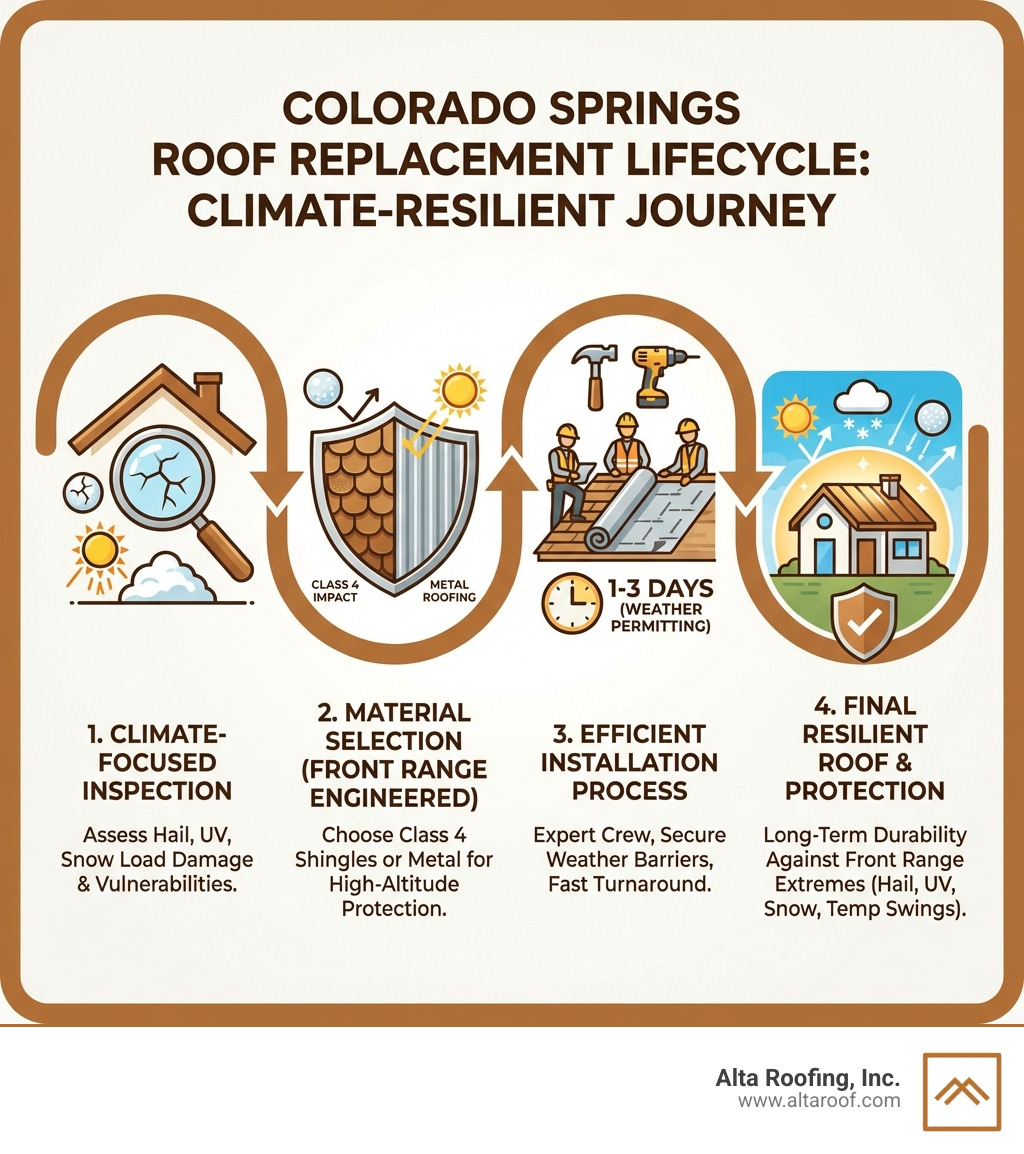
- Initial Inspection and Estimate: We start with a thorough inspection of your existing roof, assessing its condition and identifying any underlying issues. We’ll discuss material options suitable for Colorado Springs' climate and provide a detailed, free estimate.
- Permitting: For most major roofing projects in Colorado Springs, a permit is required, handled by the Pikes Peak Regional Building Department. We manage this process for you, ensuring all applications are completed well in advance to avoid delays.
- Material Delivery: Once permits are secured and materials chosen, your new roofing materials will be delivered to your property, typically placed strategically to minimize disruption.
- Property Protection: Our crews prioritize protecting your home and landscaping. We use tarps and protective coverings around your property to catch debris and prevent damage during the tear-off phase.
- Old Roof Tear-Off: We carefully remove your old roofing materials, including shingles, underlayment, and any damaged decking. This step is crucial for a clean slate and allows us to inspect the underlying structure thoroughly.
- Decking Inspection and Repair: With the old roof removed, we inspect the wood decking for any rot, damage, or weaknesses. Any necessary repairs or replacements are made at this stage to ensure a solid foundation for your new roof.
- Underlayment and Flashing Installation: A high-quality underlayment is installed to provide an additional water barrier, protecting your roof decking from wind-driven rain. We also install new flashing around chimneys, vents, and valleys to prevent leaks in vulnerable areas.
- New Roof Installation: This is where your new roof really takes shape! Our experienced crews expertly install your chosen roofing material, whether it's impact-resistant asphalt shingles, durable metal panels, or neat tile. We follow manufacturer specifications and local building codes carefully to ensure proper installation and warranty validity.
- Final Cleanup and Inspection: Once the installation is complete, we conduct a thorough cleanup of your property, removing all debris, nails, and old materials. We then perform a final inspection to ensure every detail meets our high standards and your complete satisfaction.
- Post-Installation Support: We're not just here for the installation. We provide information on warranties and maintenance best practices to help you extend the lifespan of your new roof.
The average roof replacement Colorado Springs project typically takes between one and three days, depending on the size and complexity of your roof, the chosen materials, and, of course, Colorado’s unpredictable weather. Metal or tile roofs may take slightly longer than asphalt shingles. Our crews are known for working efficiently while maintaining safety standards for high-altitude work. For more information about our comprehensive services, visit our Services page.
Choosing the Best Materials for the Front Range Climate
Selecting the right roofing material for your roof replacement Colorado Springs is paramount. Our climate demands materials that can endure heavy snow loads, intense UV radiation, extreme temperature fluctuations, and frequent hailstorms. The right choice not only protects your home but can also improve its energy efficiency and curb appeal.
At Alta Roofing, Inc., we guide you through the options, considering durability, aesthetics, and cost-effectiveness custom to our local conditions. We ensure your new roof provides lasting results that withstand local weather.
Here's a comparison of popular roofing materials and how they perform in the Colorado Front Range:
| Material Type | Lifespan (Colorado) | Durability & Climate Performance | Energy Efficiency |
|---|---|---|---|
| Asphalt Shingles | 15-30 years | Good: Quality asphalt shingles provide 20-30 years of reliable protection. Impact-resistant asphalt shingles (Class 3 or 4) are highly recommended for hail protection. They handle temperature extremes and UV exposure effectively when properly installed. | Moderate |
| Metal Roofing | 30-50+ years | Excellent: Durable, energy-efficient, and can handle snow and hail better than traditional shingles. Metal systems provide best snow shedding capability and resistance to hail damage. They are engineered to handle snow loads exceeding 40 pounds per square foot and excel in high-altitude UV exposure and temperature extremes. Warranties can extend 30-50 years depending on the metal type. | High |
| Tile Roofing | 50+ years | Excellent: Clay or concrete tiles are long-lasting and provide excellent insulation. They are highly resistant to hail, fire, and insects. However, they are heavy and require a strong roof structure. Tile roofing systems can have warranties often exceeding 50 years, and some are specifically designed for Colorado-appropriate applications like Bartile products. | High |
| Synthetic Roofing | 30-50+ years | Excellent: Designed to look like slate or cedar shake, synthetic shingles offer an ideal balance of beauty, durability, and climate-appropriate performance. They are lightweight, reducing structural stress, and are highly resistant to impact, fire, and UV. Synthetic roofing options typically have warranties spanning 30-50 years. Malarkey's focus on sustainability and impact resistance is notable in this category. | Moderate-High |
| Stone-Coated Steel | 30-50+ years | Excellent: Made of steel, these systems offer exceptional durability and aesthetic versatility. They install similarly to asphalt shingles but provide superior resistance to hail, wind, and fire. Decra's stone-coated steel products are engineered for harsh mountain climates. | Moderate-High |
High-Performance Shingles and Metal Systems
For your roof replacement Colorado Springs, high-performance shingles and metal systems are often the go-to choices due to their proven resilience against our challenging weather.
- Impact-Resistant Asphalt Shingles: These aren't your average shingles! Class 3 or 4 impact-resistant shingles are specifically designed to withstand hail damage, a common occurrence in Colorado Springs. Manufacturers like GAF, CertainTeed, Owens Corning, Tamko, and Malarkey offer top-rated products that meet these standards. CertainTeed's premium shingle lines, for instance, offer superior performance in temperature extremes, while Malarkey’s shingles are known for their sustainability and impact resistance. Properly installed, quality asphalt shingles provide 20-30 years of reliable protection.
- Metal Roofing Systems: If you're looking for ultimate durability and best performance against snow and hail, metal roofing is an excellent investment for your roof replacement Colorado Springs. Standing seam metal roofs are particularly popular and beautiful throughout our community. These systems are engineered to handle snow loads exceeding 40 pounds per square foot and provide superior snow shedding capabilities. Metal roofing also offers significant energy efficiency benefits, with some clients reporting 20-30% reductions in cooling costs. Warranties for metal roofs can extend 30-50 years, making them a long-term solution.
- Stone-Coated Steel Roofing: Combining the aesthetic appeal of traditional materials like tile or shake with the strength of steel, stone-coated steel systems are engineered for harsh mountain climates. They are lightweight, durable, and highly resistant to hail, wind, and fire, making them a smart choice for Colorado homes.
To help you visualize how these materials and colors would look on your home, we recommend using resources like the Shingle Color Selector from Malarkey.
Synthetic and Tile Options
Beyond traditional shingles and metal, synthetic and tile roofing options offer unique advantages for your roof replacement Colorado Springs, especially in terms of aesthetics and extreme durability.
- Synthetic Roofing Solutions: These innovative materials are made from synthetic polymers and are designed to mimic the look of natural slate or cedar shake roofs without the associated weight or maintenance. They are lightweight, highly durable, and offer excellent resistance to impact, fire, and UV degradation. With warranties often spanning 30-50 years, synthetic options represent an ideal balance of beauty, durability, and climate-appropriate performance for Colorado Springs.
- Clay and Concrete Tile Roofing: For homeowners seeking a distinct aesthetic and exceptional longevity, clay or concrete tiles are a superb choice. These materials are incredibly long-lasting, often exceeding 50 years, and provide excellent insulation, contributing to energy efficiency. Common profiles include S-Tile and Flat-Tile, offering a variety of looks. While they require a strong roof structure due to their weight, their resistance to hail, fire, and insects makes them a robust option for our climate. Bartile products, for example, are specifically noted for their suitability in Colorado.
We're proud of the beautiful and resilient roofs we install. You can see examples of our quality craftsmanship and climate-appropriate materials in our past projects in Colorado Springs and the Pikes Peak region by visiting Our Work.
Navigating Insurance Claims and Warranties
Dealing with a damaged roof, especially after one of Colorado Springs' notorious hailstorms or wind events, can be stressful. But understanding your homeowner's insurance and the warranties on your new roof can provide significant peace of mind. At Alta Roofing, Inc., we specialize in handling insurance claims and coordinating all necessary trades, acting as a single point of contact for homeowners, particularly in Colorado Springs. We work directly with insurance adjusters and provide detailed documentation to support your claim, leveraging our experience with Colorado weather damage to ensure fair coverage.
Understanding Your Coverage
Does homeowner's insurance cover roof replacement Colorado Springs? In many cases, yes! Your homeowner's insurance will typically cover the cost of roof replacement if the damage is due to a covered event, such as hail, windstorms, or heavy snow loads. However, it usually does not cover damage resulting from normal wear and tear or lack of maintenance.
Here’s what you need to know about navigating insurance claims:
- Covered Events: Most Colorado insurance policies cover sudden and accidental damage from perils like hail, wind, and snow load issues. If a hailstorm leaves small dents, exposed mat, or missing shingles, you likely have a claim.
- Deductibles: Be aware of your deductible, which is the amount you're responsible for paying before your insurance coverage kicks in.
- Claim Expiration: Don't delay! Homeowners insurance claims can expire. It's crucial to contact your insurance provider and a reputable roofer for an inspection as soon as you suspect storm damage. We can help you understand the "10-Year Rule" in roofing and whether your claim might expire.
- Adjuster Meetings: We can assist you during the insurance adjuster's inspection, providing expert insight and ensuring all damages are properly documented and assessed. Our team has decades of experience working with insurance companies and can guide you through the entire claims process, making it easy for you.
- Storm Restoration Expertise: Our unique selling proposition (USP) is handling insurance claims and coordinating all necessary trades. We act as a single point of contact, taking the burden off your shoulders during storm restoration projects.
Navigating insurance can feel overwhelming, but we're here to help. For an immediate assessment, get an Instant Quote from us. And if you're exploring ways to finance your roof replacement, consider options through our partner, Hearth, by clicking here: Explore financing options through Hearth.
Long-Term Protection and Maintenance
A new roof is a significant investment, and protecting that investment with comprehensive warranties and proper maintenance is crucial.
- Manufacturer’s Warranty: This warranty covers defects in the roofing materials themselves. The duration and coverage vary by manufacturer and product, with some materials like metal and tile offering warranties that extend 30-50 years or even more. GAF Master Elite contractors, for example, can offer industry-leading warranties.
- Workmanship Warranty: This is provided by us, your contractor, and covers issues related to the installation. Our workmanship warranties typically last between 5 to 10 years, ensuring that if any problems arise due to our installation, we'll make it right. Colorado Front Range Roofing, for instance, provides a 2-year workmanship warranty on residential projects, but we aim for longer-term peace of mind.
- Extending Your Roof’s Lifespan: To get the most out of your new roof, especially in Colorado’s climate, follow these best practices:
- Annual Professional Inspections: Schedule regular annual inspections, ideally in late spring after winter weather and before summer hail season. Colorado’s extreme conditions accelerate wear, making regular professional assessments crucial for catching problems early and maintaining warranty coverage.
- Maintain Proper Attic Ventilation: Adequate attic ventilation is vital. It allows the entire roofing system to remain dry, free of mold and pests, and prevents overheating of components, which avoids premature aging of your roofing materials and lowers cooling expenses.
- Keep Gutters Clean: Clean gutters channel rainwater runoff away from your home and property, preventing water damage to your roof, fascia, and foundation.
- Trim Overhanging Branches: Prevent debris accumulation and potential damage from falling branches by keeping trees trimmed.
By combining robust warranties with proactive maintenance, you can ensure your roof replacement Colorado Springs provides decades of reliable protection and improves your home's value.
Frequently Asked Questions
We know you have questions, and we're here to provide clear, straightforward answers about your roof replacement Colorado Springs.
How long does a roof replacement take in Colorado Springs?
The average roof replacement Colorado Springs project takes between one and three days. However, this timeline can vary based on several factors:
- Roof Size and Complexity: Larger or more intricate roofs with multiple angles, dormers, or skylights will naturally take longer.
- Material Type: Installing asphalt shingles is generally quicker than installing metal or tile roofs, which require more specialized techniques and may take a few extra days.
- Weather Conditions: Colorado's unpredictable weather, including sudden storms or high winds, can cause delays. We always schedule projects carefully around weather patterns and have backup plans for sudden changes.
- Existing Roof Condition: If the underlying decking has extensive damage that needs repair, it can add time to the project.
We strive to schedule most projects within 1–2 weeks of approval, depending on the season and material availability, and always aim for efficient, safe work.
Does homeowners insurance cover roof replacement for hail?
Yes, in most cases, homeowners insurance in Colorado Springs does cover roof replacement Colorado Springs if the damage is specifically due to hail. Colorado insurance policies typically cover sudden storm damage, including hail, wind, and snow load issues.
However, it's important to note:
- Covered Events vs. Wear and Tear: Insurance generally covers damage from sudden, unforeseen events like hailstorms, not normal wear and tear or lack of maintenance over time.
- Deductibles: You will be responsible for paying your deductible before your insurance coverage takes effect.
- Claim Process: It’s crucial to contact your insurance provider as soon as you suspect hail damage. We recommend getting a free inspection from a reputable roofer like us first. We can help you identify damage, document it with photos, and guide you through the entire claims process, including meeting with your insurance adjuster, to ensure you receive a fair settlement.
Don't wait until it leaks! If your roof has been through a significant hailstorm, even if you don't see obvious damage from the ground, it's worth a professional inspection.
What is the best roofing material for Colorado weather?
Given Colorado Springs' unique climate challenges—heavy hail, intense UV exposure, and significant snow loads—the "best" roofing material often comes down to a balance of durability, budget, and aesthetic preference. However, two options consistently stand out for their superior performance:
- Class 4 Impact-Resistant Asphalt Shingles: These are highly recommended for their excellent hail resistance. They are specifically designed and tested to withstand significant impact, making them a smart choice for an area prone to severe hailstorms. They also handle UV exposure and temperature fluctuations well when properly installed.
- Metal Roofing Systems: Metal roofs, especially standing seam, offer best durability. They excel at shedding snow and are highly resistant to hail damage. Many metal systems are engineered to handle snow loads exceeding 40 pounds per square foot and provide long-term protection against UV degradation. They are also energy-efficient, potentially reducing cooling costs.
Both options provide reliable, long-lasting protection against the specific demands of Colorado weather. We can help you weigh the pros and cons of each, including synthetic and tile options, to find the perfect fit for your home during your roof replacement Colorado Springs.
Conclusion
Starting on a roof replacement Colorado Springs project is a significant decision, but it's one that offers substantial rewards. A new roof isn't just about protection; it's an investment that can dramatically increase your home's value, improve its curb appeal, and improve energy efficiency, potentially leading to 20-30% reductions in cooling costs. Upgrading to a modern, high-performance roofing system can give your home a fresh, updated look and provide superior insulation, keeping your home more comfortable year-round.
At Alta Roofing, Inc., we understand that a strong roof is proof of a strong home. We’re a Colorado-based roofing and storm restoration company specializing in roof replacement, repairs, and comprehensive storm damage restoration across Colorado Springs, Aurora, Thornton, Lakewood, Castle Rock, Manitou Springs, Elizabeth, Parker, Golden, Arvada, Woodland Park, Highlands Ranch, Littleton, Lone Tree, Fountain, and Centennial. Our unique expertise lies in handling insurance claims and coordinating all necessary trades, acting as a single point of contact for you. We take pride in our family-owned origins and our commitment to tailoring solutions and streamlining the roofing process to your needs.
When it's time for your roof replacement Colorado Springs, choose a partner who understands the local climate, values quality and integrity, and makes the entire process as smooth and stress-free as possible. We are here to help you make your home shine for decades to come.
Ready to protect your home with a beautiful, durable new roof? Contact Us today for a free inspection and to discuss your options. Explore all our offerings on our Services page.
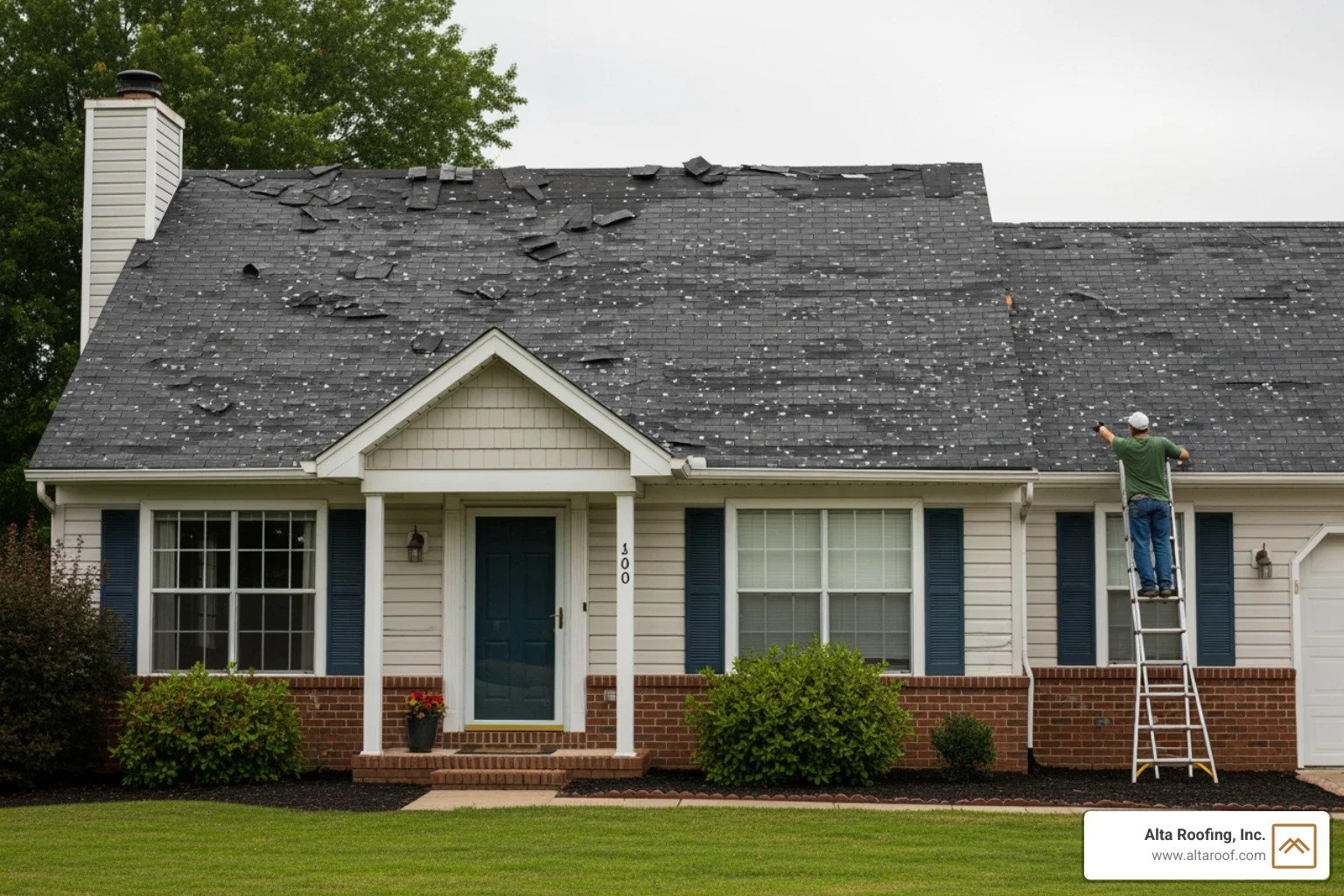
How to File Roofing Insurance Claim Fast
Why Filing an Insurance Claim for Roofing Damage Matters
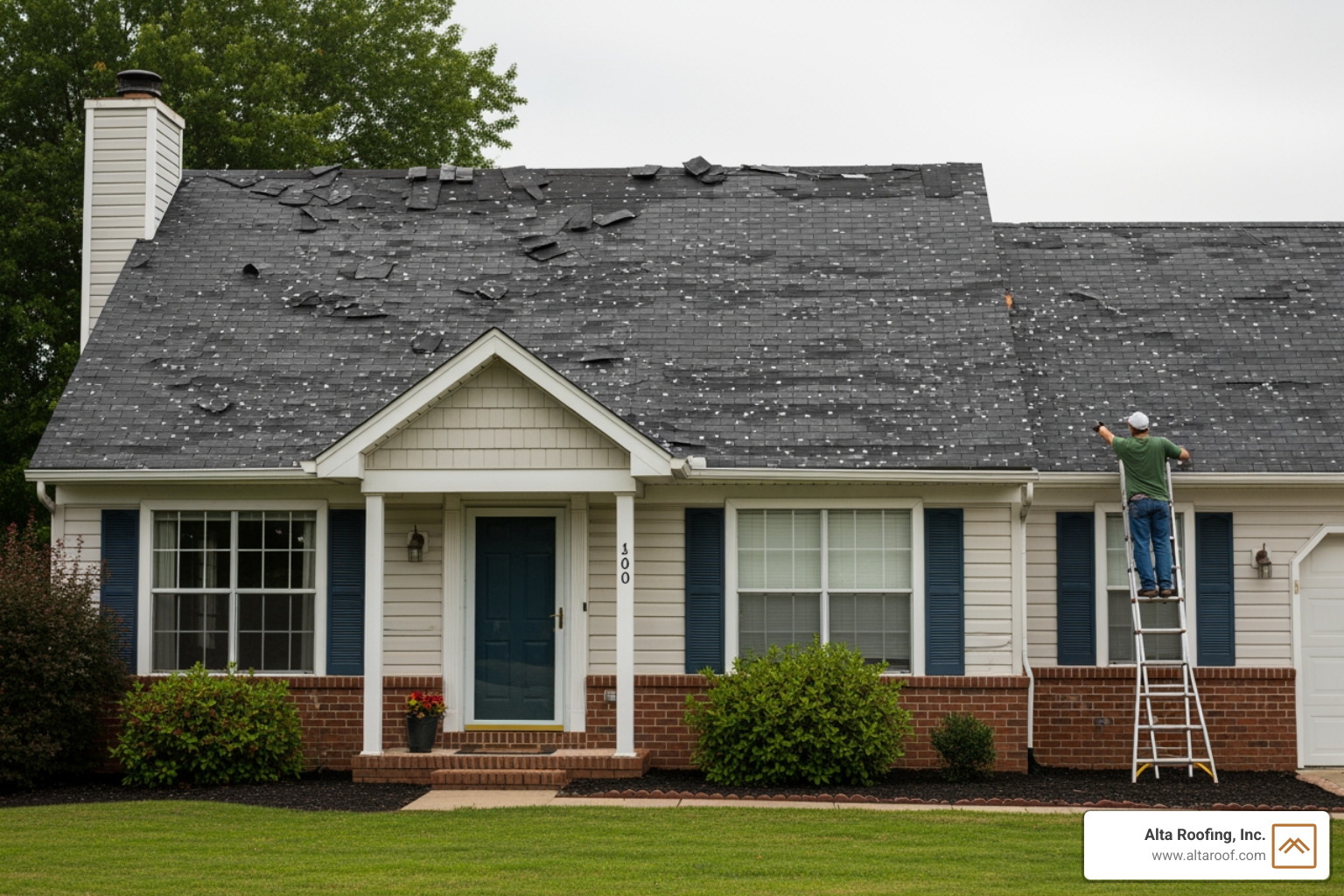
Insurance claim roofing is the process homeowners use to get their insurance company to pay for storm-damaged roofs. When Colorado's severe weather strikes—bringing hail, wind, or heavy snow—your roof often takes the biggest hit. Filing a successful claim can mean the difference between paying thousands out of pocket or getting your roof fully restored at minimal cost.
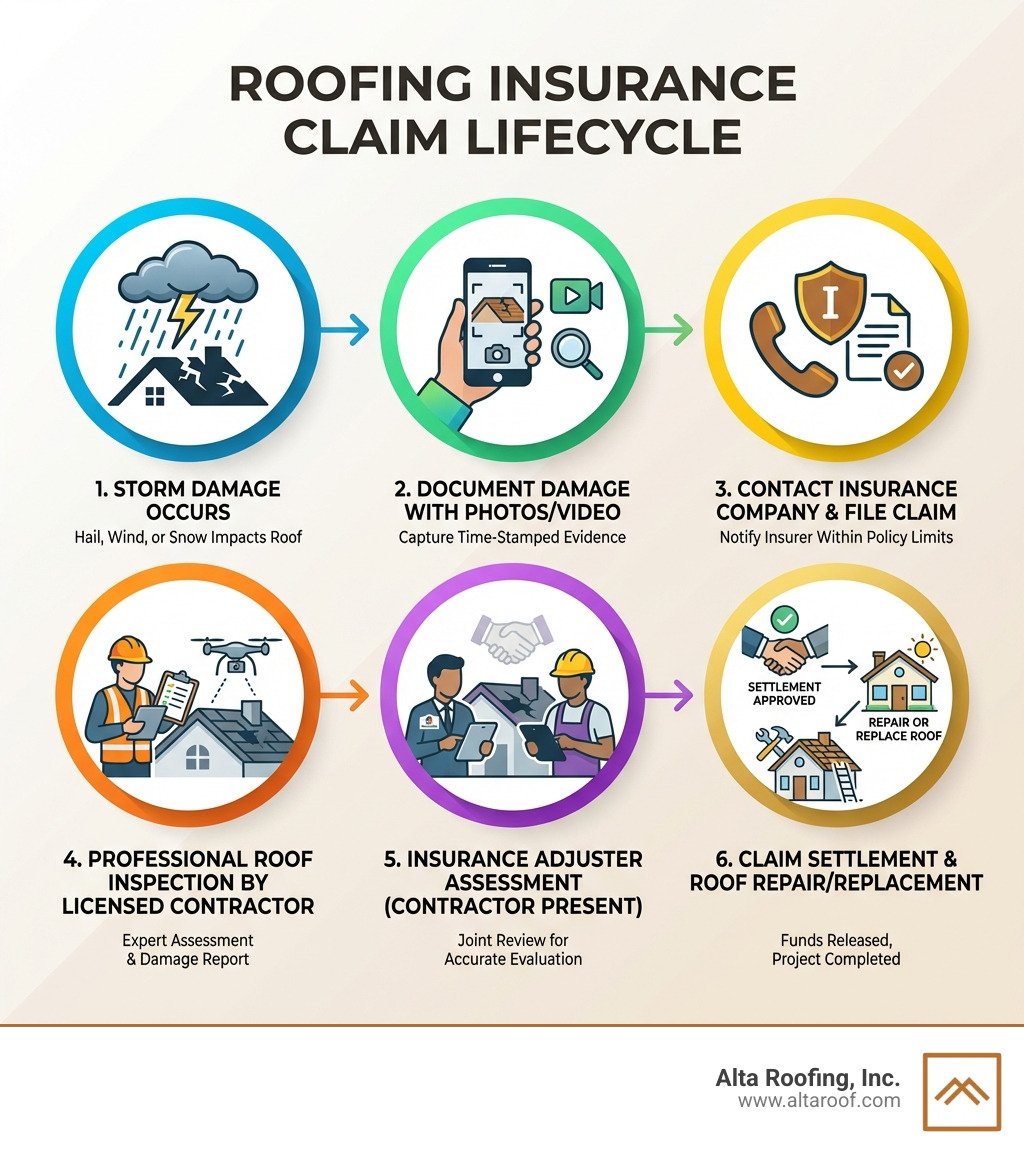
Quick Answer: The 5 Essential Steps to File a Roofing Insurance Claim
- Document the damage immediately with time-stamped photos and videos
- Contact your insurance company within 30-60 days of the storm
- Get a professional roof inspection from a licensed contractor
- Meet with the insurance adjuster (have your contractor present)
- Review the settlement offer and negotiate if needed
Most homeowners insurance policies cover sudden, accidental damage from weather events like hail, wind, and falling debris. However, they typically don't cover damage from normal wear and tear, poor maintenance, or aging roofs. The key is understanding what your specific policy covers—and how to document your claim properly.
Why the process feels overwhelming: You're dealing with multiple parties (your insurer, adjusters, contractors), complex policy language (ACV vs. RCV, deductibles, depreciation), tight deadlines, and the stress of a damaged home. Many homeowners make costly mistakes by waiting too long to file, failing to document damage thoroughly, or accepting lowball settlements without negotiation.
The good news? With the right preparation and professional support, you can steer this process successfully and get your roof restored to full protection.
I'm Barry Goers, and through my construction industry experience with Tarben Ventures Ltd., I've seen how critical proper insurance claim roofing procedures are for homeowners facing storm damage. My background in building projects and investment has given me deep insight into what separates successful claims from denied ones.
Navigating the Insurance Claim Roofing Process
When Mother Nature decides to throw a tantrum over Colorado, your roof is often the first line of defense. From the sudden impact of hail in Colorado Springs to the relentless winds whipping through Denver and Fort Collins, our roofs take a beating. Understanding the insurance claim roofing process is essential for every homeowner. It ensures you're not left holding the bag (or the bill!) after a storm.
Step-by-Step Guide to Filing
The moment you suspect roof damage, a clear, step-by-step approach can save you a lot of headaches, and potentially, a lot of money. Here's how we recommend you proceed:
- Assess and Document the Damage Immediately: As soon as it's safe, take photos and videos of all visible damage from the ground. Look for missing shingles, dents from hail (especially on vents, gutters, and siding), granule loss, or any signs of leaks inside your home. Make sure your photos are time-stamped if possible. This initial documentation is crucial because most policies require storm damage to be reported within 30–60 days, and insurers expect professional documentation for approval. This helps establish a clear timeline and extent of the damage.
- Contact a Reputable Roofing Contractor for Inspection: Before even calling your insurance company, it's wise to get a professional, unbiased assessment from a local roofing company like Alta Roofing. Why? Because a certified roofer can distinguish between storm damage (which is usually covered) and pre-existing wear and tear (which typically isn't). This initial inspection strengthens your claim by providing expert evidence and a detailed scope of work. Our team at Alta Roofing specializes in these inspections and can provide you with comprehensive Local Roofing Contractors services. We're here to help you know When to Replace Your Roof or if a repair will suffice.
- Review Your Insurance Policy: Take a moment to understand your specific coverage. Familiarize yourself with your deductible, whether you have Actual Cash Value (ACV) or Replacement Cost Value (RCV) coverage (we'll dive into this soon), and any specific exclusions. This knowledge empowers you when you speak with your insurance provider.
- File the Claim with Your Insurance Company: Now, armed with your documentation and a contractor's assessment, contact your insurance company. Provide them with the storm date, the damage you've observed, and any reports from your roofer. They will assign you a claim number, which is essential for tracking your case.
- Schedule the Adjuster's Inspection (with your roofer present): Your insurance company will send an adjuster to assess the damage. This is a critical step. We strongly recommend having your chosen roofing contractor present during this inspection. Our experts can speak the same technical language as the adjuster, point out hidden damage they might miss, and ensure a thorough and fair assessment. This collaboration often leads to a more accurate and favorable outcome for your claim.
- Review the Settlement Offer and Negotiate if Needed: Once the adjuster completes their assessment, your insurance company will provide a settlement offer. Review this offer carefully with your roofing contractor. If the offer seems low or doesn't cover all necessary repairs, don't hesitate to negotiate. Your contractor can provide additional documentation or a detailed estimate to support your case.
- Schedule Approved Repairs: Once the claim is approved and settled, you can proceed with scheduling the repairs or replacement. Our team at Alta Roofing is ready to help you restore your roof to its former glory.
Following these best practices from GAF's guide on Best practices for filing a claim helps ensure a smoother process. Remember to make temporary repairs (like tarping) to prevent further damage, but save all receipts!
Essential Documentation for Your Insurance Claim Roofing File
Think of your documentation as the story of your roof's damage, told with irrefutable evidence. The more detailed and organized it is, the stronger your insurance claim roofing case will be.
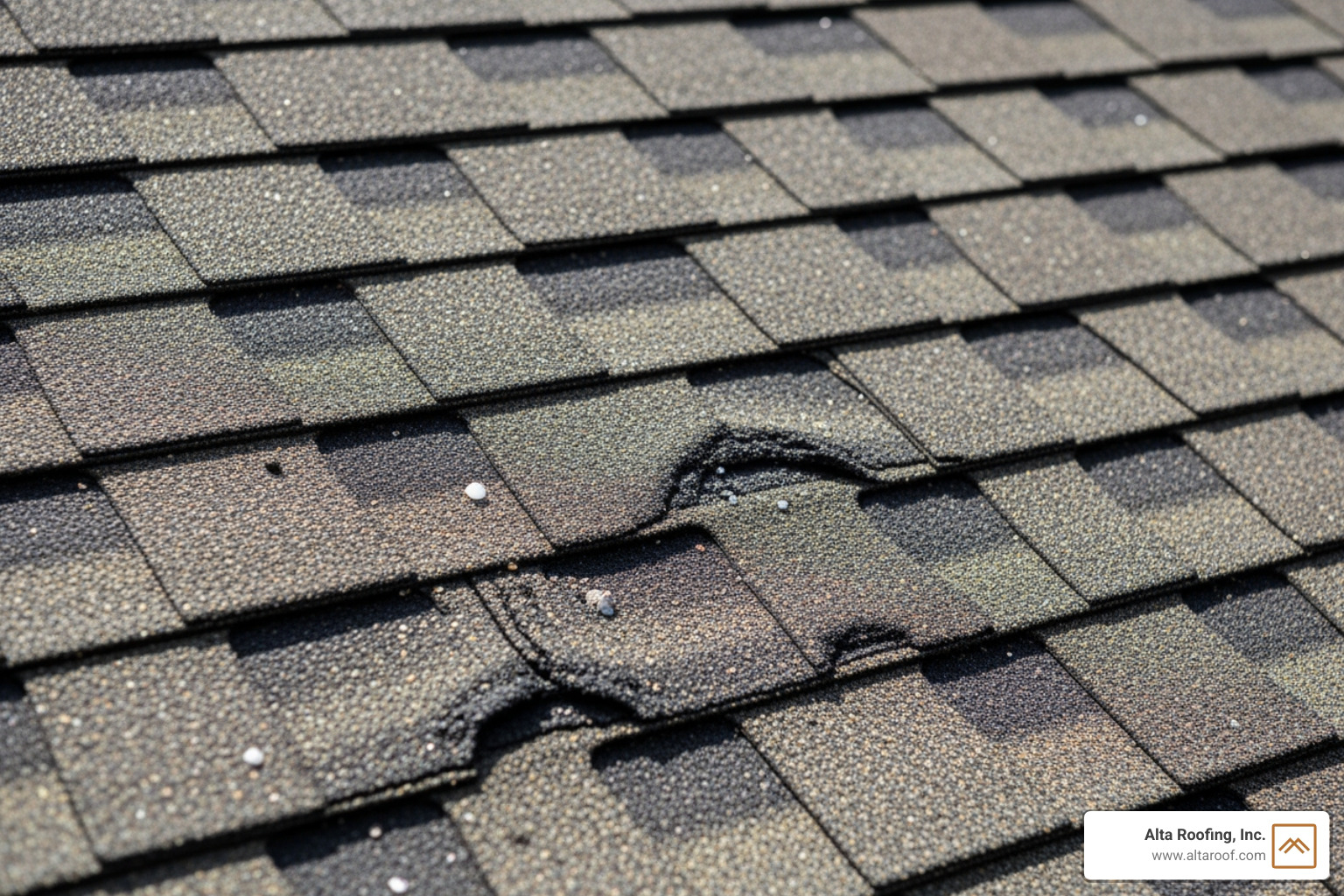
Here's what you'll need:
- Time-Stamped Photos and Video Evidence: This is your best friend. Capture every angle of the damage, both up close and from a distance. Include pictures of any fallen debris, broken windows, or damaged gutters. Don't forget to photograph any interior damage, like water stains on ceilings. For examples of what to look for, check out our guide on Hail Damage on Roof Pictures.
- Detailed Contractor's Report: A professional inspection report from a reputable roofer should outline the type and extent of damage, its likely cause (e.g., hail, wind), and a comprehensive estimate for repairs or replacement. This report serves as objective proof of your claim.
- Receipts for Temporary Repairs: If you had to make any emergency repairs (like tarping your roof to prevent further water intrusion), keep all receipts. Your insurance policy often covers these mitigation costs.
- Date of Loss: Clearly record the date and time of the storm or event that caused the damage. This helps your insurer verify the claim against weather records.
- Policy Information: Have your policy number readily available.
- Communication Log: Keep a detailed log of all communications with your insurance company and adjuster, including names, dates, times, and summaries of conversations.
Professional documentation is key for approval. Without it, you might find yourself explaining "what ifs" instead of presenting "what is."
Understanding Coverage: ACV vs. RCV and Deductibles
One of the most confusing aspects of insurance claim roofing is understanding how your policy actually pays out. The terms Actual Cash Value (ACV) and Replacement Cost Value (RCV) are crucial to grasp, as they significantly impact your reimbursement.
Actual Cash Value vs. Replacement Cost Value
Let's break down these two types of coverage:
- Actual Cash Value (ACV): This coverage pays for the depreciated value of your roof. Think of it like buying a used car; it's worth less than a brand-new one. Your insurance company will calculate the replacement cost of your roof and then subtract depreciation based on its age and condition. For example, if your roof is 20-years-old and has depreciated significantly, your insurance company will cover significantly less of the cost to replace it, even if the claim is related to a natural event. This means you'll receive a lower payout, leaving you to cover a larger portion of the replacement cost out of your own pocket.
- Replacement Cost Value (RCV): This is the gold standard of coverage. RCV policies pay the full cost to repair or replace your roof at current market prices, without deducting for depreciation. If you have replacement cost coverage, the company will typically pay with two checks. The first check will be a partial payment, representing the actual cash value. Your company will send the rest of your claim amount (the "recoverable depreciation") after you’ve started and completed repairs. This ensures you get enough to rebuild or replace your roof with new materials of similar quality.
Here's a quick comparison:
| Feature | Actual Cash Value (ACV) | Replacement Cost Value (RCV) |
|---|---|---|
| Payout Basis | Current market value minus depreciation | Cost to replace/repair with new materials at current prices |
| Depreciation | Deducted from payout | Not deducted (initially withheld, then paid upon completion) |
| Out-of-Pocket | Higher, as you cover the depreciated amount | Lower, as insurance covers full replacement cost after repairs |
| Benefit | Lower premiums, but less coverage for older roofs | Higher premiums, but more comprehensive coverage |
Understanding which type of coverage you have is vital. We always recommend reviewing your policy with your agent, or referring to resources like Insurance and your roof: What to know to fully grasp the implications for your situation.
Deductibles and Policy Limits
Beyond ACV and RCV, two other terms are critical for your financial responsibility:
- Deductibles: This is the amount you pay out-of-pocket before your insurance coverage kicks in. The deductible is often a fixed dollar amount—usually $500 to $2,000 or more—or it may be a percentage of the home’s insured value. For example, if your roof repair costs $10,000 and your deductible is $1,000, you pay the first $1,000, and your insurer covers the remaining $9,000. Many policies in Colorado also have specific wind and hail deductibles, which can be a percentage (e.g., 1-5%) of your home's total insured value, rather than a fixed dollar amount. It's crucial to understand this, as a 1% deductible on a $400,000 home is $4,000! If a repair estimate is less than your deductible, it often makes more sense to pay out-of-pocket to avoid filing a claim that might impact your future premiums.
- Policy Limits: Every insurance policy has maximum amounts it will pay for different types of claims. These "policy limits" apply to the total amount your insurer will cover for roof repairs or replacement. It's important to ensure your limits are adequate to cover potential damage, especially given rising construction costs.
Knowing these details upfront empowers you to make informed decisions and avoid surprises during the insurance claim roofing process.
Common Reasons for Claim Denials and How to Avoid Them
It's heartbreaking to go through the stress of storm damage, only to have your insurance claim roofing denied. While insurance companies aim to cover legitimate damage, there are common pitfalls that can lead to a denial. Understanding these and taking preventative measures is key.
Maintenance Neglect and Wear and Tear
This is perhaps the most common reason for claim denials. Homeowners insurance is designed to cover sudden, accidental damage, not issues that arise from neglect or the natural aging process of your roof. As one source points out, "If an inspector finds that the damage was caused or worsened by neglect, your claim could be denied."
Here’s how to avoid this:
- Regular Inspections: We recommend annual roof inspections (ideally in the spring and fall) by a professional roofer. This helps identify minor issues before they become major problems. Even a brand-new roof isn’t invincible and can have installation defects, as noted in some research. An inspection establishes a documented baseline of your roof's condition.
- Gutter Cleaning: Keep your gutters and downspouts clear. Clogged gutters can lead to water backup, fascia damage, and even ice dams in colder months, causing leaks that may be attributed to neglect.
- Tree Trimming: Trim overhanging tree branches away from your roof. Falling branches are a common cause of storm damage, and dead or rotted trees that you failed to remove could lead to a claim denial if they fall.
- Minor Repairs Promptly: Address small issues like loose or cracked shingles immediately. Ignoring them can worsen damage during a storm, giving the insurer grounds to deny coverage for the exacerbated portion.
Your insurance company expects you to perform reasonable upkeep on your property. If damage is deemed to be from "normal wear and tear" or "gradual deterioration" rather than a sudden event, your claim is unlikely to be covered. While research on terracotta and cement roofs being vulnerable to wildfires highlights different risks, the underlying principle is that neglect of any roof type can lead to uninsurable losses.
Ordinance and Law Coverage
This type of coverage is often overlooked but can be incredibly important, especially for older homes in areas like Castle Rock or Manitou Springs. Ordinance and Law Coverage helps pay for the additional costs of rebuilding or repairing your home to meet current building codes after a covered loss.
For example, if your 20-year-old roof is damaged by hail and needs replacement, current building codes in your Colorado city might require new ventilation, specific underlayment, or even a different type of shingle that wasn't required when your original roof was installed. Without Ordinance and Law coverage, your standard policy might only cover the cost to replace your roof to its previous (and now non-compliant) condition. The extra costs to bring it up to code would then fall to you.
This coverage is not included in every policy, so check if you have it. If not, consider adding it as an endorsement (or rider) to your policy. It's a small investment that can prevent significant out-of-pocket expenses if a full roof replacement is needed after a storm.
The Role of Professional Inspections and Impact-Resistant Materials
Navigating the aftermath of a storm and dealing with insurance can feel like a full-time job. This is where a professional roofing contractor, especially one experienced in insurance claim roofing, becomes your greatest ally.
How an Insurance Claim Roofing Specialist Advocates for You
When an insurance adjuster comes to assess your roof damage, their primary goal is to determine the company's liability. While they aim for fairness, they might not always spot every nuance of damage, especially hidden issues. This is why having your roofing contractor present during the adjuster's visit is so valuable.
Here’s how our team at Alta Roofing advocates for you:
- Unbiased Assessment: Before the adjuster arrives, we provide you with a detailed, unbiased assessment of your roof's condition, identifying all storm-related damage. This gives you a clear picture of what needs to be repaired or replaced.
- Technical Expertise: Our specialists speak the technical language of roofing and insurance. We can accurately point out specific damage, explain its cause, and present solutions that align with industry standards.
- Negotiation Support: If an adjuster's initial assessment undervalues the damage or misses key issues, we can provide additional documentation, photos, and a comprehensive scope of work to support negotiations. Homeowners often have much better success with their claims when they have an expert on their side.
- Hidden Damage Identification: Hail damage, for instance, can be subtle. Granule loss, bruising on shingles, or damage to flashing might be missed by an untrained eye. Our experts know exactly what to look for, both on the surface and in the underlying structure, to ensure all damage is accounted for.
- Single Point of Contact: As a Colorado-based company specializing in storm restoration, we understand the unique challenges homeowners face in areas like Denver, Aurora, and Castle Pines. We handle the insurance claims process and coordinate all necessary trades, acting as your single point of contact. This comprehensive approach simplifies the entire process, allowing you to focus on getting your home back to normal. You can learn more about our comprehensive offerings on our Services page.
We believe that a knowledgeable roofing contractor can make all the difference in your claim, ensuring you receive a fair settlement for all necessary repairs.
Benefits of Impact-Resistant Roofing
In a state like Colorado, where hail and strong winds are common, investing in impact-resistant roofing materials can offer significant benefits, including potential savings on your homeowners insurance premiums.
- What it is: Impact-resistant roofing products are designed to withstand severe weather. They are often rated using the UL 2218 standard, with Class 4 being the highest rating for impact resistance. These shingles are made with advanced materials that can absorb impact without cracking or breaking.
- Premium Discounts: Many insurance companies recognize the durability of these materials and offer premium discounts to homeowners who install them. By choosing a Class 4 impact-resistant shingle, you're signaling to your insurer that your roof is less likely to be damaged in a hail storm, potentially leading to lower rates.
- Improved Durability: Beyond insurance savings, these materials offer superior protection for your home, reducing the likelihood of needing repairs or replacements after every storm. This means less stress, fewer claims, and a longer lifespan for your roof.
When discussing your roof replacement options, ask us about impact-resistant materials. It's an investment that pays off in both peace of mind and potential financial savings.
Frequently Asked Questions about Roofing Claims
We know that dealing with insurance claim roofing can bring up a lot of questions. Here are some of the most common ones we hear from Colorado homeowners:
How long does the insurance claim process typically take?
The timeline for an insurance claim roofing process can vary, but here's a general idea:
- Approval or Denial: After the adjuster inspects the damage, you can typically expect an approval or denial within a week to ten days.
- Reimbursement Check: Once the claim is approved, it usually takes 30 to 60 days to receive a reimbursement check. Some state laws might even require checks to be received within 30 days of settlement. That for RCV policies, this first check will be the ACV portion, with the recoverable depreciation released after repairs are completed.
Factors like the severity of the storm, the volume of claims in your area (especially after widespread events in places like Golden or Arvada), and the efficiency of your insurance company can all influence these timelines.
What should I do if I disagree with the adjuster's assessment?
It's not uncommon for homeowners to disagree with an adjuster's assessment. The adjuster works for the insurance company, and while they strive for accuracy, they can sometimes miss damage or undervalue repairs.
Here's what we recommend:
- Request a Detailed Explanation: Ask your adjuster for a clear, written explanation of their assessment and why certain damages or costs were excluded.
- Provide Additional Evidence: If your roofing contractor identified damage that the adjuster missed, provide the adjuster with your contractor's detailed report, photos, and estimates. Our team at Alta Roofing is experienced in this and can help present a strong case.
- Get a Second Opinion: You have the right to get a second opinion from an independent roofing inspector or another reputable contractor. Their report can serve as powerful evidence in your appeal.
- Appeal the Decision: Most insurance companies have an appeal process. Follow their guidelines for submitting an appeal, providing all supporting documentation.
- Consider a Public Adjuster: If you're still not getting a fair shake, you might consider hiring a public adjuster. Unlike the insurance company's adjuster, a public adjuster works solely for you and advocates on your behalf. They typically charge a percentage of the settlement.
- Mediation or Legal Action: As a last resort, if all else fails, you might explore mediation or legal action.
The key is to remain calm, communicate professionally, and back up your arguments with solid evidence.
Can I make temporary repairs before the adjuster arrives?
Absolutely, and you should! Making temporary repairs is called "mitigation," and it's your responsibility as a homeowner to prevent further damage after a loss.
- Preventing Further Loss: If your roof has a hole or significant damage, it's crucial to tarp it or take other immediate steps to prevent water from entering your home and causing more extensive (and costly) interior damage.
- Document Everything: Before you make any temporary repairs, take photos and videos of the damage. This is essential for your claim.
- Track Expenses: Keep all receipts for materials and labor related to your temporary repairs. Your insurance policy typically covers these reasonable mitigation expenses.
- Safety First: Only undertake temporary repairs if it's safe to do so. If the damage is extensive or requires working at heights, it's best to call a professional emergency service.
Your insurer will appreciate your proactive efforts to prevent secondary damage, and it strengthens your claim by showing you acted responsibly.
Conclusion
Navigating the insurance claim roofing process doesn't have to be a daunting experience. With the right knowledge, thorough documentation, and the support of an experienced and reputable roofing contractor, you can ensure a fair and successful outcome for your home.
At Alta Roofing, Inc., we're more than just roofers; we're your dedicated partners in storm restoration. Specializing in roof replacement, repairs, and comprehensive storm damage restoration, we pride ourselves on handling insurance claims and coordinating all necessary trades. We act as a single point of contact for homeowners throughout Colorado, particularly in Colorado Springs, Denver, Aurora, Thornton, Lakewood, Castle Rock, Manitou Springs, Elizabeth, Parker, Golden, Arvada, Woodland Park, Highlands Ranch, Littleton, Lone Tree, Fountain, Centennial, Englewood, Castle Pines, and Monument.
We understand the unique weather challenges our beautiful state presents and are committed to helping you protect your most valuable asset. Don't let the complexities of an insurance claim overwhelm you.
Reach out to us today for a free inspection and let us guide you through every step of the process. Your peace of mind is our priority.
Contact us now!
Buyer's Guide: Best Roofing Contractors Colorado for 2026
Why Colorado Homeowners Need Specialized Roofing Contractors
Roofing contractors Colorado homeowners choose must understand the state's unique climate challenges—from intense high-altitude UV exposure to notorious hailstorms and extreme temperature swings. The right contractor not only installs your roof but also steers complex insurance claims, sources impact-resistant materials, and provides long-term protection against Colorado's harsh weather conditions.
Key Factors When Choosing Colorado Roofing Contractors:
- Local Licensing & Insurance - Verify Colorado-specific credentials and worker's compensation coverage
- Manufacturer Certifications - Look for GAF Master Elite or CertainTeed SELECT ShingleMaster status
- Storm Damage Experience - Ensure expertise in hail claims and insurance negotiations
- Material Knowledge - Contractors should recommend Class 4 impact-resistant shingles for Colorado's "Hail Alley"
- Comprehensive Services - Seek contractors offering inspections, repairs, replacements, and restoration
Colorado's higher elevation means thinner atmosphere and significantly less protection from the sun’s ultraviolet (UV) rays. UV exposure at high altitudes can cause Colorado roofs to deteriorate up to 50% faster than those in lower-elevation states. The average cost of a new roof in Colorado typically ranges from $8,000 to $20,000, with standard asphalt shingle roofs averaging $10,000 to $15,000. In Colorado, roofs typically need to be replaced every 15 to 30 years, depending on material quality and weather exposure.
The Colorado Roofing Association, established in 1978, promotes ethics and education throughout the industry. Their member directory helps homeowners find licensed contractors who understand regional building codes and climate-specific installation techniques. Whether you're dealing with storm damage, planning a replacement, or simply need an honest inspection, choosing a contractor with proven Colorado experience is essential.
I'm Barry Goers, founder of Tarben Ventures Ltd. with experience in the construction industry and a deep understanding of the challenges roofing contractors Colorado homeowners face when protecting their homes against extreme weather. Through my work in construction investment and operations, I've seen how critical it is to choose contractors who combine technical expertise with honest customer service.
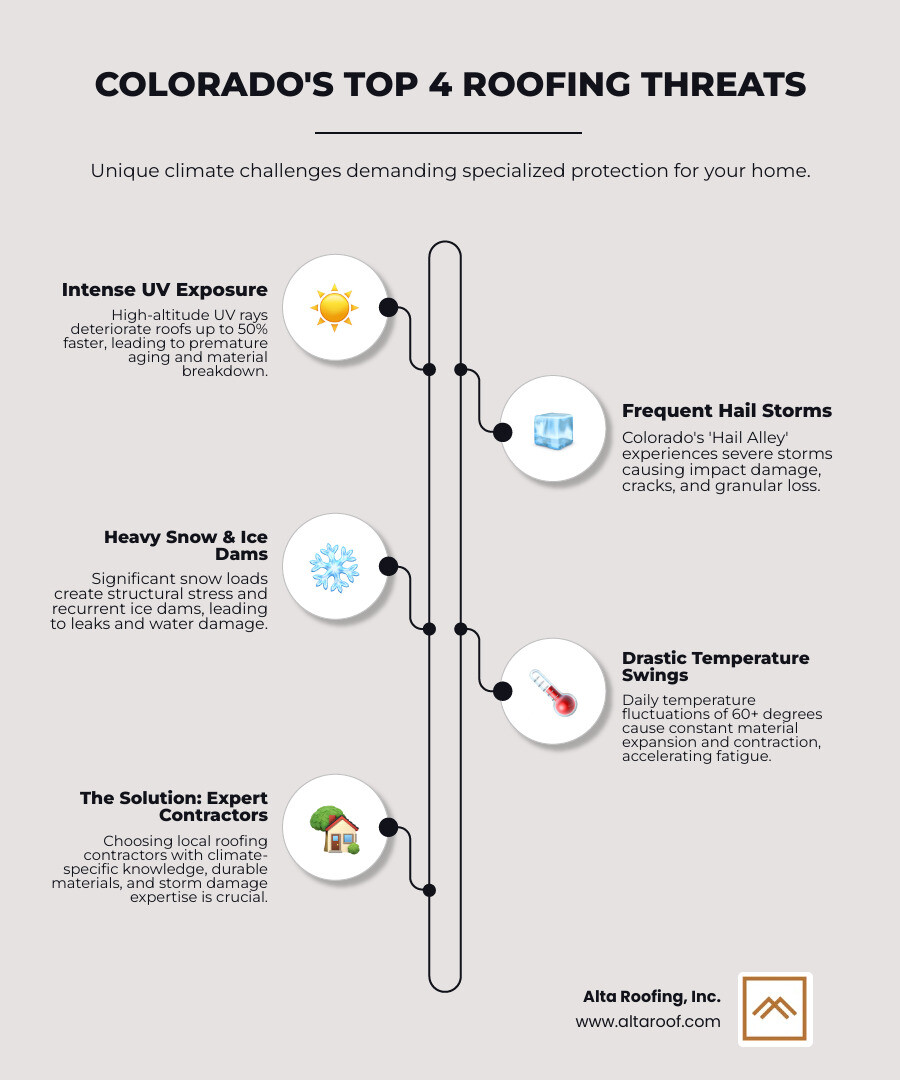
The Colorado Climate Challenge: Why Your Roof Needs Special Attention
Colorado is stunning, but let's be honest, our weather can be a bit… dramatic. From scorching summer sun to brutal winter blizzards, your roof takes a beating year-round. Understanding these unique challenges is the first step in finding the right roofing contractors Colorado has to offer.
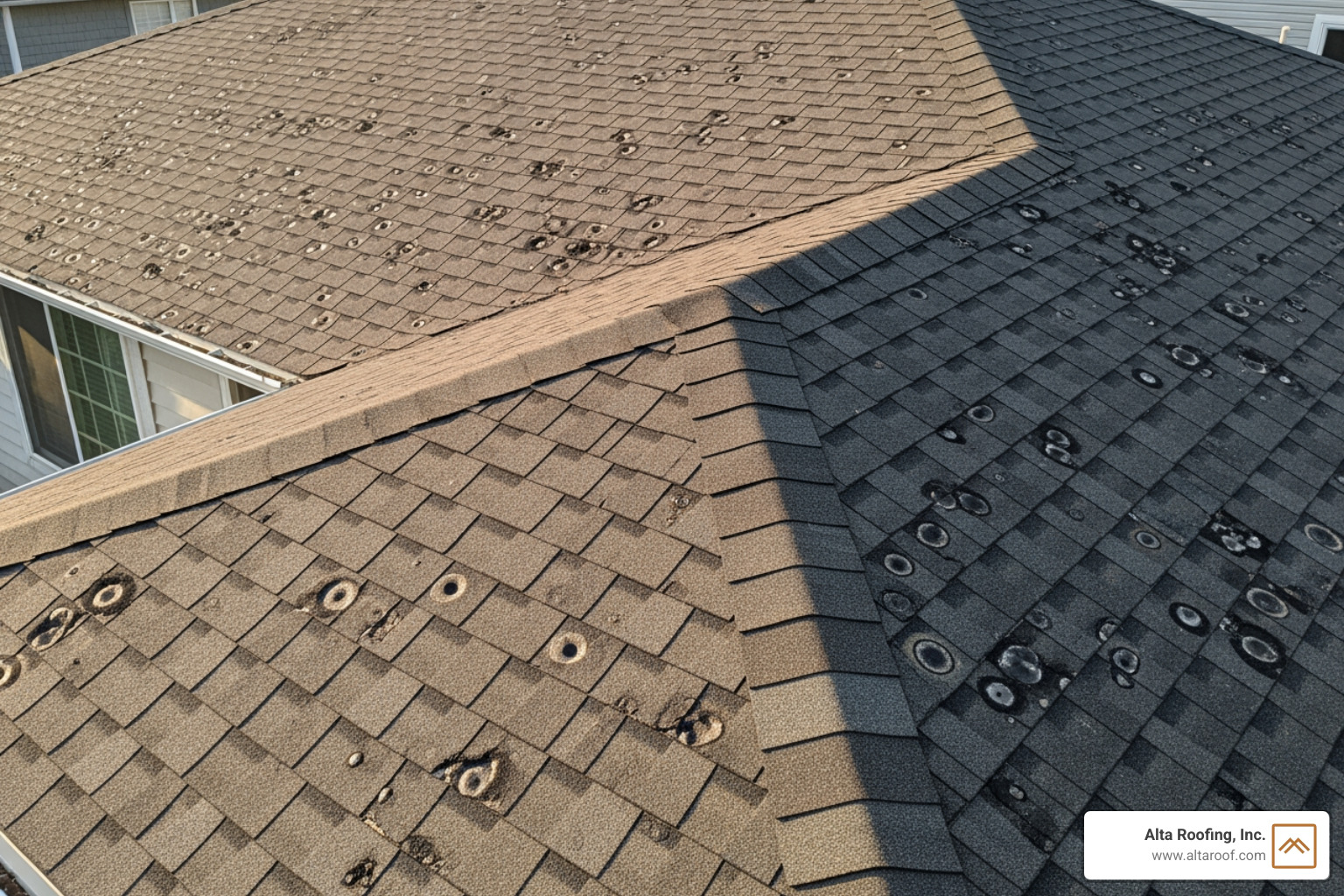
Intense UV Exposure
We love our 300+ days of sunshine, but that brilliant sun comes with a downside for your roof. Colorado’s higher elevation means a thinner atmosphere, providing significantly less protection from the sun’s ultraviolet (UV) rays. This intense UV exposure can cause roofing materials to deteriorate up to 50% faster than roofs in lower-elevation states. It breaks down the essential oils in asphalt shingles, leading to brittleness, cracking, and granule loss—the tiny, sand-like particles that protect your shingles.
Extreme Temperature Fluctuations
If you've lived here for any length of time, you've experienced the wild temperature swings—sometimes 40 to 60+ degrees in a single day! This constant expansion and contraction puts immense stress on your roofing materials. Fasteners can loosen, shingles can crack, and the layers of your roof can separate, creating vulnerabilities for water intrusion. The rapid freeze-thaw cycles, especially in areas like Golden (at 7,000+ feet elevation), can accelerate moisture infiltration damage by 40%.
Heavy Snow & Ice Dams
Our beautiful snow-capped mountains are picturesque, but heavy snowfall and subsequent ice dams pose a serious threat to your roof's integrity. Significant snow loads can cause structural stress, and as that snow melts and refreezes, ice dams can form along your eaves. These dams prevent melting snow from draining properly, allowing water to back up and seep beneath your shingles, leading to costly interior damage. Proactive maintenance and proper insulation are key to mitigating these issues.
Hail Alley
Colorado is famously part of "Hail Alley," experiencing frequent and often severe hailstorms. These storms can cause significant impact damage, from bruising and cracking shingles to completely dislodging them. Wind, often accompanying hailstorms, can also lift and tear away shingles, leaving your home exposed. This is why we strongly recommend bi-annual roof inspections—one in the spring to assess winter damage and one in the fall to prepare for snow season. Additionally, always schedule an inspection after any significant weather event, especially winds over 50 mph or hail larger than ¼ inch. For more detailed information on how hail impacts your roof, visit our page on More info about hail damage.
Your 7-Point Checklist for Choosing the Best Roofing Contractors Colorado
Choosing a roofing contractor in Colorado isn't just about finding someone to nail down shingles; it's about partnering with an expert who understands our unique climate, building codes, and insurance landscape. Here's our comprehensive checklist to help you make an informed decision.
1. Verify They Are Local, Licensed, and Insured
This is non-negotiable. A local contractor, particularly one serving areas like Denver, Aurora, Colorado Springs, Castle Rock, Golden, and other Front Range communities, will have an intimate understanding of the specific weather patterns, local building codes, and even HOA requirements that out-of-state "storm chasers" often lack. For instance, in Golden, where elevations exceed 7,000 feet, contractors must recommend materials and techniques suitable for intense UV, heavy snow loads, and significant temperature swings.
Beyond local knowledge, ensure your chosen roofing contractors Colorado are properly licensed and insured. This includes general liability insurance to protect your property and workers' compensation insurance to cover their crew in case of an accident. Skipping this step can leave you vulnerable to significant financial and legal headaches. The Colorado Roofing Association (CRA) is an excellent resource for finding reputable, local contractors who meet these standards. You can learn more about the benefits of choosing a local expert on our Local Roofing Contractors page.
2. Check for Manufacturer Certifications
Manufacturer certifications are a strong indicator of a contractor's commitment to quality and ongoing training. Programs like GAF Master Elite and CertainTeed SELECT ShingleMaster require contractors to meet stringent criteria, including proper licensing, insurance, a proven track record, and continuous education on the latest installation techniques and materials.
For example, GAF-certified contractors are vetted for their insurance, licensing, years of experience, and positive customer reviews. This certification allows them to offer improved warranties, such as the GAF Golden Pledge or Silver Pledge, which provide superior coverage on both materials and workmanship compared to standard warranties. These certifications demonstrate that the contractor is backed by the industry's leading manufacturers, ensuring you receive high-quality products installed by trained professionals.
3. Scrutinize Reviews and Reputation
A contractor's reputation is just a click away. We recommend thoroughly checking online reviews on platforms like Google, Yelp, and Angi. Look for consistent positive feedback regarding professionalism, communication, quality of work, and adherence to timelines and budgets. Pay attention to how contractors respond to negative reviews—a professional and constructive response can be as telling as a glowing testimonial.
Beyond online reviews, check their rating with the Better Business Bureau (BBB). Many reputable Colorado roofing companies, like Elite Roofing & Solar and CJ Roofing, boast A+ ratings, reflecting their commitment to customer satisfaction. Don't hesitate to ask for local references from past clients in your area. Hearing directly from homeowners who have worked with them can provide invaluable insights into their experience. At Alta Roofing, we pride ourselves on our positive customer experiences, and you can always View our work to see our craftsmanship firsthand.
4. Understand Their Offered Services
A comprehensive roofing contractors Colorado firm should offer a full suite of services to meet all your roofing needs. This typically includes:
- Roof Inspections: Thorough assessments to identify current damage or potential issues.
- Roof Repairs: Addressing specific problems like leaks, missing shingles, or minor storm damage.
- Full Replacements: When repairs are no longer sufficient, a complete roof overhaul.
- Storm Damage Restoration: Specialized expertise in repairing or replacing roofs damaged by hail, wind, or snow.
- Gutter Services: Often integrated with roofing, proper gutters are essential for water management.
- Attic Ventilation: Crucial for extending roof life and improving energy efficiency, especially in Colorado's climate extremes.
- Some advanced contractors even offer solar panel integration.
Ensure the contractor's services align with your specific needs. For a detailed look at the range of services we provide, including residential, commercial, and storm restoration, please visit our Services page.
5. Inquire About Warranties
Warranties are your long-term protection and a testament to a contractor's confidence in their work. There are typically two types:
- Workmanship Warranty: Provided by the contractor, covering the quality of their installation.
- Manufacturer Warranty: Provided by the material manufacturer, covering defects in the roofing products themselves.
Reputable roofing contractors Colorado will offer robust warranties for both. For instance, GAF-certified contractors can offer improved manufacturer warranties like the GAF System Plus, which extends coverage beyond standard limited warranties, or the GAF Silver Pledge, which offers even more comprehensive protection. The Silver Pledge™ Warranty Details outline specifics such as 50-year material defect coverage and 10-year workmanship coverage. Always understand what's covered, for how long, and any conditions that might void the warranty.
6. Evaluate Their Insurance Claim Assistance
Given Colorado's "Hail Alley" status, dealing with insurance claims is a common reality for many homeowners. The best roofing contractors Colorado are experts in navigating this often-complex process. They should:
- Document Damage Thoroughly: Provide detailed reports, photos, and even drone footage of the damage.
- Guide You Through Filing: Assist you in initiating the claim with your insurance provider.
- Meet with Adjusters: Be present during the insurance adjuster's inspection to ensure all damage is properly assessed and accounted for.
- Advocate for a Fair Settlement: Help you understand your policy (Actual Cash Value vs. Replacement Cost Value) and work to ensure you receive a fair payout for necessary repairs or replacement.
At Alta Roofing, our USP revolves around handling insurance claims and coordinating all necessary trades, acting as a single point of contact for homeowners, particularly in Colorado Springs and across the Front Range. We aim to make this stressful process as smooth as possible for you.
7. Avoid Common Roofing Scams
Unfortunately, where there's opportunity, there are scams. Colorado's frequent storm activity attracts unscrupulous individuals. Be wary of:
- Storm Chasers: Out-of-state contractors who appear after a storm, often pressuring homeowners with aggressive sales tactics. They may do shoddy work and disappear quickly.
- High-Pressure Tactics: Anyone demanding an immediate decision or a large upfront payment without a detailed estimate.
- "Free Roof" Promises: No legitimate contractor offers a truly "free" roof. They are likely trying to work solely with your insurance payout, potentially cutting corners or using inferior materials.
- Door-to-Door Solicitors: While some legitimate local businesses use door-to-door sales, be cautious. Always verify their credentials and local presence.
Always get multiple quotes, check references, and ensure a detailed contract is in place before any work begins. The Colorado Roofing Association provides a helpful Re-Roofing Checklist for Consumers to help you avoid common pitfalls.
Best Roofing Materials for Colorado's Climate
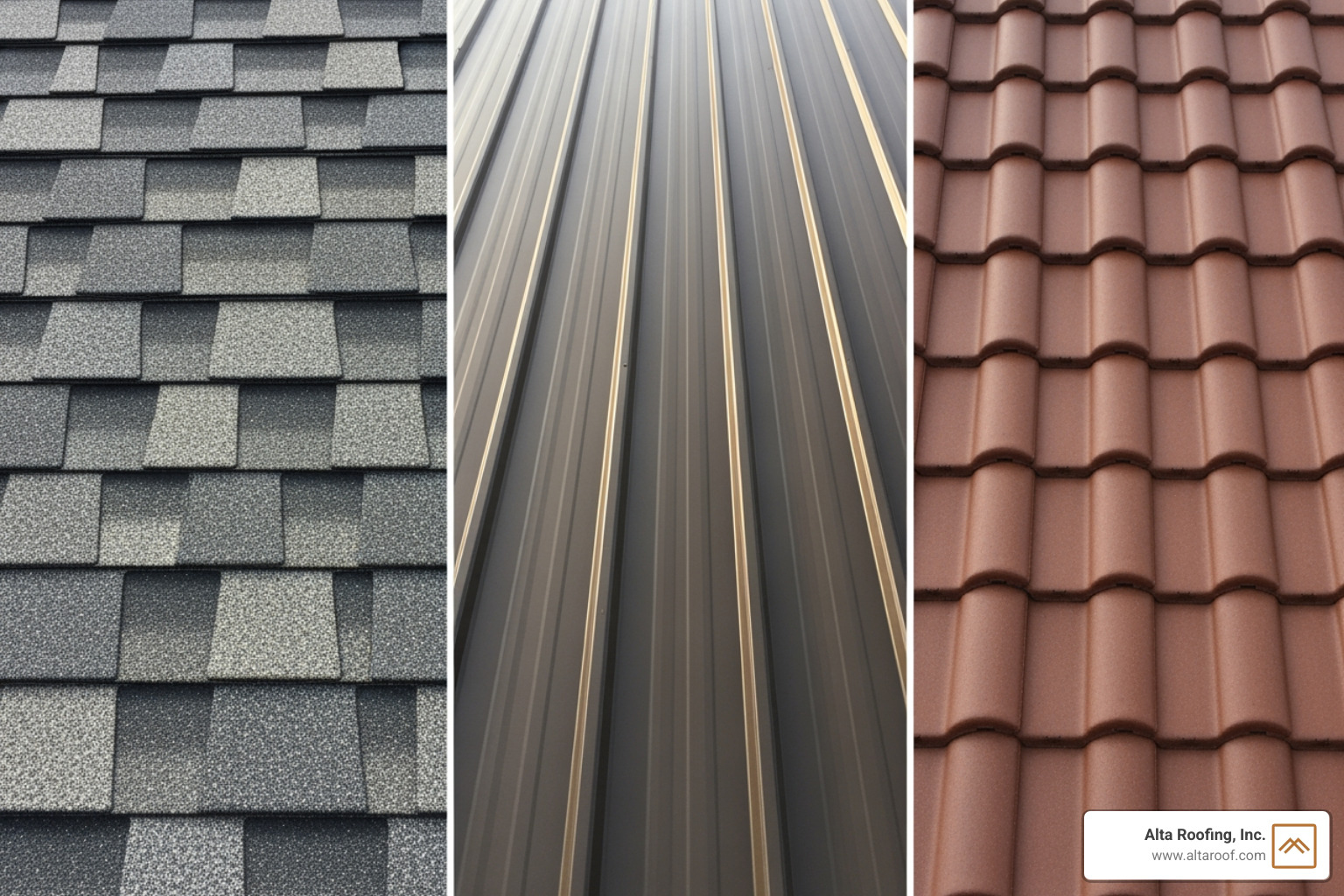
Impact-Resistant (Class 4) Asphalt Shingles
Asphalt shingles remain the most popular roofing material due to their affordability and versatility. However, for Colorado, we strongly recommend impact-resistant (IR) or Class 4 shingles. These shingles have passed the UL 2218 impact resistance test, simulating the force of hail, and are designed to withstand the frequent hailstorms we experience across Denver, Colorado Springs, and other areas.
- Pros: Cost-effective, wide range of styles and colors, good hail resistance (Class 4 can reduce insurance premiums by 15-25%), and relatively easy to install. Brands like GAF (Timberline HDZ) and Malarkey offer excellent IR options.
- Cons: While IR shingles are tough, their lifespan in Colorado's intense UV and temperature swings is still typically shorter than metal or tile—around 15 to 25 years. Granule loss due to UV exposure is a common issue.
Metal Roofing
Often considered the "gold standard" for challenging environments like Golden's 7,000+ foot elevation, metal roofing offers unparalleled durability and longevity.
- Pros: Exceptional durability against hail, wind (up to 70+ mph), and fire. Lifespan of 30-50+ years, often outperforming premium asphalt by 7-10 years on south-facing slopes with maximum UV exposure. Excellent for shedding snow and ice. Can reduce summer cooling costs by up to 25%. Available in various types, including standing seam and stone-coated steel (e.g., Decra).
- Cons: Higher initial cost compared to asphalt shingles. Installation requires specialized expertise.
Synthetic, Concrete, and Clay Tiles
These materials offer a blend of aesthetic appeal and extreme performance, making them excellent choices for Colorado homes.
- Pros: Superior longevity (30-50+ years for synthetic and tile), highly resistant to hail, wind, fire, and UV. Synthetic products (like Bartile's synthetic slate) excel against Colorado's freeze-thaw cycles and high winds. They offer a luxurious appearance and can meet strict HOA requirements.
- Cons: These materials are generally heavier than asphalt or metal, potentially requiring additional structural support. They also come with a higher initial cost and require specialized installation techniques.
Comparing Top Colorado Roofing Materials
| Material | Average Lifespan (CO) | Average Cost (CO) | Hail/Wind Resistance | Pros | Cons |
|---|---|---|---|---|---|
| Impact-Resistant Asphalt Shingle | 15-25 years | $10,000 - $15,000 | Good | Cost-effective, wide style range, insurance discounts (Class 4) | Shorter lifespan than alternatives, UV degradation over time |
| Metal Roofing | 30-50+ years | Higher than asphalt | Excellent | Extreme durability, longevity, fire resistance, snow shedding, energy efficient, "gold standard" for challenging environments | Higher initial cost, can be noisy during heavy rain/hail, specialized installation |
| Synthetic Tile | 30-50+ years | High | Excellent | Extreme durability, aesthetic appeal, good for freeze-thaw, wind resistant, lighter than natural tiles | Higher initial cost, specialized installation |
| Concrete/Clay Tile | 30-50+ years | High | Excellent | Classic aesthetic, extreme durability, fire resistant, long lifespan | Very heavy (may require structural reinforcement), high initial cost, fragile to walk on |
Budgeting and Next Steps: Costs, Repairs, and Insurance Claims
Understanding the financial aspects of roofing in Colorado, along with knowing when to act, is crucial for protecting your home investment.
Understanding the Average Cost for roofing contractors Colorado
The cost of roofing services in Colorado can vary significantly. Generally, the average cost of a new roof in Colorado typically ranges from $8,000 to $20,000. For a standard asphalt shingle roof, homeowners can expect to pay around $10,000 to $15,000 on average.
Several factors influence this pricing:
- Roof Size and Pitch: Larger roofs and those with steeper pitches require more materials and labor.
- Material Choice: As discussed, metal and tile roofs have a higher upfront cost than asphalt shingles.
- Complexity: Features like multiple valleys, skylights, or chimneys add to labor and material costs.
- Location: Mountain communities like Golden might experience higher material and labor costs due to logistics and the need for specialized, more durable materials.
- Underlying Damage: If the roof deck needs repair or replacement due to water damage, this will add to the overall expense.
Many roofing contractors Colorado offer financing options. Some local partnerships, aware of the higher costs for premium materials needed for our extreme weather, offer solutions like 18-month same-as-cash programs or fixed-rate financing from 24-120 months (starting around 5.99%). Don't hesitate to ask about these options.
Signs Your Roof Needs Repair or Replacement
Ignoring early warning signs can turn a minor repair into a costly replacement. Here are key indicators that your roof needs attention:
- Missing or Cracked Shingles: Especially after high winds or hail, these are clear signs of damage.
- Granule Loss: If you see a lot of shingle granules in your gutters or downspouts, it means your shingles are losing their protective layer.
- Ceiling Stains: Water spots on your interior ceilings or walls indicate a leak.
- Sagging Roof Deck: A visible sag in your roofline is a serious structural issue.
- Age of Roof: In Colorado, asphalt shingle roofs typically last 15 to 25 years. If your roof is approaching or exceeding this age, it's wise to have it inspected.
- Increased Energy Bills: A compromised roof can lead to poor insulation and higher heating/cooling costs.
If you notice any of these signs, it's time to call in the professionals. For a more in-depth guide on assessing your roof's condition, check out our article on When to Replace Your Roof.
Navigating the Insurance Claim Process for roofing contractors Colorado
Dealing with roof damage, especially after a major storm, is stressful enough without the added headache of insurance claims. This is where experienced roofing contractors Colorado truly shine.
Here’s how we recommend navigating the process:
- Document the Damage: Take clear photos and videos of all visible damage from various angles. This evidence will be crucial for your claim.
- File Your Claim Promptly: Contact your insurance provider as soon as possible after finding damage. Be prepared with your documentation.
- Schedule a Contractor Inspection: Before the insurance adjuster arrives, have your chosen roofing contractor conduct their own thorough inspection. They can identify damage that might be missed by an untrained eye.
- Meet the Adjuster with Your Contractor: We highly recommend having your roofing contractor present during the insurance adjuster's visit. Your contractor can point out damage, explain the repair process, and advocate for a comprehensive assessment, ensuring nothing is overlooked.
- Understand Your Policy: Familiarize yourself with your policy's terms, especially regarding Actual Cash Value (ACV) vs. Replacement Cost Value (RCV). RCV policies generally offer better coverage, paying for the full cost of replacement without depreciation.
- Review the Settlement: Your contractor can help you review the insurance settlement to ensure it covers all necessary repairs and materials, particularly for Colorado-specific requirements like impact-resistant shingles.
At Alta Roofing, we specialize in assisting homeowners across Denver, Colorado Springs, and the Front Range with their insurance claims. Our expertise in documenting damage and advocating on your behalf helps ensure a fair settlement. For more guidance, watch this helpful video: Tips For Filing Insurance Claims (video).
Frequently Asked Questions
When it comes to your roof in Colorado, you're bound to have questions. Here are some of the most common inquiries we receive from homeowners.
How often should I have my roof inspected in Colorado?
Due to Colorado's extreme weather—intense UV radiation, 60+ degree temperature swings, heavy snow loads, and spring hailstorms—we recommend bi-annual inspections. A spring check helps identify any damage sustained over the winter, allowing for repairs when conditions are optimal. A fall inspection prepares your roof for the upcoming snow season, ensuring it's sealed and ready to withstand the elements.
Additionally, always schedule an inspection after any significant weather event. This means after winds over 50 mph or hail larger than ¼ inch—conditions that Golden, for instance, experiences several times yearly. Proactive maintenance and regular inspections are the best ways to extend your roof's lifespan and catch minor issues before they become major problems.
What is a Class 4 shingle and is it worth it in Colorado?
A Class 4 shingle refers to its impact resistance rating, the highest classification under the UL 2218 test. This test simulates the impact of hail by dropping steel balls from varying heights onto the shingle. A Class 4 rating means the shingle can withstand the impact of a 2-inch steel ball dropped from 20 feet without cracking.
In Colorado's "Hail Alley," Class 4 shingles are absolutely worth it. They provide superior protection against hail damage, which is a frequent cause of roof replacement here. Beyond the improved durability, many insurance companies offer significant premium discounts (sometimes 15-25%) for homes protected with Class 4 impact-resistant roofing. This can lead to substantial long-term savings and peace of mind.
Can I choose my own roofing contractor if my insurance company recommends one?
Yes, absolutely! It is your right as a homeowner to choose your own roofing contractor. While your insurance company might provide a list of "preferred" vendors, you are under no obligation to use them. These lists often consist of contractors who have agreed to specific pricing or processes with the insurer, which may not always be in your best interest.
We strongly advise getting multiple quotes from reputable, local roofing contractors Colorado who are licensed, insured, and experienced with Colorado's climate and insurance claims. Compare their estimates, services, warranties, and customer reviews. Choosing the right contractor ensures you get quality workmanship, appropriate materials for our climate, and an advocate on your side throughout the claims process. Don't let your insurance company steer you; make an informed decision that protects your home and your investment.
Conclusion: Securing Your Home with the Right Colorado Roofing Partner
Navigating the unique challenges of Colorado's climate and the complexities of roof repair or replacement requires more than just a general contractor. It demands a specialized, local expert. We've walked through the critical steps: from understanding the brutal impact of UV, hail, snow, and temperature swings, to vetting contractors based on their local presence, certifications, reputation, and service offerings. We've emphasized the importance of robust warranties and, crucially, a contractor's ability to expertly guide you through the insurance claims process.
For homeowners across Denver, Aurora, Thornton, Lakewood, Colorado Springs, Castle Rock, Manitou Springs, Elizabeth, Parker, Golden, Arvada, Woodland Park, Highlands Ranch, Littleton, Lone Tree, Fountain, Centennial, Englewood, Castle Pines, and Monument, choosing the right roofing contractors Colorado has to offer is the ultimate safeguard for your home. At Alta Roofing, we pride ourselves on being that trusted partner. We handle insurance claims, coordinate all necessary trades, and act as your single point of contact for comprehensive exterior home restoration, ensuring a seamless and stress-free experience.
Don't let Colorado's weather dictate the lifespan of your roof. Empower yourself with knowledge and partner with professionals who understand the unique demands of our beautiful state. Schedule your free inspection today, and let us help you protect your most valuable asset.
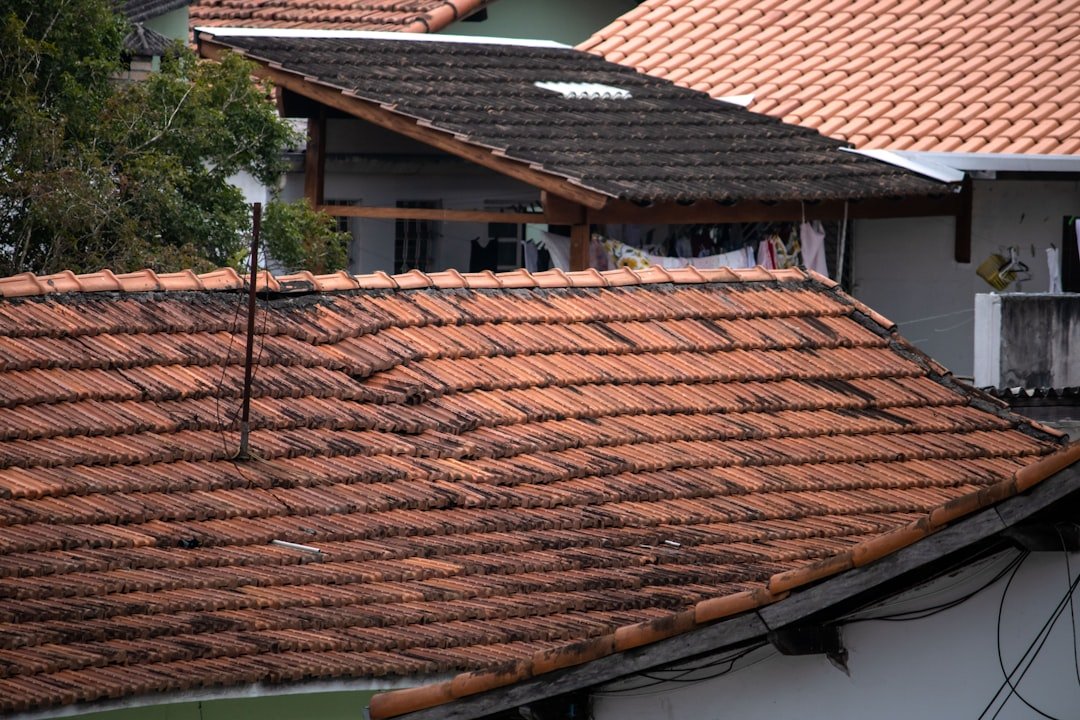
Emergency Roof Repair: Top 10 Detailed Reviews
When Every Minute Counts: Understanding Emergency Roof Repair

Emergency roof repair is the urgent response needed when your roof fails, threatening your home's interior or structural integrity. When water pours through your ceiling or a storm tears shingles from your roof, you don't have days to wait—you have hours to act.
Here's what qualifies as a roofing emergency:
- Active leaks during or after a storm with water entering your home
- Sagging ceilings or visible structural damage to the roof deck
- Missing shingles across large sections of your roof
- Fallen trees or branches that have punctured the roof
- Visible daylight shining through your attic or roof boards
These situations demand immediate professional attention to minimize costly secondary damage like mold, electrical hazards, and structural deterioration.
Colorado's severe weather takes a brutal toll on roofs. High winds can tear off shingles, and heavy rains can pour into exposed areas. If left unaddressed, even minor damage can escalate into serious issues.
By following a clear action plan—prioritizing safety, containing damage, documenting everything, and securing professional help—you can protect your home and family.
I'm Barry Goers, and through my work with construction industry ventures, I've seen how quick action during a roofing crisis makes the difference between a manageable repair and catastrophic damage. My experience has taught me that understanding the emergency roof repair process empowers homeowners to make smart decisions when minutes matter most.
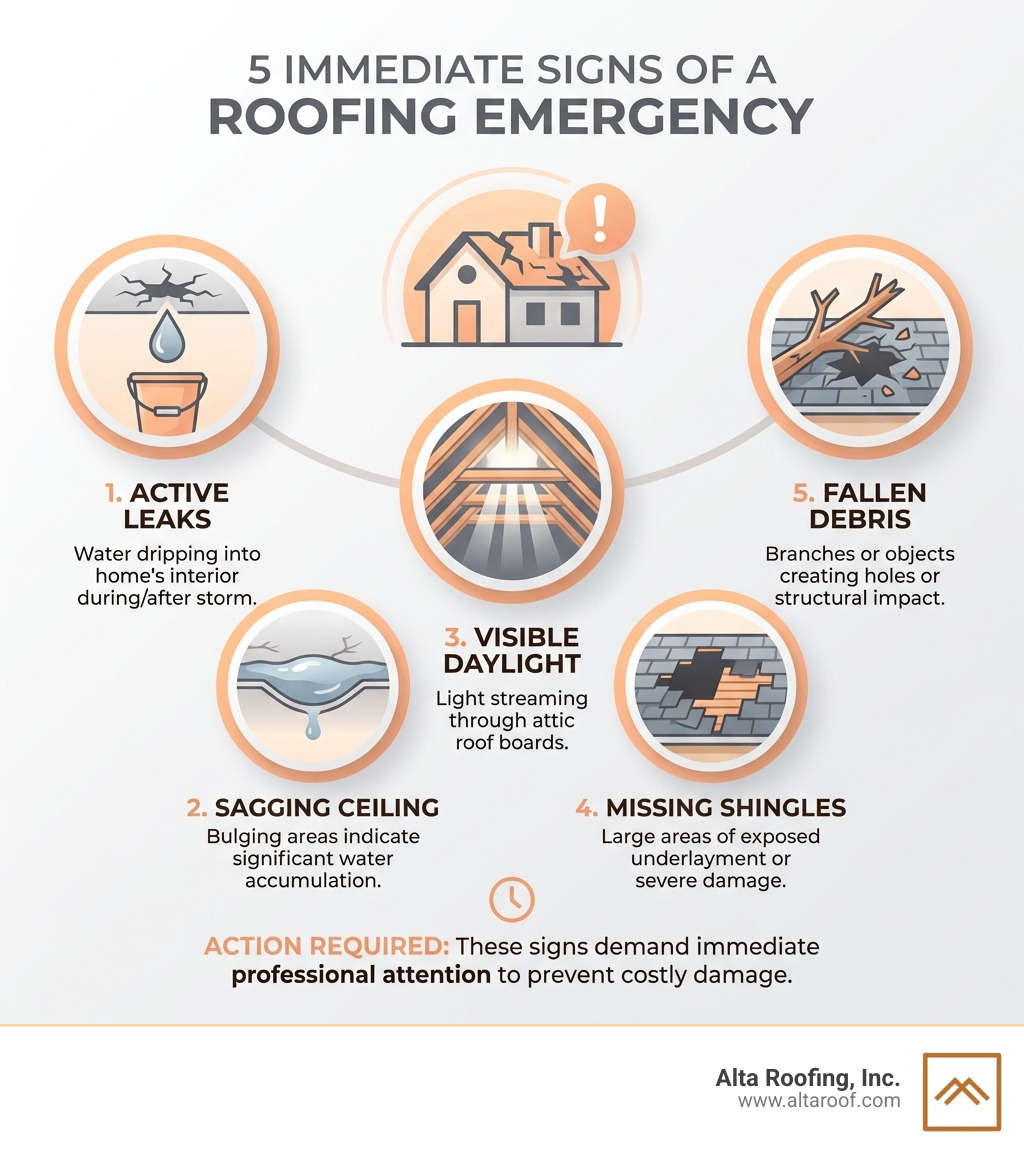
First 60 Minutes: Your Immediate Action Plan for a Roofing Emergency
When disaster strikes your roof, taking swift, decisive action can significantly reduce further damage. Our immediate action plan focuses on prioritizing safety, containing interior damage, and documenting everything for your insurance claim. These steps put you back in control and lay the groundwork for a smooth professional emergency roof repair.
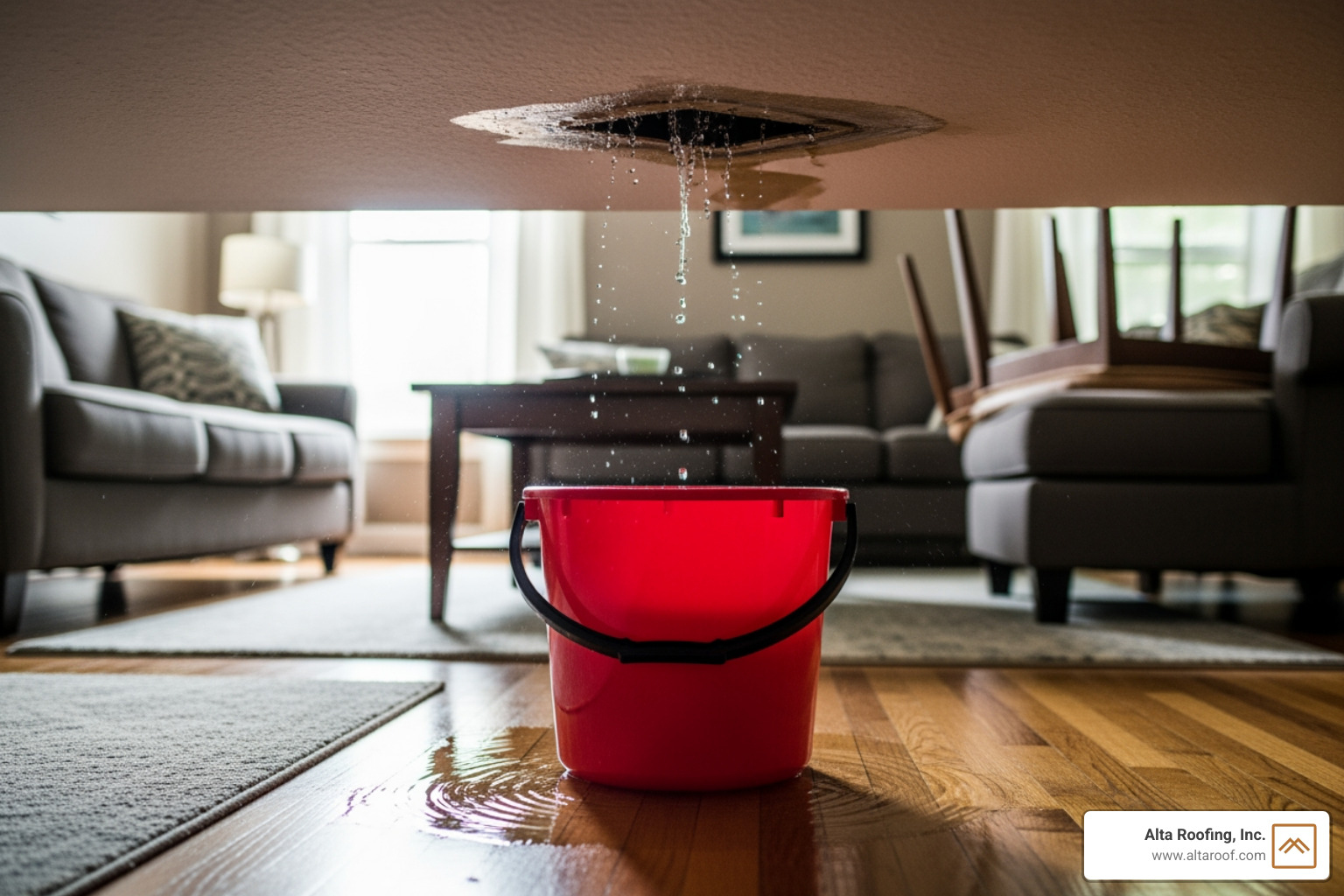
Prioritize Safety Above All Else
Your family's safety is the first priority. Roof emergencies can be dangerous, especially with active leaks or structural damage. Never attempt to inspect or repair your roof during severe weather.
Here's how to prioritize safety:
- Evacuate if Necessary: If you suspect severe structural damage, such as a significantly sagging roof or large penetration, it's safer to evacuate. If you see signs like shifted foundations or slanted walls, consult a professional engineer immediately.
- Beware of Electrical Hazards: Water and electricity are a dangerous mix. If water is leaking near outlets or light fixtures, turn off the circuit breaker for that area. Do not touch wet electrical fixtures.
- Avoid Sagging Ceilings: A water-soaked ceiling can collapse. Clear the room below any sagging or bulging spots and place a bucket underneath to catch drips.
- Stay Off the Roof: We cannot stress this enough: do not climb onto your roof. Wet or damaged surfaces are extremely slippery and unstable. Leave roof access to licensed, trained professionals. For more guidance, check out this guide to handling emergencies.
Contain Interior Damage Immediately
Once everyone is safe, mitigate interior damage to prevent water from spreading.
- Place Buckets and Containers: Position buckets or trash cans directly under active leaks to catch water.
- Protect Valuables: Move furniture, electronics, and other belongings away from affected areas. Use plastic sheeting to cover items that cannot be moved.
- Soak Up Spills: Use towels to absorb standing water. Fans or dehumidifiers can help dry the area after you've documented the initial damage.
- Channel Attic Drips: In an accessible attic, you can control leaks. Place a bucket on a piece of plywood spanning two joists. Thread a string from the leak point down into the bucket; water will follow the string, channeling drips into one spot.
These steps are about containment, not repair. You're buying time until professional help arrives.
Document Everything for Your Insurance Claim
Thorough documentation can significantly expedite your insurance claim.
- Take Photos and Videos: If it's safe, take clear photos and videos of all visible damage, both inside and out. Capture the leak source, damaged shingles, and interior water stains. Time-stamped images are particularly useful.
- Note the Details: Record the date, time, and weather conditions when the damage occurred.
- Keep Records: Maintain a log of all communications with your insurance company and roofer. Keep receipts for any temporary supplies you purchase.
Our team at Alta Roofing understands the importance of precise documentation. We provide detailed inspection reports and photo documentation to support your claim and communicate directly with your adjuster.
How to Get Professional Emergency Roof Repair Help Fast
When your roof is compromised, time is of the essence. The quicker you connect with a reliable roofing professional, the sooner your home can be secured. This section guides you through finding the right help and what to expect when you call.
Finding a Reliable 24/7 Roofing Contractor
Choosing the right contractor is a critical decision. As a Colorado-based company serving Denver, Aurora, Thornton, Lakewood, Colorado Springs, Castle Rock, and many other local communities, we understand the challenges homeowners face.
Here’s what to look for:
- 24/7 Availability: A true emergency service is available around the clock. We provide prompt, reliable 24/7 emergency roof repair services.
- Licensed and Insured: Always verify that any contractor is fully licensed and insured. This protects you and ensures they meet professional standards.
- Local Expertise: Choose a contractor familiar with Colorado's weather and building codes.
- Reputation and Reviews: Check online reviews and ask for references from any reputable company.
- Avoid "Storm Chasers": After severe weather, out-of-state contractors often appear. They may provide low-quality work or engage in unethical practices. Always choose a local, established company. We are a veteran-owned company dedicated to serving our community. You can see examples of our work on our website.
What to Expect from an Emergency Call
When you call us for an emergency roof repair, our priority is to get you help quickly.
- Prompt Response: Our team responds promptly and can often arrange a same-day or next-day inspection.
- Key Questions: Be prepared to provide your address, roof type (e.g., asphalt, tile, metal), and a description of the damage. Photos are incredibly helpful.
- Dispatch Process: Based on your information, we'll dispatch a team with the right equipment to stabilize the situation and prevent further water intrusion.
The Initial On-Site Assessment
Once our emergency crew arrives, they will:
- Inspect the Damage: Our technicians will conduct a full damage assessment, looking for both visible and hidden issues.
- Evaluate Safety: We'll evaluate the structural integrity of your roof to ensure it's safe.
- Provide Temporary Solutions: If weather prevents a full repair, we will install temporary coverings or tarps to stop active leaks.
- Deliver an Initial Report: Our team will explain the damage, outline potential repair options, and provide a quote range and timeline.
The Professional Process: From Temporary Protection to Permanent Fix
Once our team has assessed the situation, the focus shifts to protecting your home from further damage. This involves professional temporary measures, followed by expert repairs custom to your roof type.
The Critical Role of Professional Emergency Protection
When water is entering your home, the primary goal is to stop it until permanent repairs can be made. It's always safer and more effective to leave this to professionals.
- Preventing Further Damage: A professionally installed tarp protects your home's interior, insulation, and structural components from ongoing moisture, helping avoid mold and rot.
- Dangers of DIY Attempts: Getting on a damaged, wet roof is incredibly dangerous. Improper tarping can also worsen the damage. Professionals have the proper safety gear and experience.
- Professional Anchoring and Installation: Our experts know how to properly anchor tarps to withstand wind and divert water, often securing them with batten boards for a tight seal. This is far more effective than a DIY attempt. For more on proper tarping, see this resource on how to tarp a roof.
Here's a quick comparison of DIY vs. Professional Emergency Protection:
| Feature | DIY Attempts | Professional Emergency Protection |
|---|---|---|
| Safety | High risk of falls, injury, or electrical hazards. | Trained crews with safety gear, fall protection, and experience. |
| Effectiveness | Often temporary, prone to failure in adverse weather. | Securely anchored, designed to withstand weather, effectively diverts water. |
| Cost | Initial low material cost, but high risk of further damage. | Higher initial cost, but prevents costly secondary damage. |
| Insurance Acceptance | May not be fully reimbursed; could complicate claims. | Often covered by insurance; provides credible documentation. |
Emergency Repair Approaches for Different Roof Types
Each roofing material requires a specific approach for emergency roof repair.
- Asphalt Shingles: For missing or damaged shingles, we can often apply a temporary patch or use professional tarping for larger areas.
- Tile Roofs: The underlayment beneath the tiles provides the waterproofing. Walking on tiles can easily crack them. For emergencies, we focus on placing a tarp from the ridge downward to protect this crucial layer.
- Flat Roofs: For leaks on modified bitumen or asphalt roll roofing, we apply a two-part patch. For TPO or PVC roofs, a heat-welded patch is the correct long-term solution after a temporary tape patch. It's critical to address standing water on flat roofs quickly.
- Metal Roofs: Emergency repairs typically involve using specialized sealants to fix punctures or re-seal compromised seams. For larger damage, professional tarping may be necessary.
When a Full Roof Replacement Becomes Necessary
Sometimes, an emergency roof repair reveals that a full replacement is the only safe, long-term solution.
- Widespread Damage: If your roof has extensive damage from a severe storm, repairing individual sections may not be practical.
- Advanced Roof Age: If your roof is nearing the end of its typical 20-30 year lifespan, even minor damage can indicate system failure.
- Persistent Leaks: A history of recurring leaks often points to underlying issues that a simple repair won't fix.
- Compromised Structural Integrity: If the roof decking is spongy, rotting, or sagging, it suggests a deeper structural problem that requires a full replacement for safety.
- Cost-Effectiveness: Sometimes, the cost of extensive repairs can approach or exceed the cost of a new roof. We provide an honest assessment to help you decide.
Navigating Insurance and Costs for Your Emergency Repair
Dealing with an emergency roof repair is stressful enough without worrying about insurance and costs. At Alta Roofing, we specialize in making this process smooth for Colorado Springs homeowners. We act as your single point of contact, coordinating trades and guiding you through the complexities of insurance.
How Insurance Covers Emergency Roof Repair
Most homeowner's insurance policies cover sudden and accidental damage from events like hail or wind.
- Coverage for Temporary Repairs: A crucial part of most policies is coverage for "reasonable steps" taken to prevent further damage. This means the cost of professional tarping is often reimbursed by your insurance. Taking immediate action is key to fulfilling your policy's requirements.
- Permanent Fix Process: Once temporary measures are in place, we work with your insurance adjuster to assess the full scope of damage. Our team provides detailed reports, estimates, and photos to support your claim and ensure a fair assessment.
- Material Upgrades: Depending on your policy and local building codes, insurance may also cover material upgrades if required during replacement.
- Policy Specifics: Every policy is different. We encourage you to contact us after an emergency, and we can help you understand your coverage and guide you through the claims process.
Essential Documentation for a Successful Claim
To ensure a smooth insurance claim, meticulous documentation is key.
Here's a list of essential documents:
- Time-Stamped Photos and Videos: Visual evidence of interior and exterior damage, taken before cleanup (if safe).
- Professional Roofer's Inspection Report: A detailed report from us outlining the damage and recommended repairs.
- Detailed Repair Estimates: Itemized estimates for both temporary and permanent work.
- Receipts for Temporary Measures: Any expenses for emergency supplies.
- Communication Log: A record of all interactions with your insurance company.
- Moisture Readings: We can provide moisture readings to document the extent of water intrusion for your claim.
Understanding the Potential Costs
The costs of emergency roof repair vary, but understanding the factors can help you prepare.
- Emergency Protection Costs: The cost to professionally tarp a roof depends on factors like roof pitch, accessibility, and urgency, ranging from a few hundred to several thousand dollars.
- Repair Costs: The cost of permanent repairs depends on the damage extent, roofing material, and whether underlying components need replacement.
- Factors Affecting Price:
- Roof Type: Tile and metal roofs often have higher repair costs than asphalt shingles.
- Damage Extent: A small puncture is cheaper to fix than a large section of blown-off roof.
- Accessibility: Steep or multi-story roofs incur higher labor costs.
- Time of Day/Weather: Emergency services outside normal business hours may have higher rates.
- Full Replacement Costs: If a full replacement is necessary, we provide transparent pricing and work with your insurance to ensure you understand all costs involved.
Proactive Maintenance to Prevent Future Emergencies
While some roofing emergencies are unavoidable—you can't control a falling tree or a severe hailstorm—many can be prevented with regular, proactive maintenance. Think of it as your roof's annual check-up! Investing a little time and effort now can save you significant stress and money on emergency roof repair down the line.
- Schedule Regular Inspections: The key to avoiding emergencies is catching small issues before they become major problems. We recommend scheduling professional roof inspections at least once or twice a year, especially before and after Colorado's challenging storm seasons. Our experts can identify minor issues like cracked flashing, loose shingles, or deteriorating pipe boots that might otherwise go unnoticed until a leak appears.
- Keep Gutters and Drains Clear: Clogged gutters are a leading cause of roof leaks and structural stress. When gutters are blocked, water can back up, seep under shingles, and rot fascia and soffits. Ensure your gutters and downspouts are cleared at least twice annually, and especially after heavy storms or leaf fall. This ensures proper water flow away from your roof and foundation.
- Trim Overhanging Trees: Falling branches are one of the most common causes of emergency roof damage. Keeping nearby trees trimmed and removing weak or dead limbs helps prevent impact damage during strong winds or heavy snow loads. We recommend trimming branches back from the roof by at least 6 to 10 feet.
- Address Small Leaks Promptly: Even a seemingly minor leak can worsen quickly, especially during severe weather. If you notice any signs of water intrusion—even just a small water stain on your ceiling or attic—schedule prompt repairs. Addressing these small problems ensures they are fixed before they develop into major emergencies.
- Check for Warning Signs: After any significant wind event (over 40 mph), scan your yard for shingle pieces and check your roof for shiny nail heads at the ridge. These are subtle clues that your roof may have sustained damage requiring attention. Also, keep an eye out for cracked pipe boots, as older neoprene boots can split at the cone, creating a leak path.
By adopting these simple habits and utilizing our comprehensive services, you can significantly reduce the risk of a sudden roofing disaster and prolong the life of your roof.
Frequently Asked Questions about Emergency Roof Repair
We understand that when a roofing emergency strikes, you'll have a lot of questions. Here are answers to some of the most common ones we hear from Colorado homeowners.
What officially constitutes a roofing emergency?
An emergency roof repair situation is one that exposes your home's interior to the elements or compromises its structural integrity, demanding immediate attention. This includes:
- Active water intrusion: Water is actively dripping into your home.
- Significant storm damage: Large sections of missing shingles or exposed roof decking.
- Structural issues: A sagging roof deck or visible light coming through the attic.
- Penetrations: A hole in the roof from a fallen tree or other debris.
Any of these situations require immediate action to protect your home.
Is it safe to attempt a DIY patch on my roof?
No, attempting a DIY patch, especially during or after a storm, is extremely dangerous and not recommended. Here's why:
- Safety Risks: Wet or damaged roofs are incredibly slippery and unstable.
- Ineffectiveness: Most DIY attempts are temporary at best and can often worsen the damage.
- Voiding Warranties: Improper DIY repairs can void your roof's warranty.
- Insurance Complications: Your insurance company may not cover damages resulting from improper DIY repairs.
The risk of a fall or making things worse far exceeds the cost of calling a professional for emergency roof repair.
How long will a temporary roof tarp last?
A temporary roof tarp is a short-term solution. Its lifespan depends on its quality and the weather conditions it endures.
- Quality and Installation: A heavy-duty, professionally installed tarp will last much longer than a cheap one, potentially 30 to 60 days in calm conditions.
- Weather Conditions: Colorado's storms, high winds, and sun can degrade tarps and stress fasteners quickly. Any temporary cover should be checked after each storm.
A temporary measure should be replaced with a permanent repair as soon as it is safe to do so.
When is it advisable to contact a professional engineer in addition to a roofer?
While our roofing experts can assess most roof damage, a professional structural engineer is crucial in certain situations.
- Suspected Structural Compromise: Involve an engineer if you notice signs like:
- The entire structure has shifted on its foundation.
- There are broken pilings or noticeably slanted walls.
- The foundation has shifted, or floors are no longer level.
- Erosion has undermined the foundation.
- Major Load-Bearing Damage: If a large tree has damaged the underlying trusses, rafters, or load-bearing walls.
An engineer can perform a thorough evaluation to determine if the building is sound before extensive repairs begin. When in doubt about structural integrity, always call a professional engineer.
Conclusion: Secure Your Home and Peace of Mind
Facing a roofing emergency is daunting, but prompt action makes all the difference. The first hour is critical. By prioritizing safety, containing water, documenting damage, and swiftly contacting a trusted professional, you can effectively manage the situation and prevent costly secondary issues like mold and structural weakening.
As a trusted partner for Colorado homeowners, Alta Roofing, Inc. specializes in roof replacement, repairs, and storm damage restoration. We are committed to providing 24/7 emergency roof repair services. Our unique selling proposition is handling insurance claims and coordinating all necessary trades, acting as a single point of contact for homeowners throughout the Colorado Springs and Denver metro areas, including Castle Rock, Parker, and Monument.
For comprehensive storm damage restoration and expert assistance, explore our Services. We're here to help you secure your home and restore your peace of mind.
Find Your Perfect Roof: Metal Roof Installation & More in Colorado Springs
Why a Metal Roof is Your Best Defense Against Colorado's Weather
When considering a new roof for your home, metal roof installation Colorado Springs stands out as a superior choice for homeowners seeking long-term protection and value. This durable option offers peace of mind against the region's challenging weather, from intense hail and heavy snow to high winds and wildfire risks.
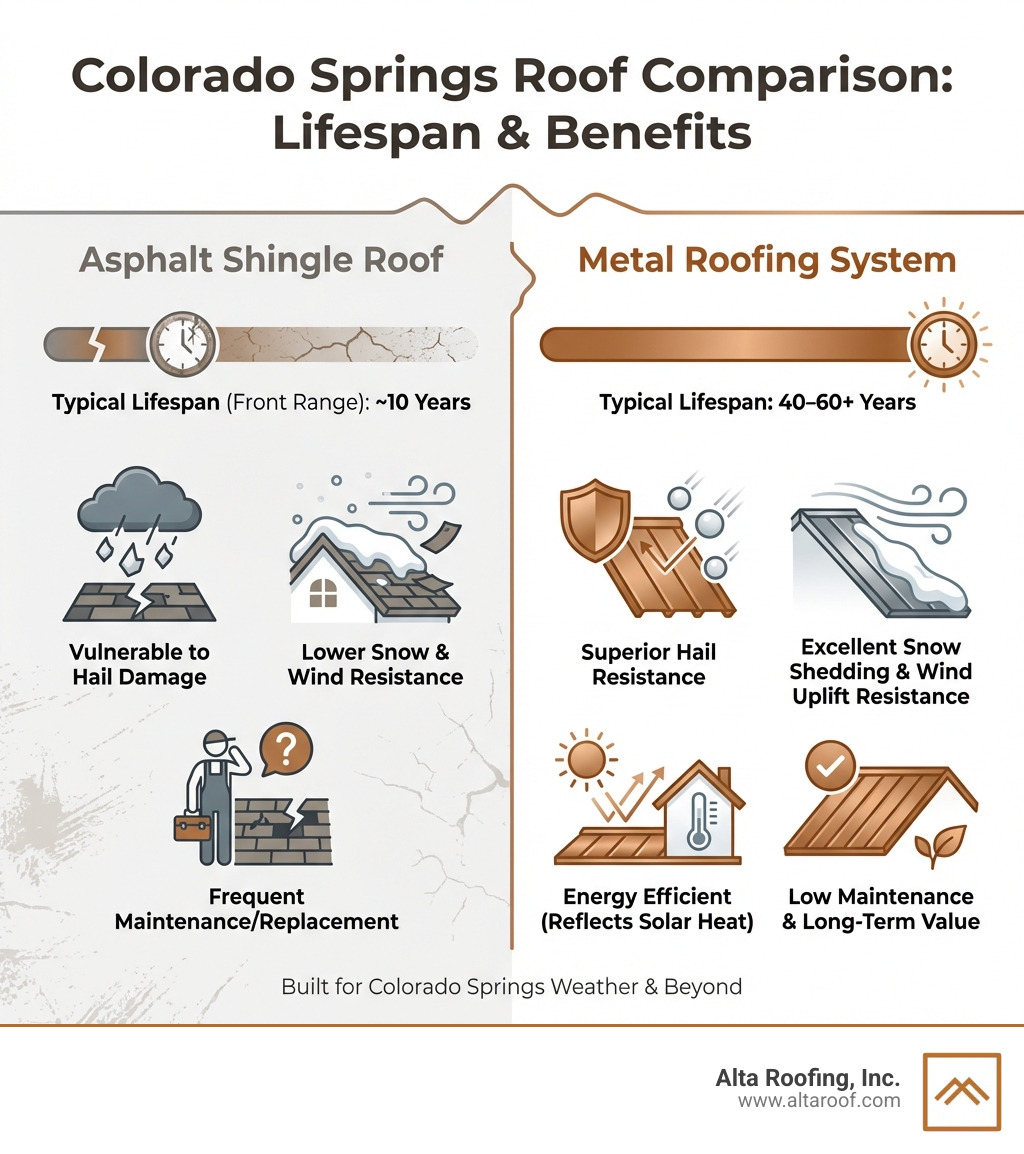
Superior Performance in the Pikes Peak Region
The unique climate of the Pikes Peak Region, with its intense UV exposure, rapid temperature shifts, and unpredictable hail, demands a robust roofing solution. Here's why metal is the ideal choice:
- Durability and Longevity: Metal roofs are built to last, with a lifespan of 40-60 years or more. This is a significant upgrade from asphalt shingles, which often need replacement in as little as 10 years in the harsh Front Range climate.
- Weather Resistance: Many metal roofing systems have a Class 4 impact rating, the highest available, offering superior protection against hail. Their smooth, interlocking panels also excel at shedding snow to prevent ice dams and can withstand high winds without damage.
- Fire Safety: With a Class A fire rating, metal roofs are non-combustible, providing a critical layer of protection for homes in wildfire-prone areas.
- Low Maintenance: Metal is resistant to rot, mold, and insects, requiring minimal upkeep over its long life.
Metal vs. Asphalt Shingles: A Long-Term Value Comparison
While the initial cost of a metal roof is higher than asphalt, it's a smarter long-term investment. The extended lifespan means you avoid the cost and hassle of multiple re-roofing projects. A metal roof can also increase your home's resale value, improve energy efficiency by reflecting solar heat, and may even lead to lower insurance premiums. When you consider the total cost of ownership, metal roofing is often the more economical choice over time.
For more information on how we can help protect your home from the elements, including comprehensive solutions for storm damage, please visit our Services page.
Exploring Your Metal Roofing Options: Materials, Styles, and Costs

One of the most exciting aspects of choosing a metal roof is the sheer variety available. Gone are the days of a single, industrial look. Today, an incredible array of materials, styles, and colors allows you to perfectly match your home's architecture and your personal aesthetic, from sleek and modern to classic and traditional.
Common Metal Roofing Materials
When considering metal roof installation Colorado Springs, understanding the different materials is key to making the best choice for your home and budget. Here's a comparison of some of the most common options we work with. For a deeper dive into material specifications, resources like Metal Roofing Solutions can be helpful.
| Material | Cost (per sq ft) | Lifespan (Years) | Key Characteristics |
|---|---|---|---|
| Steel (Galvanized/Galvalume) | $6 - $12 | 50+ | The most popular choice. It's strong, durable, and relatively affordable. Coated with zinc (Galvanized) or a zinc-aluminum alloy (Galvalume) for excellent corrosion resistance. |
| Aluminum | $9 - $16 | 50+ | Extremely lightweight and highly resistant to rust and corrosion. A great choice for longevity, though softer than steel. |
| Copper | $20 - $35+ | 100+ | A premium, high-end choice that develops a beautiful green patina over time. Extremely durable but also the most expensive option. |
| Stone-Coated Steel | $8 - $15 | 50+ | Combines the strength of steel with the look of traditional shingles, tiles, or shakes. A layer of stone chips provides added durability and texture. |
Popular Styles for Colorado Springs Homes
Modern metal roofing comes in a wide range of styles to complement any architectural design:
- Standing Seam: Features clean, vertical lines and a concealed fastener system for a sleek, modern look and superior weather protection.
- Metal Shingles, Shakes, and Tiles: Mimic the appearance of classic materials like asphalt, wood, or clay while providing the longevity and strength of metal.
- Corrugated Panels: Offer a more rustic or industrial aesthetic and are known for their strength and affordability.
Understanding the Cost of a Metal Roof
The cost of a metal roof installation in Colorado Springs varies based on several factors. While the initial investment is higher than for asphalt shingles, the long-term value is best.
- Material Choice: Prices range from more affordable steel options to premium materials like copper.
- Roof Complexity: The pitch, size, and complexity of your roof (e.g., number of gables, dormers, and skylights) will impact labor costs.
- Labor and Installation: Professional installation is key to a long-lasting roof. The cost will reflect the expertise and time required.
On average, you can expect a new metal roof to cost between $8 to $20 per square foot installed, but this can vary. The best way to get an accurate price is to get a detailed estimate.
Your Guide to Metal Roof Installation Colorado Springs
Understanding the installation process can help you feel confident in your investment. A professional installation is critical to ensuring your new metal roof performs as expected for decades to come.
The Installation Process from Start to Finish
A typical metal roof installation follows a clear, systematic process:
- Initial Inspection & Consultation: We assess your current roof, discuss your material and style preferences, and provide a detailed, transparent estimate.
- Tear-Off (if necessary): The old roofing material is removed and disposed of properly, and the underlying roof deck is inspected for any damage.
- Underlayment Installation: A high-quality, water-resistant underlayment is installed to provide a secondary barrier against moisture.
- Panel or Shingle Placement: The metal panels or shingles are carefully installed, ensuring proper alignment and fastening for maximum wind and weather resistance.
- Flashing and Sealing: All vents, chimneys, and valleys are properly flashed and sealed to prevent leaks.
- Final Inspection and Cleanup: We conduct a thorough final inspection and ensure your property is left clean and free of debris.
Lifespan and Warranty
One of the biggest advantages of a metal roof is its incredible longevity. With professional installation, you can expect your roof to last 50 years or more. This investment is protected by two types of warranties:
- Manufacturer's Warranty: This covers the integrity of the metal panels and their finish against defects like chipping, cracking, or fading.
- Workmanship Warranty: This is provided by the installer (like Alta Roofing) and covers the quality of the installation itself. A 5-year workmanship warranty is a good industry standard.
Low-Maintenance Living
Metal roofs are famously low-maintenance. Unlike asphalt, they don't require frequent repairs or replacement of individual shingles. We recommend a simple annual inspection to:
- Check and clear gutters and downspouts.
- Ensure sealants around vents and flashing are intact.
- Remove any accumulated debris from the roof surface.
This minimal upkeep helps ensure your roof remains in peak condition for its entire lifespan.
Beyond the Basics: Energy Efficiency, Solar, and Common Concerns
Beyond durability, metal roofs offer modern advantages that make them an even smarter choice for today's homeowner.
Are Metal Roofs Energy-Efficient?
Yes, highly. Metal roofs are considered "cool roofs" because they reflect a significant amount of the sun's heat instead of absorbing it. This can reduce your cooling costs by up to 25%, a major benefit during hot Colorado summers. In winter, the added insulation can also help retain heat. Furthermore, metal roofing is often made from recycled materials and is 100% recyclable at the end of its life, making it an environmentally friendly option.
Can Solar Panels Be Installed on a Metal Roof?
Absolutely. In fact, a standing seam metal roof is one of the best platforms for a solar panel system. Special clamps can attach the solar array to the standing seams of the roof without any penetrations. This eliminates the risk of leaks and makes installation simpler and more secure. The long lifespan of a metal roof also means it will likely outlast the solar panels themselves, so you won't have to remove and reinstall them for a roof replacement.
For more information on how we can help protect your home from the elements, including comprehensive solutions for storm damage, please visit our Services page.
Addressing Common Concerns
- Cost: While the upfront cost is higher than asphalt, a metal roof's longevity makes it a more cost-effective investment over the life of your home.
- Noise: This is a common myth. With modern installation techniques and proper insulation, a metal roof is no louder than any other type of roof during a rain or hail storm.
- Denting: While extreme hail can dent any roof, modern metal roofing is incredibly resilient. Many products carry a Class 4 impact resistance rating, the highest available, and are designed to withstand significant hail without compromising the roof's integrity.
How to Choose the Right Metal Roofing Contractor
Choosing the right contractor is just as important as choosing the right material. A quality installation is key to the longevity and performance of your metal roof. Look for a company that is not just a roofer, but a partner in protecting your home.
Key Qualities of a Reputable Roofer
When vetting potential contractors for your metal roof installation in Colorado Springs, ensure they have:
- Proper Licensing and Insurance: This is non-negotiable and protects you from liability.
- Local Experience: A contractor familiar with Colorado's climate, building codes, and common weather-related issues is invaluable.
- Positive Reviews and References: Check online reviews and ask for references from previous local customers.
- Transparent Estimates: You should receive a detailed, written estimate that clearly outlines all costs, materials, and the scope of work.
- Insurance Claim Expertise: In a hail-prone area like Colorado Springs, a roofer who can expertly steer the insurance claims process is a major asset. At Alta Roofing, we specialize in storm damage restoration and work directly with your insurance company to ensure your claim is handled correctly.
Questions to Ask Your Contractor
Before signing a contract, be sure to ask:
- Do you specialize in metal roofing?
- Can you provide local references for recent metal roofing projects?
- What warranties do you offer on your workmanship?
- How do you handle unexpected issues or damage found during the installation?
- Are you experienced with handling insurance claims for storm damage?
Your Lifetime Roofing Solution Awaits
A metal roof is a smart, durable, and beautiful investment for any Colorado Springs homeowner, offering unparalleled protection and long-term value. It's a decision that pays for itself through longevity, energy savings, and peace of mind. Ready to upgrade your home's defense and curb appeal?
Our team at Alta Roofing is here to guide you through every step, from material selection to expert installation and navigating insurance claims. We are committed to providing a seamless experience and a roof that will protect your home for a lifetime.
Contact us today to schedule your free inspection and discover the benefits of a metal roof!
Revamp Your Roost: Creative Exterior Home Renovation Ideas
Why Your Home's Exterior Deserves a Second Look

Exterior home renovations can transform your property, delivering impressive returns on investment. The right upgrades dramatically boost curb appeal, increase property value, and improve energy efficiency, whether you're recovering from storm damage or simply refreshing your home's look.
Top Exterior Renovation Benefits:
- Increased Home Value - Well-planned renovations can boost perceived home value by up to 17%
- High ROI - Garage door replacements recoup nearly 96% of costs; entry doors can return up to 119%
- Energy Savings - New windows reduce energy costs by up to 30%
- Improved Security - Smart outdoor lighting can increase home security by 300%
- Better Protection - Quality siding and roofing protect against Colorado's harsh weather and storms
For Colorado homeowners, exterior renovations are essential protection against the state's unpredictable weather—from hailstorms to intense UV exposure. A damaged roof or aging siding can lead to water intrusion, mold growth, and costly structural repairs if left unaddressed.
The most impactful projects typically include roof replacement (57-60% ROI), siding upgrades (up to 88% cost recovery), and new doors (garage doors at 96% ROI, entry doors up to 119%). These improvements make your home more attractive to future buyers, reduce utility bills, and prevent expensive emergency repairs.
As a founder and investor in the construction industry, I've seen how strategic exterior home renovations protect investments and transform properties, especially for homeowners navigating storm damage recovery and insurance claims.
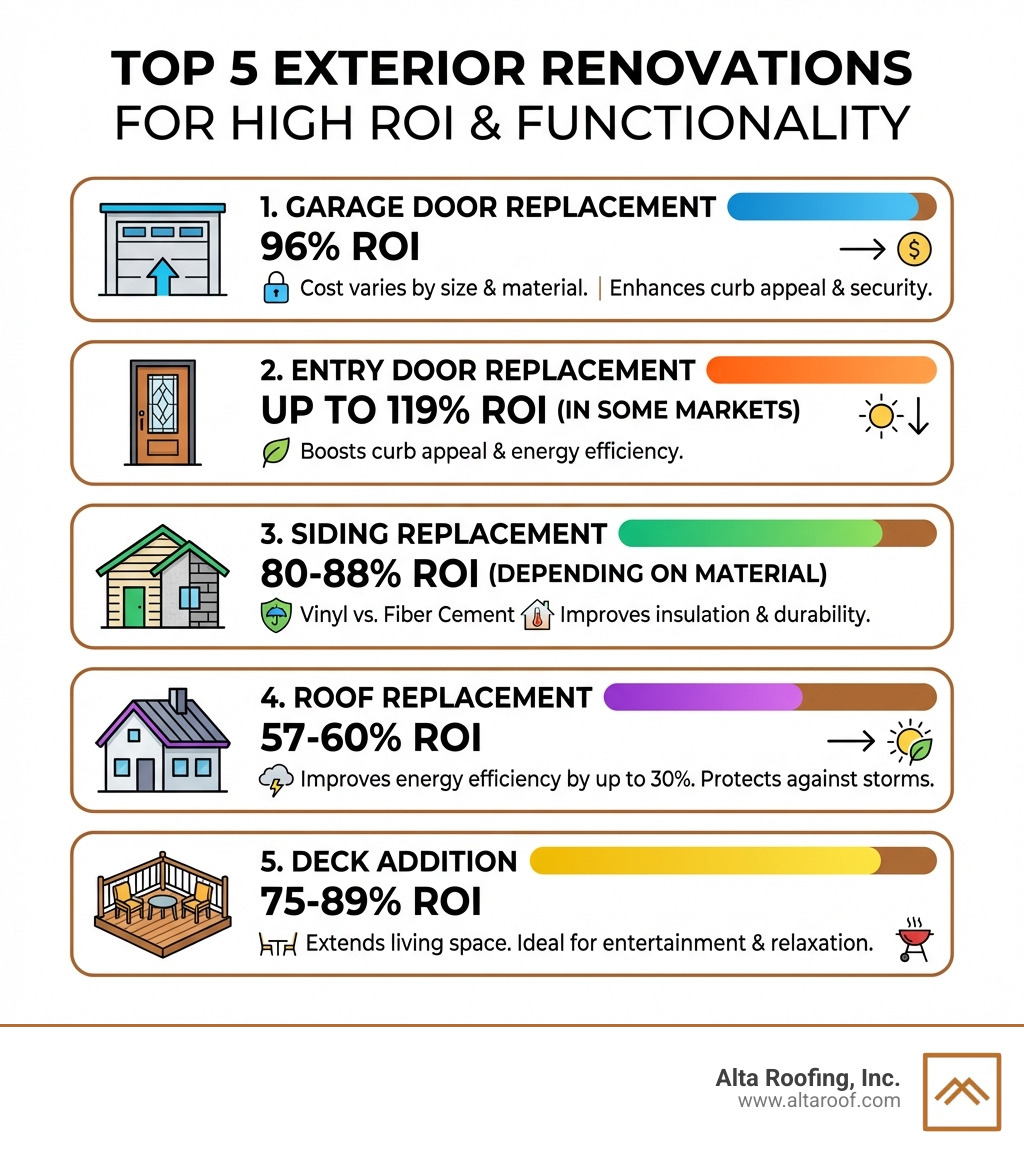
High-Impact Renovations for Maximum Home Value
This section covers high-impact exterior home renovations known for providing the best financial returns. These projects offer impressive ROI, significantly increase your home's value, and protect your biggest asset.
Upgrade Your Siding
New siding is one of the most impactful exterior home renovations, drastically changing your home's appearance, protecting it from the elements, and offering a substantial ROI. A fresh exterior can make your Aurora, Colorado home look brand new.
When considering new siding, you have several excellent material choices:
- Fiber Cement Siding: This material is highly praised for its durability and aesthetic versatility. It's often cited as a top way to increase resale value, with 91% of builders agreeing it boosts appraisal value. Fiber cement siding can deliver an impressive ROI of up to 88.4%. It’s a fantastic option for homes in Colorado Springs or Castle Rock, offering robust protection against our diverse weather.
- Vinyl Siding: As America’s most popular exterior cladding, vinyl siding is a versatile and cost-effective choice available in many colors. It can provide an ROI of about 80.2%. Modern insulated vinyl siding also offers significant energy efficiency benefits, helping to keep your home cozy in winter and cool in summer.
A siding upgrade can recover up to 88% of its cost at resale, making it a smart financial decision. New siding can last for 30 years or more with proper care, providing long-term peace of mind. For homeowners in areas like Denver or Lakewood, choosing the right siding is a crucial step in any exterior home renovation.
If you're ready to explore your options and find the perfect siding solution for your home, check out More info about our siding services.
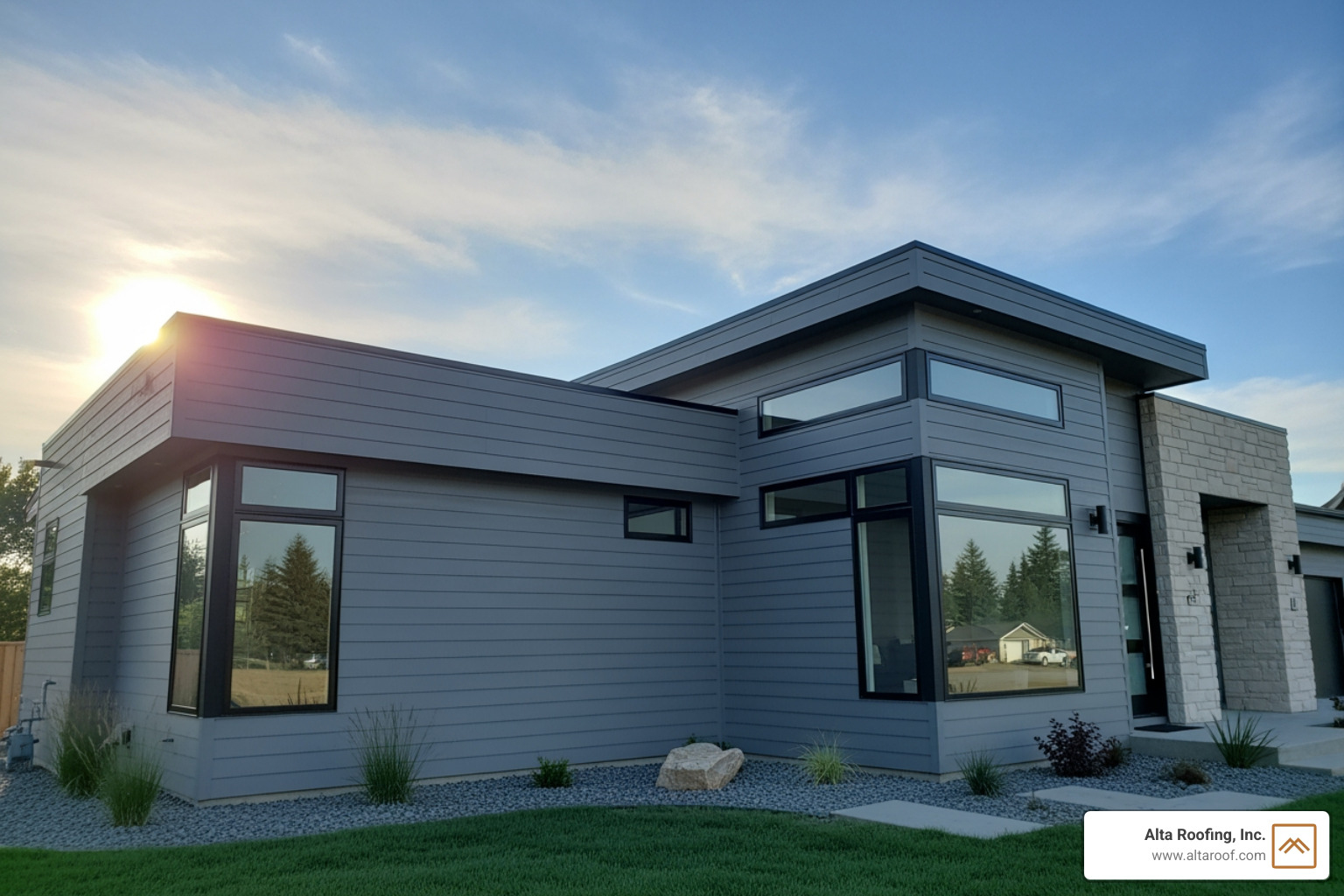
Replace Your Roof
Replacing your roof is a significant but critical investment, especially for Colorado homes facing hail, strong winds, and heavy snow. A new roof offers a solid return by improving energy efficiency, enhancing your home’s appearance, and ensuring safe, comfortable living conditions.
A new roof can provide a 57-60% ROI. Beyond direct resale value, a properly insulated and sealed roof can cut heating and cooling costs by up to 30%, paying for itself over time through utility savings.
For homeowners in Fountain or Monument, your roof is your first line of defense. If your current roof is missing shingles, showing wear, or leaking, delaying replacement can lead to costly water damage, mold, and structural issues. We’ve seen how wind damage, often overlooked, can jeopardize a home’s structure if not addressed promptly.
Common roofing materials we work with include:
- Asphalt Shingles: A popular and cost-effective choice, modern asphalt shingles offer good durability and a wide range of styles. High-quality asphalt shingle roofs can last for 30 years or more.
- Metal Roofing: Known for its exceptional longevity, resistance to extreme weather (including hail and high winds), and energy efficiency, metal roofing is a fantastic option for many Colorado homes.
The average cost for a roof replacement on an average-sized home is about $11,500. This investment protects your home and makes it more appealing to potential buyers. If you're wondering if it's time for a new roof, we have a helpful guide on How to Know When It's Time to Replace Your Roof.
Install New Doors (Entry & Garage)
Don't underestimate the power of new doors in exterior home renovations. They are a worthwhile investment, offering immediate benefits for curb appeal, energy efficiency, and security.
- Entry Doors: Your front door is your home's first impression. A new front door can provide an astounding ROI of up to 119% in some markets, making it one of the highest-value exterior home renovations. A modern, energy-efficient entry door can reduce drafts and save on utility bills. Steel and fiberglass doors are popular choices for security and insulation, changing a tired entryway into a grand statement. If you're considering this upgrade, check out why it's a worthwhile investment.
- Garage Doors: A new garage door is another high-impact renovation. It can recoup nearly 96% of its cost at resale, making it an incredibly smart investment. Modern garage doors come in various styles and materials, allowing you to integrate them with your home's design. A new garage door also improves functionality, security, and insulation.
For homeowners in Arvada, Golden, or Highlands Ranch, upgrading your entry and garage doors is a quick way to refresh your home's look and add significant value.
Aesthetic Upgrades for Curb Appeal and Enjoyment
While ROI is important, some exterior home renovations are about making your home more beautiful and enjoyable. These projects offer immense personal satisfaction and significantly boost curb appeal, even if they don't have the highest financial return.
Create Outdoor Living Spaces with Decks & Patios
Creating or improving outdoor living spaces like decks and patios is a fantastic way to extend your home's usable area in Littleton or Lone Tree. It provides more room for relaxation and entertaining while enjoying Colorado's beautiful weather.
- Decks: A new deck can recoup up to 75% of its cost in resale value. An average wood deck costs around $16,900 and offers an 89% return. Materials like treated wood or low-maintenance composite decking stand up well to Colorado’s sun and snow.
- Patios: Patios are another excellent option for creating inviting outdoor zones. The average cost of a new patio is about $10,500, and it can generate an impressive 95% ROI. Material choices like flagstone or pavers allow for unique designs that complement your home's style.
Beyond financial returns, new decks and patios consistently receive high "joy scores" from homeowners, indicating the immense personal satisfaction they bring. It's hard to put a price on hosting a barbecue or simply unwinding outdoors.

Refresh with Paint, Windows, and Landscaping
A few strategic updates can revitalize your home's exterior without a full overhaul. These exterior home renovations improve both visual appeal and functionality.
- Exterior Paint: A fresh coat of paint can make an older home look new. For homes in Elizabeth or Woodland Park, a new color palette transforms the facade, protects the siding, and boosts curb appeal. High-quality, weather-resistant paint is crucial for longevity in our Colorado climate.
- Window Replacement: Old, inefficient windows are an eyesore and a drain on your energy bills. New windows can reduce energy costs by up to 30% and recover approximately 70% of their cost in added home value. According to Remodeling magazine’s annual Cost vs. Value report, replacing windows is a wise investment that provides comfort and savings year-round.
- Landscaping: A well-maintained yard improves exterior appeal and can increase property value by up to 17%. Refreshing your landscaping can be as simple as planting new grass and flowers or repainting a fence. For homes in Centennial or Englewood, thoughtful landscaping creates an inviting atmosphere.
These updates offer a powerful way to improve your home's aesthetic and functional appeal.
Improve Security and Ambiance with Outdoor Lighting
Outdoor lighting is an underestimated part of exterior home renovations. It improves curb appeal while dramatically improving safety and security.
Well-placed outdoor lighting makes your home more inviting by highlighting architecture and landscaping. Homes with good outdoor lighting are less likely to be targeted by burglars, and smart lighting systems can increase home security by 300%.
Consider incorporating:
- Motion-activated floodlights: Deters unwanted visitors near entry points.
- Pathway lights: Illuminate walkways to prevent trips and falls.
- Upgraded porch and exterior sconces: Modern fixtures can update your home's look and provide a welcoming glow.
- Smart lighting systems: Allow remote control and scheduling for unparalleled peace of mind.
For homeowners in Castle Pines or Monument, investing in proper outdoor lighting is a bright idea!
Planning Your Exterior Home Renovations Project
A successful project starts with a solid plan. Prioritizing your budget, timeline, and resources ensures your exterior home renovations go smoothly.
How to Prioritize Exterior Home Renovations
Exterior home renovations can feel overwhelming. A clear prioritization strategy helps you tackle projects effectively. Consider these key factors:
- Budgeting: Be realistic about your budget. Gather project estimates and include a contingency fund. Remember to account for demolition, prep work ($4-$17/sq ft), and permits ($460-$2,860).
- Needs vs. Wants: Prioritize needs (protection, safety) over wants (aesthetics). A leaking roof in Aurora, for example, must be fixed before building a new patio. Addressing critical issues first prevents costlier future repairs.
- Assessing Home Condition: Thoroughly inspect your home's exterior for issues like damaged shingles, cracked siding, or drafty windows. Early identification prevents escalation. In Colorado, this includes assessing for subtle storm damage.
- Long-Term Value: Consider each project's ROI. Some renovations offer immediate aesthetic appeal, while others, like siding and door replacements, provide greater long-term financial benefits and are smart investments for resale.
- Phasing Projects: You don't have to do everything at once. Breaking down large exterior home renovations into manageable phases makes them more affordable and less disruptive. For example, replace your roof one year and the siding the next.
By thoughtfully prioritizing, you can ensure your renovation efforts are both impactful and financially sound.
Full Renovation vs. Minor Repairs
Homeowners often debate whether to repair or fully renovate. The answer depends on the extent of damage, component age, and your long-term goals.
- When to Repair: Minor repairs are advisable for isolated, relatively new issues that don't compromise the system's integrity. Examples include replacing a few missing shingles in Parker or fixing a small section of damaged siding. Repairs are cheaper short-term and prevent immediate problems from worsening.
- When to Replace/Renovate: A full renovation is necessary when components are aging, extensively damaged, or failing. If your roof has widespread hail damage or your siding is cracked and faded, a full replacement offers better long-term value. While remodeling costs more upfront, it prevents future repairs, improves energy efficiency, and boosts curb appeal. If your roof is over 20 years old, a full replacement is usually the smarter move, especially after storm damage in Colorado, where insurance may cover full replacements.
Remodeling offers better long-term value and is an investment in your home’s future safety, efficiency, and appeal.
DIY vs. Hiring a Professional Contractor
Deciding between DIY and hiring a professional for exterior home renovations is a critical choice, weighing cost, complexity, safety, and desired outcome.
| Project Type | DIY Considerations | Professional Contractor Considerations |
|---|---|---|
| Roofing | Not recommended for DIY. High complexity, safety risks (falls), specialized tools, permits often required, warranty issues, insurance claim complexity. | Highly Recommended. Expertise in local codes (e.g., Colorado wind/hail standards), safety equipment, proper material installation, insurance claim handling, warranties, access to bulk materials. |
| Siding | Possible for small sections or simple materials like vinyl with proper instruction. Requires precision, specialized tools, and understanding of flashing/weatherproofing. | Expertise in various materials (fiber cement, vinyl), proper installation for weather protection, efficiency, quality finish, permits, insurance. |
| Painting | Feasible for many homeowners. Requires prep (cleaning, scraping), quality paint, proper technique. Time-consuming for large homes. | Professional finish, efficiency, proper surface preparation, high-quality durable paints suitable for Colorado climate, safety for high areas. |
| Windows/Doors | Minor cosmetic fixes. Full replacement involves structural integrity, sealing, energy efficiency, and proper installation to avoid drafts. | Precision installation, ensuring energy efficiency, proper sealing, managing structural adjustments, warranty, disposal of old materials. |
| Landscaping | Many tasks (planting flowers, basic gardening, fence painting) are great for DIY. Large projects (hardscaping, grading, irrigation) can be complex. | Landscape design, heavy equipment for hardscaping, expert knowledge of plants suitable for Colorado, drainage solutions, efficient project completion. |
Project Complexity & Safety: Complex exterior home renovations like roofing and siding involve significant safety risks and require specialized knowledge. Working with electricity for outdoor lighting is best left to an electrician.
Permits & Insurance: Most major exterior home renovations require permits in cities like Denver or Colorado Springs. Professionals are familiar with these requirements and carry liability insurance, protecting you from accidents.
Access to Materials & Expertise: Professional remodelers often get bulk pricing on materials and bring a wealth of experience, identifying hidden issues a DIYer might miss. Our expertise at Alta Roofing includes navigating complex insurance claims after storm damage, acting as a single point of contact for homeowners in our Colorado service areas. This means you don't have to juggle multiple contractors or worry about the claims process.
For anything beyond minor cosmetic fixes, hiring a professional contractor ensures the job is done safely, correctly, and efficiently, protecting your investment.
Frequently Asked Questions about Exterior Renovations
Here are answers to common questions about exterior home renovations.
Which exterior renovation adds the most value?
To boost property value, focus on exterior home renovations that consistently deliver high ROI. Based on industry reports and our experience, these projects top the list:
- Garage Door Replacement: Often tops the list, recouping nearly 96% of its cost.
- Front Door Replacement: A smart investment, providing an ROI of up to 119% in some markets.
- Siding Replacement: A high-impact renovation that can recoup up to 88% of its cost. Fiber cement siding (88.4% ROI) and vinyl siding (80.2% ROI) are both excellent choices.
- Roof Replacement: A crucial investment that can return up to 60% in resale value while protecting your home from Colorado's weather.
- Window Replacement: Can reduce energy costs by up to 30% and recover approximately 70% of their cost.
- Deck or Patio Addition: A new patio can generate a 95% ROI, while a wood deck can offer an 89% return.
Local market factors in areas like Denver or Colorado Springs can influence these percentages, but these key renovations generally provide the best value.
How much do exterior renovations typically cost?
The cost of exterior home renovations varies based on project scope, materials, home size, and labor rates. Here are some general industry averages, noting that costs in Colorado may differ:
- Roofing Costs: Averages about $11,500 for an average-sized home, depending on material and complexity.
- Siding Costs: Typically ranges between $8,000 and $26,000 for a 2,000-square-foot house.
- Window Costs: Varies by the number of windows, type, and energy efficiency. New windows recover about 70% of their cost.
- Deck and Patio Costs: A new patio averages around $10,500, while a new wood deck averages about $16,900.
- Additional Costs: Don't forget demolition/prep ($4-$17 per sq ft) and permit fees ($460-$2,860).
High-quality, durable materials suited to Colorado's climate cost more upfront but offer better longevity and long-term value. Always get detailed quotes from reputable local contractors in Lakewood, Thornton, or Castle Rock to ensure accuracy.
How do I choose the right materials for my climate?
Choosing the right materials is paramount for exterior home renovations in Colorado's challenging climate. From intense UV exposure and heat to heavy snow, hail, and high winds, your materials must be durable enough to withstand these conditions.
Here are key considerations:
- Durability and Storm Resistance: For roofing, impact-resistant asphalt shingles or metal are excellent choices against hail and high winds. For siding, durable fiber cement is resistant to impact, rot, and pests.
- Maintenance Needs: Consider your willingness for upkeep. Composite decking and vinyl siding are low-maintenance, while natural wood requires regular staining or painting.
- UV Protection: At Colorado's high altitude, UV-resistant materials are essential to maintain color and integrity.
- Energy Efficiency: Insulated materials like vinyl siding, energy-efficient windows, and sealed roofing systems reduce energy bills.
- Freeze-Thaw Cycle Resistance: Materials must withstand repeated freezing and thawing without cracking. This applies to concrete, masonry, and siding.
Consult with experienced local contractors in Manitou Springs or Woodland Park who understand the Colorado climate. They can guide you toward materials that offer the best protection and performance.
Begin Your Exterior Change
Exterior home renovations are strategic investments in your property's future. The benefits are clear, from boosting curb appeal and home value to enhancing safety and energy efficiency. Careful planning of your budget, priorities, and material choices for our Colorado climate is key to success.
Whether you're upgrading siding, replacing a roof, or creating an outdoor living space, the right choices can transform your home.
For Colorado homeowners dealing with storm damage or planning a major upgrade, working with a single, trusted contractor is crucial. We handle insurance claims and coordinate all trades, acting as your single point of contact. This ensures a smoother, less stressful renovation process.
Ready to revitalize your home's exterior? Explore our comprehensive exterior services to get started.
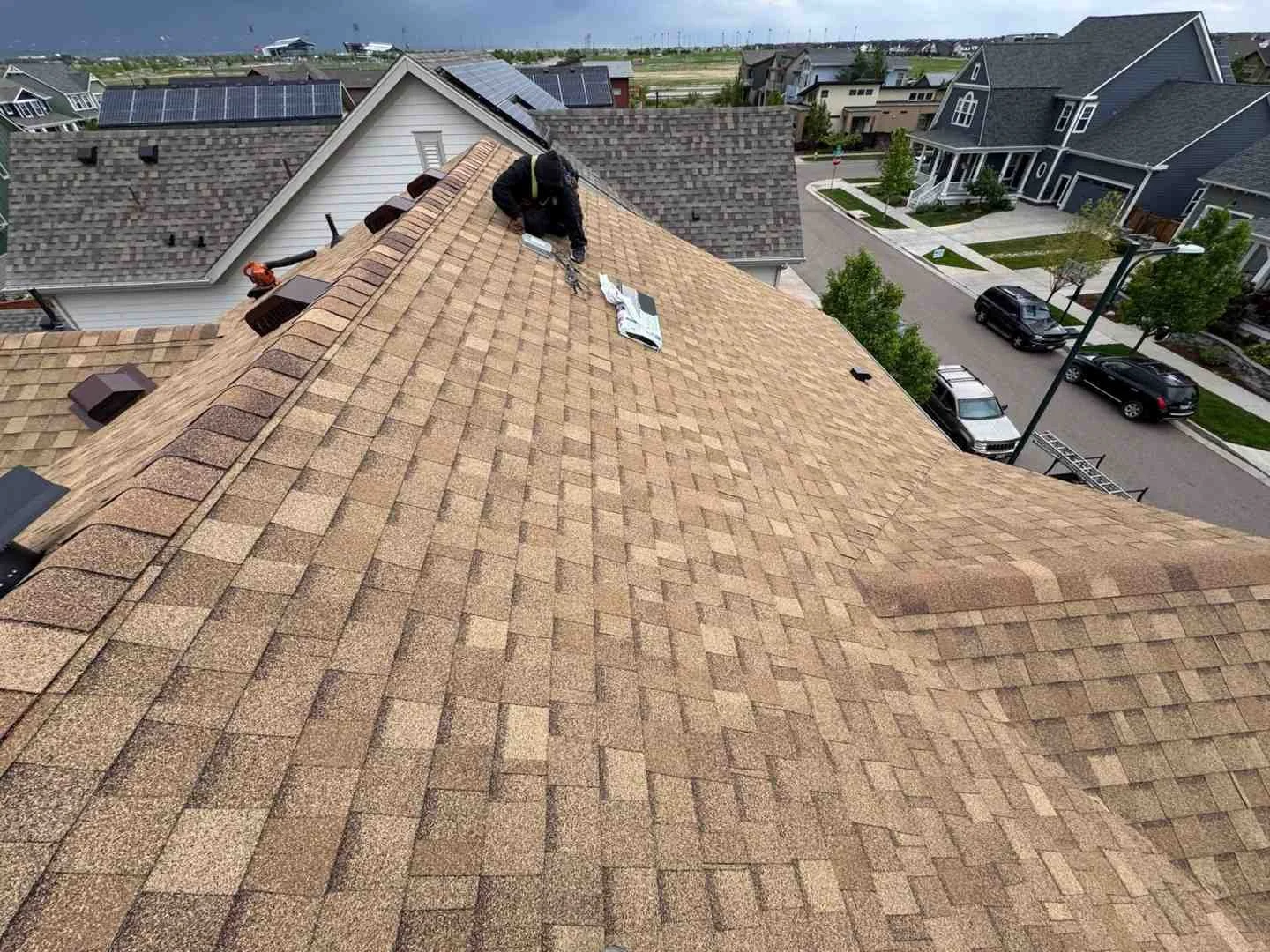
Shingle Shockers: Understanding Roof Replacement Costs in Colorado
What's the Real Cost of a New Roof in Colorado?

Roof replacement cost estimate in Colorado typically ranges from $7,000 to $14,500 for most homes, though the final price depends heavily on your specific situation. Here's what you need to know right away:
- National Average: $11,000
- Colorado Range: $10,000 to $50,000+ depending on size and materials
- Typical 2,000 sq. ft. Home: $9,000 to $13,000 for asphalt shingles
- Cost Breakdown: 60% labor, 40% materials
- Additional Costs: Permits ($500-$2,000), tear-off ($1,500-$4,000), disposal fees
Replacing the roof is probably the house renovation project that homeowners most dread. And with good reason: It's one of the most expensive home improvements you'll face, and the price can vary wildly based on factors you might not even know to consider.
Why do estimates vary so much? The difference between a $7,000 and a $50,000 roof isn't just about square footage. Your roof's pitch, complexity, the materials you choose, and even Colorado's unique climate challenges all play a role. A steep, multi-valley roof with skylights in Denver will cost significantly more than a simple gable roof in Colorado Springs.
Colorado-specific factors also drive up costs. Higher elevation means more intense UV exposure, which affects material longevity. Hail damage is a major concern across the Front Range. Snow load requirements mean stronger materials and specialized installation. And labor rates in metro areas like Denver run higher than in smaller towns.
The good news? Understanding these variables puts you in control. When you know what drives the cost, you can make smart decisions about materials, timing, and contractors. You can spot when a quote is missing important items. And you'll know if you're getting a fair price or being overcharged.
As Barry Goers, I've spent years helping Colorado homeowners steer major exterior projects through Tarben Ventures and Alta Roofing, Inc. Understanding a roof replacement cost estimate is critical to making informed decisions about protecting your home and managing your investment effectively.
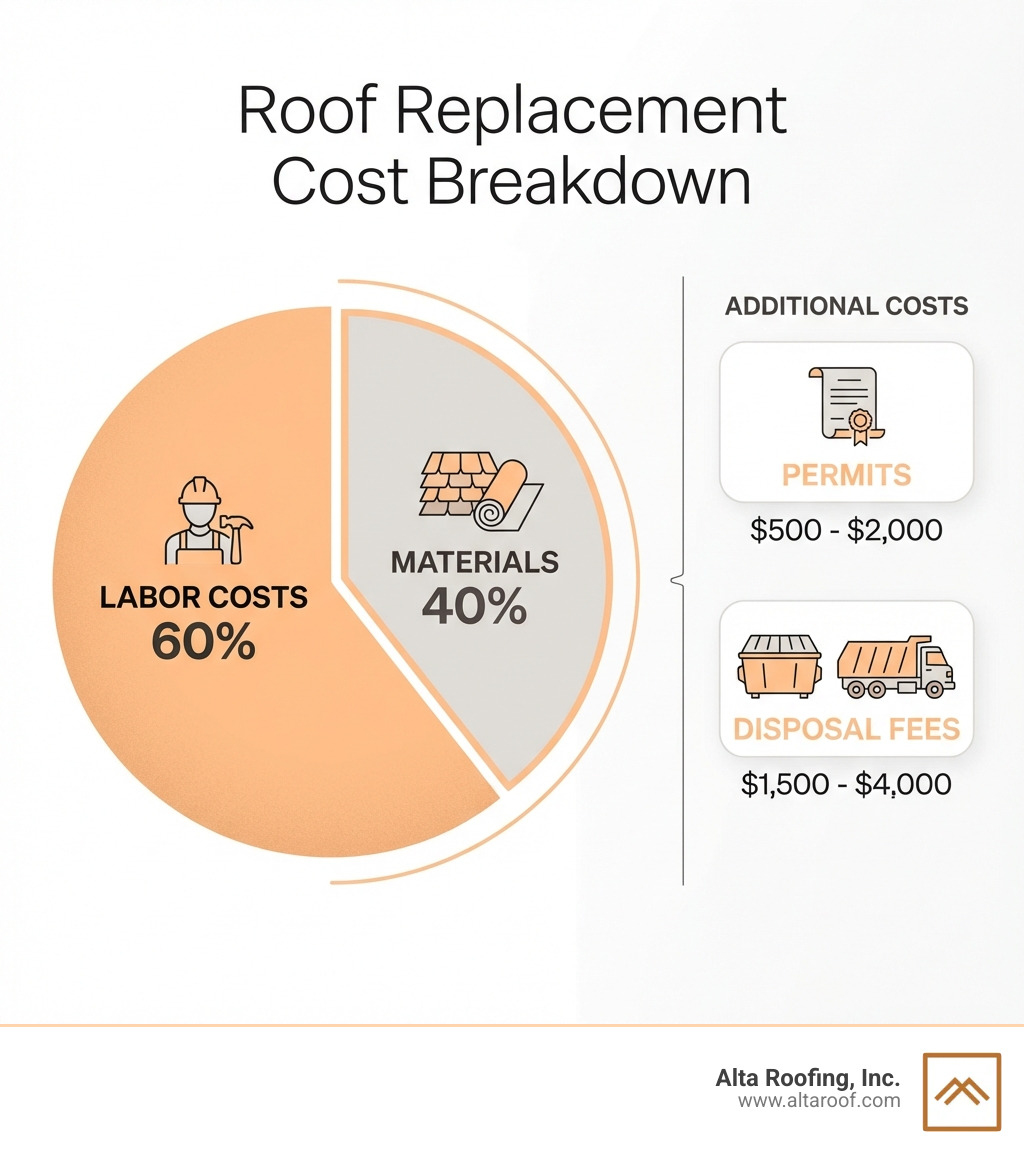
The national average cost to replace a roof in the U.S. is about $11,000 in 2026, with most homeowners spending between $7,000 and $14,500. However, for a typical 1,700 square foot asphalt shingle roof, you might expect to pay between $6,000 to $9,000. These figures are just averages, and as we'll explore, the cost for your home in Colorado can fluctuate significantly. For instance, while a simple roof might start around $5,000, complex or high-end projects, especially in our Colorado climate, can easily exceed $25,000, or even $50,000 plus.
The cost of a new roof is influenced by a myriad of factors, from the materials chosen to the complexity of your roof's design. This is why understand what goes into your Understanding roof costs and why different estimates might vary. For homeowners in our service areas like Denver, Aurora, Colorado Springs, and Castle Rock, local conditions and labor markets will play a significant role in your final price. Prices tend to be higher in more metropolitan areas or places with a higher cost of living.
Breaking Down Your Roof Replacement Cost Estimate
When we provide a roof replacement cost estimate, we're essentially looking at two major components: the materials needed to cover and protect your home, and the labor required to install them. These two variables account for the vast majority of your total expense, with materials typically making up about 40% and labor a significant 60%.
How Different Materials Affect Your Roof Replacement Cost Estimate
The type of roofing material you choose is one of the most impactful decisions you'll make when considering a roof replacement. It directly affects the upfront cost, the installation time, and the long-term durability and aesthetic of your home.
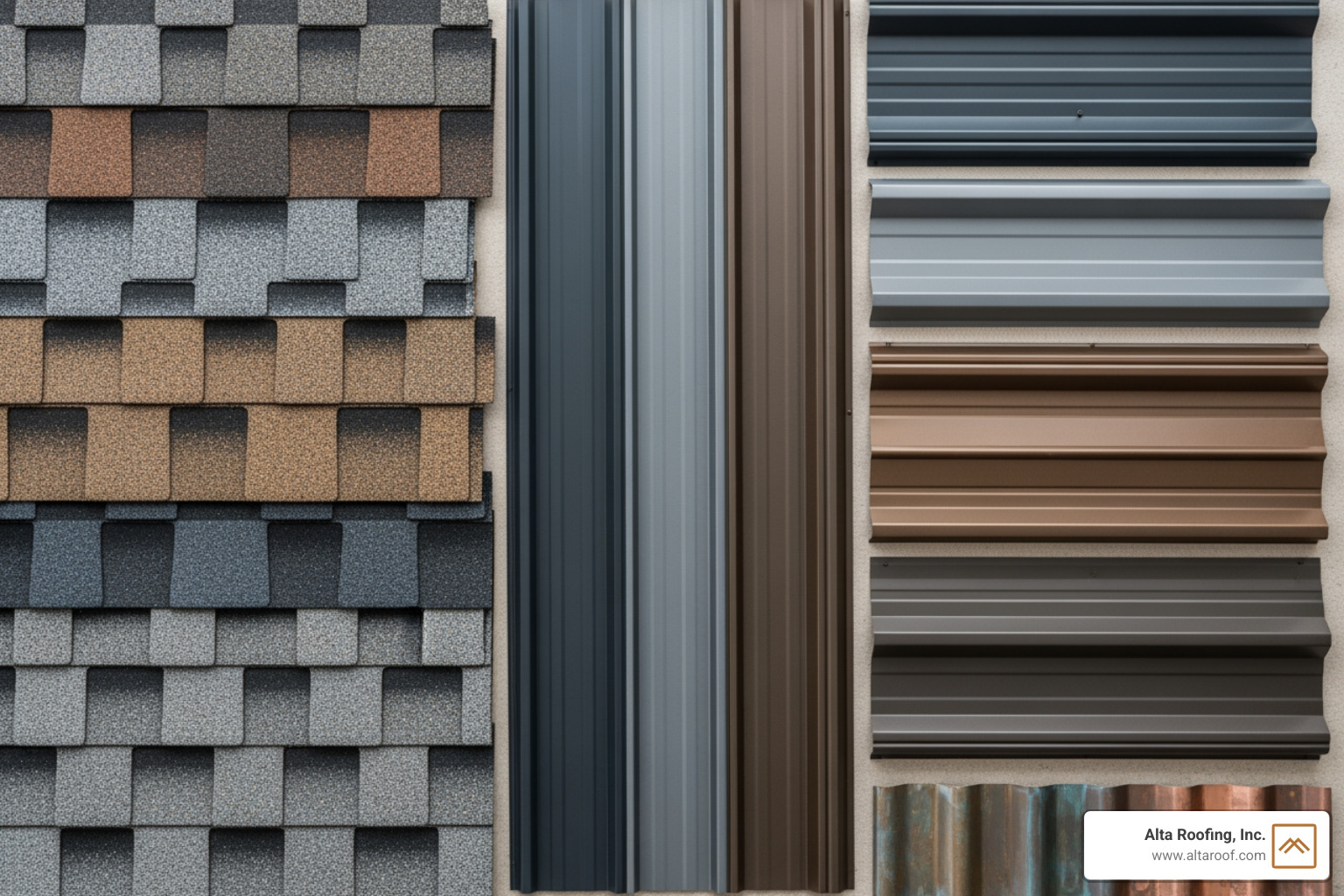
Here’s a look at how different materials stack up in terms of cost, lifespan, and their unique advantages and disadvantages, especially considering Colorado's climate:
| Material | Cost per Sq. Ft. (Installed) | Lifespan | Pros
- Graphic:
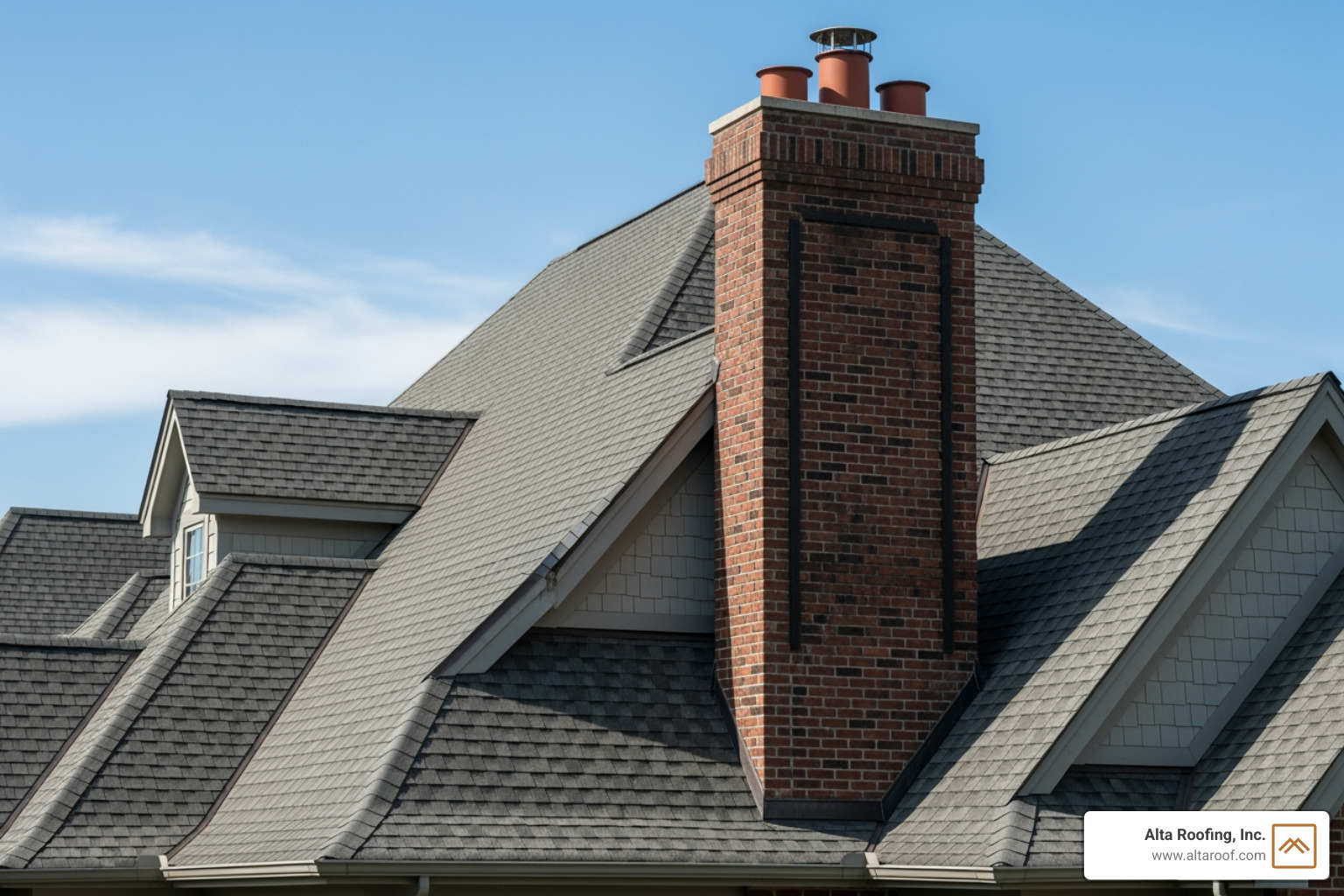(already in intro)
Size, Pitch, and Shape
The size of your roof is paramount, but don't confuse it with your home's square footage. A roof's surface area is typically about 1.2 times larger than the home's footprint. So, for a 1,200 sq. ft. home, we're looking at an estimated roof area of 1,400 – 1,600 sq. ft. For a larger 3,200 sq. ft. home, this could expand to 3,700 – 4,200 sq. ft. More surface area naturally means more materials and more labor.
Then there's the pitch, or steepness, of your roof. This is measured as a ratio of vertical rise for every 12 inches of horizontal run. A 4/12 pitch means the roof rises 4 inches for every 12 inches horizontally. Common residential roof pitches in Colorado range between 4/12 and 8/12. Pitches below 4/12 are considered 'low slope', while anything higher than 8/12 is generally considered steep. Some roofs, especially on older or custom homes in areas like Golden or Evergreen, can have pitches of 12/12 or more, which means they rise at a 45-degree angle.
Steeper roofs present several challenges:
- Increased Surface Area: A steeper pitch means more square footage to cover, even if the home's footprint remains the same.
- Difficulty and Safety: Working on a steep roof is inherently more difficult and dangerous. We often need specialized safety equipment like scaffolding, harnesses, and toe boards to ensure our crew's safety and efficient work. This directly impacts labor costs, adding anywhere from 10% to 25% to the total cost, or an additional $1,000 to $3,000 on top of standard expenses.
- Material Compatibility: Certain roofing materials are not suitable for low-slope roofs, and some materials are more challenging to install on very steep roofs.
The shape of your roof also impacts cost. A simple gable roof (two sloping sides) is generally less expensive than a complex hipped roof (slopes on all four sides), which can cost up to $25 per square foot due to the intricate cuts and angles. Flat roofs, common on commercial buildings or modern residential designs, don't usually exceed $7 per square foot for material and installation, but they often require specialized materials like TPO. For more insights on how these factors influence your estimate, you can refer to resources like How Much Does Roof Replacement Cost in 2025?.
Additional Features and Obstacles
Beyond the basic size and pitch, your roof might have features that add to the complexity and, consequently, the cost. Think of these as the "extras" that require more intricate work and specialized attention.
- Skylights: While beautiful, each skylight adds to the labor and material cost. They require careful flashing and sealing to prevent leaks, adding between $500 and $2,000 per skylight to the project.
- Chimneys: Similar to skylights, chimneys need meticulous flashing and often require more complex cuts around their base.
- Vents and Pipe Boots: Every vent pipe, exhaust fan, or plumbing stack that penetrates your roof needs a special seal, known as a pipe boot, and flashing. Each pipe boot can cost between $63.00 and $85.00. Flashing, typically thin galvanized steel, costs between $9.00 and $11.00 per foot.
- Dormers: These windowed structures projecting from the roof create additional valleys, hips, and edges that increase the complexity and material needs.
- Multiple Roof Layers: If your existing roof has multiple layers of shingles, removing them will increase the tear-off costs. Most cities and county building codes in Colorado will allow two or three layers of shingles to be installed on top of one another, but removing them all is crucial for a quality new installation.
- Tear-Off and Disposal Costs: Removing and disposing of your existing roofing material is a necessary step. This can cost between $0.40 and $2.00 per square foot, or typically $1,500 to $4,000 for a residential roof. This includes the labor for removal and the dump fees for proper disposal. For a typical 1,700 sq. ft. roof, asphalt shingle removal alone can cost $0.39-$0.53 per square foot.
Each of these elements adds to the overall intricacy of the job, increasing both material requirements and the labor time needed for precise installation.
Beyond the Basics: Hidden Costs and Ways to Save
When we present a roof replacement cost estimate, we aim to be as transparent as possible. However, it's wise for homeowners to be aware of all potential costs, some of which might not be immediately obvious. A comprehensive quote covers more than just shingles and nails; it ensures a durable, compliant, and problem-free roof for years to come.
Additional Costs to Factor In
These are the items that ensure your roof system is robust and up to code, and they are crucial to a long-lasting installation:
- Permits and Inspection Fees: Don't overlook these! Most roof replacements in Colorado require local permits to ensure the work meets building codes. These fees can range from $100 to $500, but in some areas or for complex projects, they might be between $500 and $2,000. We always handle the permitting process for our clients, ensuring compliance.
- Underlayment: This protective layer goes between your roof deck and the shingles. New underlayment costs between $1.50 and $2.10 per square foot. It's vital for waterproofing and protecting your roof deck.
- Ice and Water Shields: Especially critical in Colorado's snowy climate, these self-adhering membranes protect vulnerable areas like eaves, valleys, and around penetrations from ice dams and water penetration. Replacing ice and water barriers may cost between $1.87 and $2.53 per square foot, not including installation costs.
- Decking Replacement: If our inspection reveals damaged or rotted roof decking (the plywood or OSB sheathing), it will need to be replaced. This unforeseen cost can range between $2.20 and $3.00 per square foot.
- Fascia and Soffit Repair: These components protect your roof's edges and ventilation. If they are damaged during removal or are already deteriorated, they may need repair or replacement. Installing new fascia boards will cost between $4.25 and $8.62 per linear foot, and replacing your soffits will cost between $2.80 and $5.28 per linear foot.
- Dumpster Fees and Cleanup: As mentioned earlier, the removal and disposal of old roofing materials involve dumpster rentals and hauling. While often bundled into the "tear-off" cost, sometimes cleanup and disposal are listed separately, adding about $500 total. We always ensure our work sites are left spotless.
How to Reduce Your Overall Cost
While a roof replacement is a significant investment, there are smart ways to manage and potentially reduce your overall roof replacement cost estimate:
- Off-Season Scheduling: If your roof isn't in critical condition, consider scheduling your replacement during the roofer's slower periods, typically late winter or early spring. Contractors might offer better rates to keep their crews busy.
- Material Selection: As we saw in the table above, material costs vary widely. Asphalt shingles are generally the most budget-friendly option. While premium materials offer longer lifespans, choosing a high-quality architectural shingle can provide a great balance of durability and cost-effectiveness for many Colorado homes.
- Insurance Claims for Storm Damage: This is where Alta Roofing, Inc. truly shines. If your roof damage is due to a covered event like hail or high winds, your homeowner's insurance might cover a significant portion, or even all, of the replacement cost. We specialize in storm restoration and can act as your single point of contact, handling the insurance claim process and coordinating all necessary trades to restore your home, particularly in areas like Colorado Springs, Parker, and Monument, where hail is common. This can be a huge relief, turning a daunting expense into a manageable one.
- Getting Multiple Quotes: Always get at least three detailed estimates from reputable roofing contractors. This allows you to compare not just the bottom line, but also the materials, warranties, and scope of work included. Be wary of estimates that seem too low; they might indicate subpar materials or shortcuts that could cost you more in the long run.
- Research Roofers: Choose a contractor with a proven track record, proper licensing, and comprehensive insurance. Check references and online reviews. We invite you to View our past projects to see the quality of our work for yourself.
- DIY vs. Professional Value: While some minor tasks like fascia or soffit repair might be DIY-friendly for experienced homeowners, roof replacement is a complex and dangerous job best left to professionals. Attempting DIY can void material warranties, lead to safety hazards, and result in costly mistakes. The labor cost (50-60% of the total) is an investment in proper installation, safety, and a reliable warranty.
Repair vs. Replace: Making the Smart Financial Decision
When your roof starts showing its age or sustains damage, a common question arises: is it better to repair it or opt for a full replacement? This is a critical decision that impacts both your immediate budget and your home's long-term health. Knowing when to repair can save you thousands, but delaying a necessary replacement can lead to more extensive and costly damage down the line.
When to Repair Your Roof
Roof repair is typically the best option for:
- Minor, Localized Damage: If only a few shingles are missing, cracked, or damaged from a localized event (like a small tree branch falling), a repair is likely sufficient. Minor roof repairs can range from $300 to $3,000, with simple fixes like replacing a few damaged shingles costing as low as $150.
- Isolated Leaks: If you have a single leak around a pipe boot, vent, or a small section of flashing, it can often be patched effectively. The average cost for repairing your roof is $379-$1,763, with the national average being $1,064.
- Young Roof Age: If your roof is relatively new (under 10-15 years old) and well-maintained, small issues can usually be addressed with repairs. For example, a few damaged asphalt shingles here and there, or in one contained area, can be handled for as low as $150.
- Flashing Issues: Problems with flashing around chimneys, skylights, or valleys can often be repaired by re-sealing or replacing the affected sections.
We always recommend addressing visible leaks immediately. Inspecting connections and caulking around roof penetrations (chimneys, vents, antennas) can often prevent small issues from becoming big problems.
When a Full Replacement is Unavoidable
Sometimes, a repair is just a temporary fix for a problem that requires a comprehensive solution. A full roof replacement makes more sense when:
- End of Lifespan: Your roof is nearing or has exceeded its expected lifespan. For instance, if your asphalt shingle roof is 15-20 years old, it's likely time for a replacement. While metal and tile roofs can last 50 years or longer, even they have a finite lifespan.
- Widespread Damage: If you see widespread curling, cracking, or rust across a large portion of your roof, or if a storm has caused significant, extensive damage (common with hail in Colorado Springs, Aurora, or Highlands Ranch), a full replacement is often the only way to restore integrity.
- Recurring Leaks: If you're experiencing leaks in multiple areas, or persistent leaks even after repairs, it often indicates a deeper, systemic problem with the entire roof system, not just an isolated spot.
- Excessive Granule Loss: For asphalt shingles, if you notice bald spots or a significant amount of granules in your gutters, it means the shingles are deteriorating and losing their protective qualities.
- Sagging Roof Deck: A visibly sagging roofline or dips in the roof deck can signal structural issues or water-soaked wood underneath, requiring immediate and extensive intervention.
- Improving Home Value: While a roof replacement recoups around 49 percent (for metal roofs) to nearly 61 percent (for asphalt) of its cost at resale, according to Remodeling’s “2023 Cost vs Value Report,” it's a crucial investment. A new, well-installed roof significantly improves curb appeal, protects your home from the elements, and is a major selling point. Ignoring the need for a new roof will not only cause additional damage to your home but will decrease its value and impact your ability to sell it for top price.
If repair costs are approaching 30% or more of the cost of a full replacement, replacement is often the smarter long-term decision. Investing in a new roof often saves money over continued patchwork fixes, ensuring lasting protection and peace of mind.
Frequently Asked Questions about Roof Replacement
Navigating roof replacement can bring up many questions. Here, we address some of the most common concerns we hear from homeowners in Colorado.
What are the signs that my roof needs to be replaced?
Knowing when your roof is signaling for help is crucial. Here are the key indicators we look for:
- Curling or Cracked Shingles: If your shingles are curling at the edges, cupping in the middle, or showing visible cracks, they are deteriorating and losing their effectiveness.
- Bald Spots with Missing Granules: For asphalt shingles, the granules protect the asphalt from UV rays. If you see dark, exposed asphalt or an excessive amount of granules in your gutters, your roof is losing its protective layer.
- Moss or Algae Growth: While not always a direct sign of failure, extensive moss or algae can trap moisture, accelerate deterioration, and hide underlying issues.
- Water Stains on Ceilings or Walls: Any water stains, drips, or streaks on your interior ceilings, upper walls, or in the attic are undeniable signs of a leak that needs immediate attention.
- Sagging Roof Deck: A visible sag or dip in your roofline indicates a serious structural problem, possibly due to water damage or inadequate framing, requiring urgent professional assessment.
- Roof Age Over 20 Years: If your asphalt shingle roof is approaching or past the 20-year mark (for 3-tab) or 25-30 years (for architectural), it's likely nearing the end of its functional life, even if it looks okay from the ground. We recommend an annual inspection to catch problems early.
How does living in Colorado affect my roof replacement cost?
Colorado's unique climate and geography significantly impact roof replacement costs and material choices. Here's how:
- High-Altitude UV Exposure: Our abundant sunshine and higher altitude mean intense UV radiation. This accelerates the breakdown of many roofing materials, especially asphalt shingles. We often recommend materials designed for improved UV resistance, which can sometimes come at a higher cost but offer better longevity.
- Hail and Snow Load Considerations: Hailstorms are a frequent occurrence across the Front Range, from Denver to Colorado Springs. Roofing materials must be able to withstand significant impact. Similarly, heavy snow loads demand robust roof structures and materials that can handle the weight without damage. Local building codes in areas like Aurora, Lakewood, and Castle Rock often have specific requirements for hail resistance (e.g., Class 4 impact resistance) and snow load capacity, which can influence material selection and installation methods.
- Local Building Codes: Beyond weather, each city and county in our service areas (e.g., Thornton, Golden, Arvada, Littleton) has its own set of building codes for roofing. These codes dictate everything from acceptable materials to ventilation requirements, all of which factor into the cost and complexity of a replacement.
- Labor Rates in Metro Areas: As with any service, labor rates tend to be higher in densely populated metropolitan areas like Denver, Aurora, and Centennial compared to smaller towns such as Elizabeth, Woodland Park, or Manitou Springs. This is a common factor influencing overall project costs.
- Material Availability: While most standard materials are readily available, specialized or premium options might have varying lead times and transportation costs depending on their origin.
Our expertise at Alta Roofing, Inc. lies in understanding these Colorado-specific challenges and recommending solutions that offer the best long-term value and protection for your home.
What is the typical lifespan of different roofing materials?
The lifespan of your roof is a critical factor in its long-term cost-effectiveness. Here's a general overview of how long different popular materials typically last, though proper installation and maintenance can extend these ranges:
- Asphalt Shingles:
- 3-Tab: Generally 15-20 years.
- Architectural/Dimensional: 25-30 years. These are more durable and aesthetically pleasing than 3-tab shingles.
- Metal Roofing: 40-70 years. Metal roofs, especially standing seam, are highly durable, fire-resistant, and excellent for shedding snow and resisting hail, making them a popular choice in Colorado.
- Tile Roofs (Concrete & Clay): 50+ years for concrete tiles, and 75+ years for clay tiles. These are extremely durable, fire-resistant, and can withstand harsh weather, though they are heavier and require a robust roof structure.
- Wood Shakes/Shingles: 20-25 years. While offering a classic aesthetic, wood roofs require more maintenance and may not be permitted in all fire-prone areas of Colorado.
- TPO Flat Roofs: 20-30 years. Common for low-slope or flat roofs, TPO (Thermoplastic Polyolefin) is durable and energy-efficient.
- Slate Shingles: 125-200 years. Slate is one of the longest-lasting and most premium roofing materials, requiring specialized installation and a significant upfront investment.
Choosing a material with a longer lifespan can mean a higher upfront roof replacement cost estimate, but it often translates to lower costs over the decades, as you'll replace your roof less frequently. For more detailed information on roofing materials and their longevity, you can always Read more on our blog.
Get a Clear and Accurate Estimate for Your Colorado Roof
Understanding your roof replacement cost estimate is the first step toward a secure and valuable home. While national averages provide a baseline, factors like materials, labor, roof complexity, and Colorado's unique climate will determine your final price. For a detailed, transparent quote that considers all variables, including potential insurance claims for storm damage, it's crucial to work with a local expert. Alta Roofing, Inc. specializes in navigating these complexities for Colorado homeowners, acting as your single point of contact for seamless storm restoration and replacement projects.
Don't Get Ripped Off: How to Pick a Top Roofing Contractor in Colorado Springs
Your Guide to Choosing the Right Roofer
Finding a trustworthy Colorado Springs roofing contractor is critical, especially after our state's unpredictable weather damages your home. The right contractor can make the difference between a smooth project and a nightmare of delays, poor work, and insurance headaches.
A top contractor should have a local presence, proper licensing and insurance, strong certifications (like GAF Master Elite), high customer ratings, insurance claim expertise, and comprehensive warranties.
Colorado Springs presents unique challenges: high-altitude UV exposure, sudden hailstorms, extreme temperature swings, and heavy snow loads. You need a contractor who understands how to build and repair roofs engineered for our climate. A bad choice can lead to a roof that fails prematurely, voided warranties, or out-of-pocket expenses when an insurance claim is mishandled. A great contractor acts as your single point of contact, using proven materials and ensuring your insurance company covers everything it should.
This guide will walk you through vetting contractors, choosing the right materials, understanding costs, and navigating the insurance process. You'll learn to spot red flags and hire a professional who will deliver a roof that protects your home for decades.
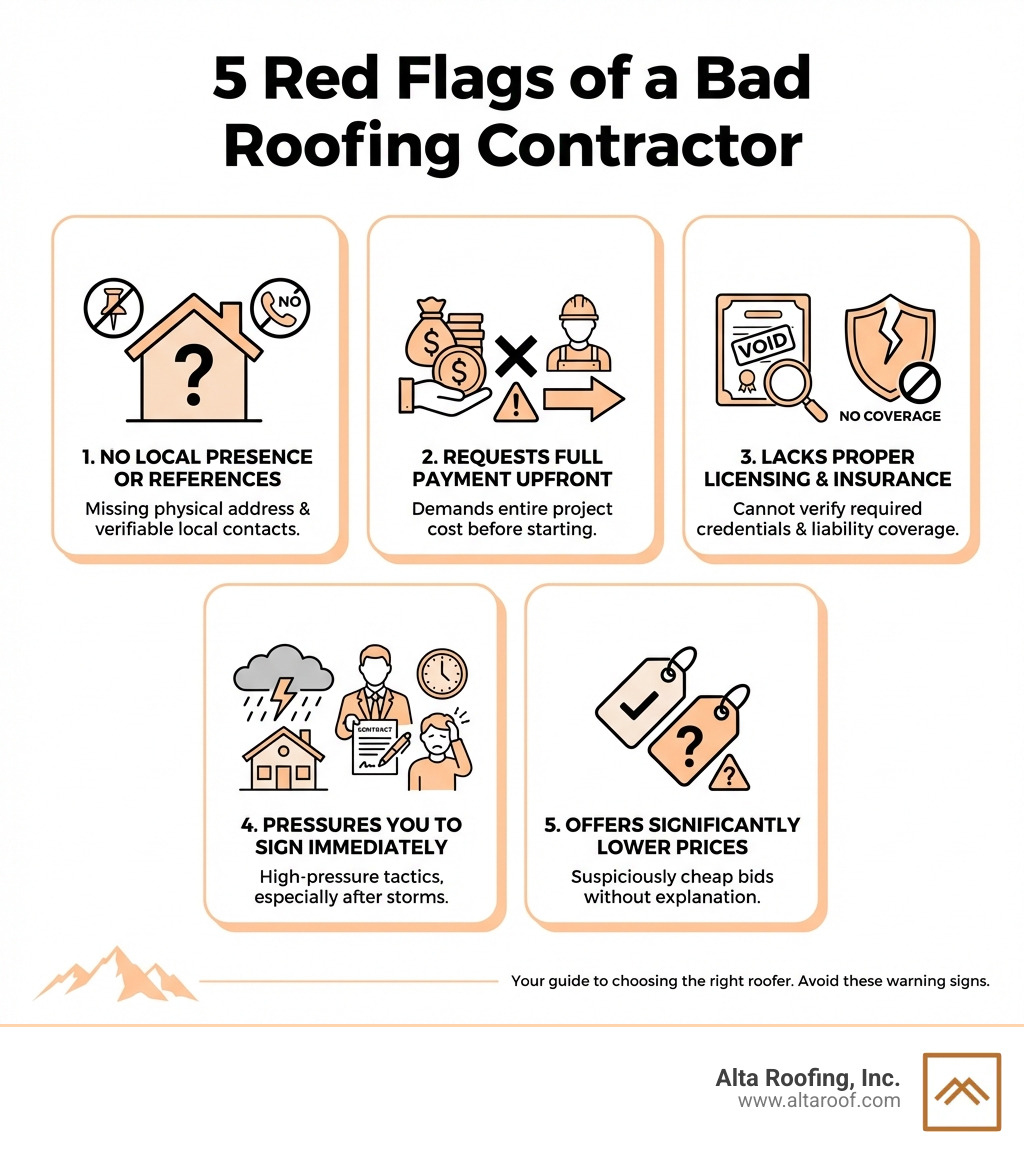
Signs Your Colorado Springs Roof Needs Attention
Ignoring early signs of roof damage can lead to costlier problems. Here are common indicators that your roof needs professional attention:
- Missing or Damaged Shingles: After a windstorm, you might find shingles on your lawn or see bare spots on your roof. This requires an immediate inspection.
- Granule Loss in Gutters: A large accumulation of sand-like shingle granules in your gutters indicates your shingles are aging and losing their protective layer.
- Ceiling Water Stains: Brown or yellow stains on interior ceilings or walls are a critical sign of a leak, which can lead to structural damage or mold.
- Dented or Damaged Flashing: Flashing is the metal around chimneys, vents, and skylights. If it's bent or cracked, often from hail, water can seep into your roofing system.
- Ice Dams: These ridges of ice at your roof's edge prevent proper drainage, causing water to back up under shingles. This often points to attic ventilation or insulation issues.
- Sagging Roof Deck: A visible sag in your roofline is a serious structural issue that needs immediate professional assessment.
- Age of Your Roof: If your asphalt shingle roof is approaching 20-30 years old, it's wise to have it inspected, even without obvious damage.
Some damage, like from hail, isn't always visible from the ground. That's why a professional inspection is crucial after a major storm. For more details, see our guide on How to Know When It's Time to Replace Your Roof.
Vetting Your Colorado Springs Roofing Contractor
Choosing a Colorado Springs roofing contractor is a significant investment in your home's protection. Based on our experience serving Colorado homeowners, here are the key qualities to look for.
Key Qualities of a Top Colorado Springs Roofing Contractor
These are the essential qualities that separate the good from the great:
- Local Presence and Experience: A reputable contractor will have a physical office and a long history in the community (e.g., 15+ years). This ensures they understand local climate challenges, building codes, and won't disappear after the job is done.
- Customer Reviews and Reputation: Check online platforms like the BBB, Google, and Yelp for consistently high ratings (e.g., 4.9+ stars) and positive reviews. A strong reputation is a clear indicator of reliable service.
- Proper Licensing and Insurance: This is non-negotiable. The contractor must be fully licensed and carry both general liability and workers' compensation insurance. Always ask for and verify proof to protect yourself.
- BBB A+ Rating: An A+ rating from the Better Business Bureau signifies a commitment to ethical business practices and customer satisfaction.
- Insurance Claim Expertise: In a hail-prone area like ours, you need a contractor who specializes in handling insurance claims. They should guide you through the process, meet with adjusters, and ensure a fair settlement.
- Comprehensive Warranties: Look for strong warranties on both materials and workmanship. A lifetime workmanship warranty is a sign of a contractor who stands behind their work.
- Free, No-Obligation Inspections: A trustworthy contractor will offer a free inspection with detailed photos and a clear report, allowing you to make an informed decision without pressure.

Here's a list of questions we recommend you ask any potential Colorado Springs roofing contractor during your vetting process:
- Are you licensed and insured in Colorado? Can I see proof?
- How long have you been operating in Colorado Springs?
- Can you provide local references or examples of your work in the area?
- What certifications do you hold (e.g., GAF Master Elite, Owens Corning Platinum Preferred)?
- What kind of warranties do you offer on workmanship and materials?
- How do you handle the insurance claims process? Will you meet with my adjuster?
- What types of roofing materials do you recommend for Colorado Springs' climate, and why?
- What is your project timeline, from start to finish?
- How do you ensure a clean and safe job site?
- What is your communication process during the project?
- Do you offer financing options?
By asking these questions, you'll gain valuable insights into a contractor's professionalism, experience, and commitment to customer satisfaction.
Understanding Certifications and Warranties
Certifications and warranties provide peace of mind and protect your investment.
The Power of Certifications: GAF Master Elite and Owens Corning Platinum Preferred
Certifications like GAF Master Elite or Owens Corning Platinum Preferred are marks of a top-tier contractor. To earn these, a roofer must be properly licensed, insured, have a proven reputation, and commit to ongoing training.
- GAF Master Elite Status: Only a small percentage of roofers achieve this status. It allows them to offer GAF's strongest warranties, like the Golden Pledge® Limited Warranty, which covers both manufacturing defects and workmanship.
- Owens Corning Platinum Preferred Contractor: Similar to GAF's certification, this status signifies that a contractor meets strict standards for professionalism and expertise. These contractors can also offer exclusive, comprehensive warranties.
Hiring a certified contractor ensures they are knowledgeable and that their work is backed by leading manufacturers.
Warranties: Your Shield of Protection
A reputable Colorado Springs roofing contractor should offer two main types of warranties:
- Workmanship Warranty: This covers the quality of the installation. A "lifetime workmanship warranty" provides long-term assurance that the installation will withstand Colorado's weather.
- Manufacturer Warranty: This covers defects in the roofing materials themselves. Certified contractors can often offer improved manufacturer warranties that provide greater protection than standard ones.
Always get warranties in writing and understand what they cover. A strong warranty package is your ultimate peace of mind.
The Nuts and Bolts: Materials, Costs, and Timelines
Let's explore the practicalities of a roofing project: materials, costs, and timelines. A roof is a complex system, including the deck, underlayment, ice and water barriers, ventilation, and the outer shingles, all working together to protect your home.
Best Roofing Materials for Colorado's Climate
Colorado Springs homeowners face heavy snow, high-altitude UV exposure, hail, and freeze-thaw cycles. The right materials are about resilience.

Here are the best materials for our weather:
- Impact-Resistant Shingles (Class 4): A must-have for Colorado, these shingles are rated for "Class 4 hail protection" and can often lead to insurance premium discounts.
- Architectural Asphalt Shingles: Thicker and more durable than traditional shingles, they offer a longer lifespan and better wind resistance.
- Metal Roofing Systems: Excellent for handling heavy snow loads and resisting hail. Metal roofs are long-lasting (50+ years), low-maintenance, and can reduce cooling costs.
- Synthetic Roofing Solutions: Composite slate or shake offers the look of natural materials with superior durability and impact resistance.
- Tile Roofing Applications: Clay and concrete tiles are incredibly durable (50+ years) and resistant to fire and hail, but are heavier and may require a reinforced roof structure.
To see how different styles might look, use this shingle color selector. You can also view examples of our projects in Our Work.
Typical Costs and Project Timelines in Colorado Springs
While an exact price requires an inspection, costs are influenced by several factors:
- Roof Size and Complexity: Larger or more complex roofs require more materials and labor.
- Material Choice: Costs vary significantly between asphalt shingles and premium options like metal or tile.
- Extent of Damage: Repairing underlying structural damage will add to the cost.
- Permits and Disposal: Fees for permits and the disposal of old materials are part of the total cost.
A reputable contractor provides a detailed estimate. The cheapest bid isn't always the best value. We also offer financing options for your project.
Most residential roof replacements in Colorado Springs take 1-3 days, depending on the roof's size, complexity, and weather conditions. We schedule projects efficiently, usually within 1-2 weeks of approval, to minimize disruption.
Services Beyond the Roof
A comprehensive Colorado Springs roofing contractor often provides related services. This allows you to coordinate multiple repairs with a single, trusted team.
- Seamless Gutters: Custom-fabricated on-site to reduce leaks and protect your foundation.
- Attic Insulation: Improves energy efficiency and helps prevent ice dams.
- Exterior Painting: A fresh coat of paint after a new roof boosts curb appeal.
- Siding Repair and Replacement: We can repair siding damaged by the same storms that affected your roof.
- Skylight Services: We install, repair, and replace skylights, ensuring they are properly sealed.
- Comprehensive Storm Damage Restoration: We act as a single point of contact to coordinate all trades for repairs to windows, fences, and more.
Explore our full range of Services to see how we can protect and beautify your home.
Navigating Roof Insurance Claims Like a Pro
Dealing with roof damage and insurance claims can be a headache. As a leading Colorado Springs roofing contractor, we specialize in guiding homeowners through this confusing process. We handle insurance claims and coordinate all necessary trades, acting as your single point of contact to ensure you receive a fair settlement.
Colorado insurance policies typically cover sudden storm damage from hail, wind, and snow. If you suspect damage, don't hesitate to file a claim.
The Insurance Claim Process Step-by-Step
Here’s how we simplify the insurance process for you:
- Free Inspection: Contact us for a comprehensive, no-obligation inspection. We'll thoroughly document all hail, wind, or other storm damage with detailed photos and notes.
- Filing the Claim: We provide you with a clear report and guide you on how to contact your insurance provider to open a claim, ensuring the initial report is accurate.
- Meeting the Adjuster: This is a crucial step. We meet your insurance adjuster on-site to point out all damages, ensuring nothing is overlooked and advocating for a complete and fair assessment.
- Reviewing the Scope of Work: Your insurer will provide a "Scope of Loss." We review this document with you to ensure it covers all necessary repairs and materials to restore your home to pre-storm condition and meet current building codes.
- Supplementing for Missing Items: If the initial estimate is insufficient, we work to "supplement" the claim for any missed items or necessary code upgrades, ensuring you receive full compensation.
- Project Commencement and Final Invoicing: Once the scope and funding are approved, we complete your project. Upon completion, we submit the final invoice to your insurance company for the remaining payment, making the process smooth and transparent.
This guided approach minimizes your stress and maximizes your insurance payout, ensuring your home gets the quality repairs it deserves.
Frequently Asked Questions about Roofing in Colorado Springs
Here are answers to some of the most common questions we receive from homeowners in Colorado Springs.
How do I know if I need a roof repair or a full replacement?
The decision depends on a few factors. A full replacement is often the best choice if your roof is over 20 years old, has widespread damage from hail or wind, or has leaks in multiple areas. For isolated issues like a few missing shingles, a repair may be sufficient. A professional inspection is the best way to get an honest recommendation. You can get a preliminary idea of costs with an Instant Quote.
How long does a typical roof replacement take?
Most residential roof replacements in Colorado Springs take 1-3 days. The exact timeline depends on the weather, the size and complexity of your roof, and the materials being used. We work efficiently and communicate clearly to minimize disruption.
What are the most common roofing issues in Colorado Springs?
Our local climate presents unique challenges. Our Colorado Springs roofing contractor teams are experienced in handling:
- Hail Damage: Hail can bruise, crack, and puncture shingles, compromising their integrity.
- Wind Damage: High-speed gusts can lift and tear shingles, leaving your roof exposed.
- Freeze-Thaw Cycles: Daily temperature swings cause water to freeze and expand under shingles, leading to cracks and ice dams.
- Heavy Snow Load Stress: Heavy snow places immense weight on a roof's structure, which can lead to sagging or failure.
- UV Degradation: Our high altitude means more intense UV radiation, which accelerates the aging of roofing materials.
Choosing a local contractor who understands these issues is critical for a long-lasting roof.
Your Partner for a Secure and Lasting Roof
Choosing the right Colorado Springs roofing contractor is simple when you know what to look for.
Remember these key takeaways:
- Vet Your Contractor: Prioritize local experience, top certifications (like GAF Master Elite), and strong warranties.
- Choose Climate-Appropriate Materials: Use impact-resistant shingles or metal roofing to withstand Colorado's hail, wind, and UV exposure.
- Simplify the Insurance Process: Partner with an expert who can manage your claim and coordinate all repairs.
At Alta Roofing, we are committed to serving the Colorado Springs community with integrity and craftsmanship. We ensure a smooth, transparent, and high-quality roofing experience, from the free inspection to the final nail.
Don't let Colorado's weather get the best of your home. Contact Us for a free, no-obligation inspection today. Let us provide you with a durable, beautiful roof that will protect your home for decades.
Explore our comprehensive roofing services to learn more.
Colorado's Roofing Experts: A Comprehensive Guide
Why Colorado Homeowners Need a Trusted Roofing Partner

Roofers colorado are essential partners for homeowners facing one of the nation's most challenging climates for roofs. Here's what you need to know when searching for roofing help in Colorado:
Quick Guide to Finding Colorado Roofers:
- Verify credentials - Look for licensed, insured contractors with a local physical address
- Check certifications - GAF Master Elite contractors offer the strongest warranties
- Read reviews - Target companies with 4.5+ star ratings and BBB A+ accreditation
- Understand costs - Expect $4-$5 per square foot for asphalt shingle replacement in Denver
- Get insurance help - Choose roofers experienced in storm damage claims
Colorado sits in "Hail Alley," where your roof battles intense UV radiation at high altitude, heavy snow loads, damaging hail storms, and fierce winds. The state sees over 1,000 roofing contractors in the Colorado Springs area alone, making it challenging to find a trustworthy partner who understands these unique climate demands.
Your roof is your home's first line of defense. When hail damage strikes or your aging roof starts showing warning signs—missing shingles, water stains, bald spots where granules have worn away—you need more than just a quick patch job. You need a comprehensive solution that handles everything from insurance claims to final installation.
This guide walks you through exactly what Colorado homeowners need to know: which roofing materials last longest in our harsh climate, how to spot the warning signs that it's time for a replacement, what certifications truly matter, and how to steer the often-confusing insurance claim process.
I'm Barry Goers, founder of Tarben Ventures Ltd., and I've spent years in the construction industry helping homeowners steer complex exterior restoration projects. My experience working with roofers colorado has taught me that the right partner makes all the difference between a smooth restoration and a stressful nightmare.
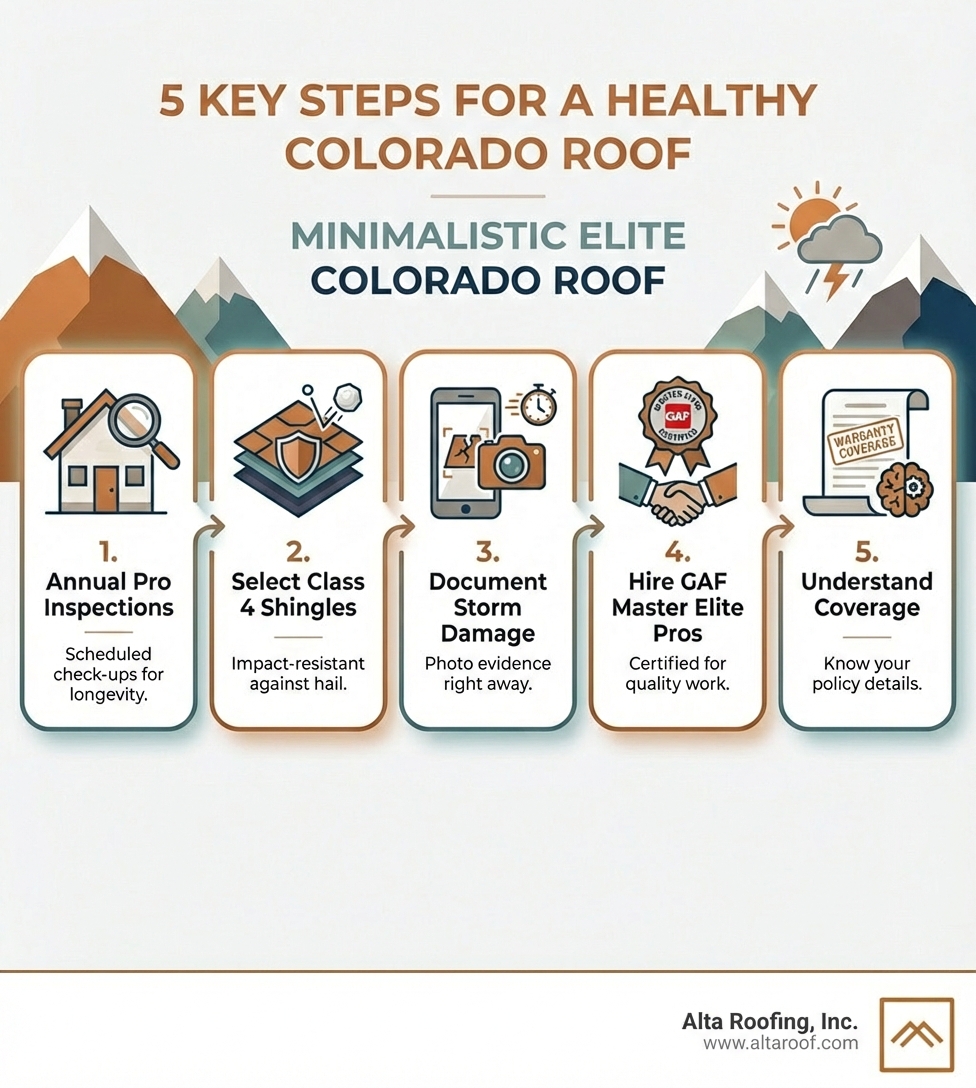
Your Roof vs. Colorado Weather: Materials & Durability
Colorado's climate is truly a force of nature, and your roof bears the brunt of it. From the scorching summer sun to the relentless winter snow, and those unpredictable hail storms that seem to come out of nowhere, our roofs are constantly put to the test. The intense UV radiation at our high altitude can accelerate material degradation, while heavy snow loads demand structural integrity. Hail, of course, is a notorious roof-wrecker, and high winds can tear shingles right off. It's a tough job, but someone's got to do it—and that someone is your roof!
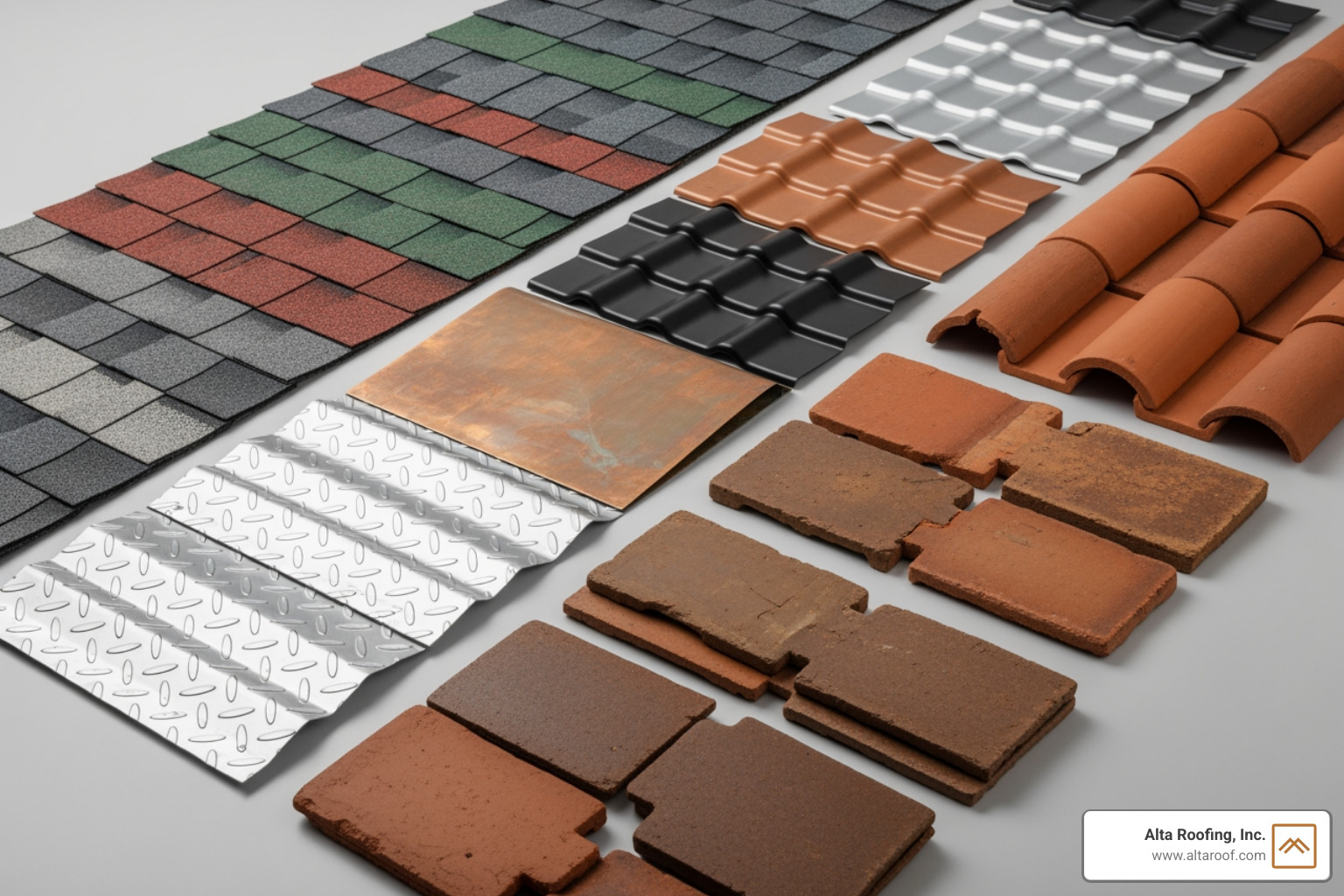
Most Common Roofing Materials in Colorado
When choosing a roofing material in Colorado, durability against our unique weather patterns is paramount. Here are the most common and effective options we see across our service areas, including Denver, Colorado Springs, and Aurora:
- Asphalt Shingles: These are the most popular choice due to their affordability and versatility. However, standard asphalt shingles can be vulnerable to hail and UV damage. This is where impact-resistant options come into play.
- Impact-Resistant (Class 4) Shingles: Designed to withstand the force of hail, these shingles are a game-changer for Colorado homeowners. They often come with extended warranties and can even qualify you for insurance premium discounts. Many homeowners in areas like Castle Rock and Parker opt for these.
- Metal Roofing: Increasingly popular for its longevity and resistance to fire, wind, and hail. Metal roofs can be a significant upfront investment but offer excellent protection and a sleek, modern look. They're a fantastic choice for homes across the Front Range, from Golden to Monument.
- Concrete & Clay Tile: These materials offer exceptional durability, fire resistance, and a distinct aesthetic. While heavier and more expensive, they can last for decades, providing superior protection against the elements, making them a good fit for homeowners in areas like Littleton and Highlands Ranch looking for a premium, long-lasting solution.
- Synthetic Composite Roofing: Mimicking the look of slate or wood shakes without the associated drawbacks, synthetic composites are lightweight, highly durable, and very resistant to impact and UV rays. They offer a fantastic blend of aesthetics and performance, suitable for any of our Colorado service locations.
No matter your choice, we’re here to help you steer the options and find the perfect fit for your home. You can find More info about our services on our website.
Roof Lifespan in Colorado's Harsh Climate
Understanding how long your roof should last in Colorado's challenging environment can help you plan for maintenance and replacement. Our climate, with its hail, intense sun, and heavy snow, can significantly impact a roof's lifespan compared to milder regions. Here’s a general overview of popular materials:
| Material Type | Average Lifespan in CO | Hail Resistance | General Cost |
|---|---|---|---|
| Asphalt (Standard) | 15-20 years | Low | Moderate |
| Asphalt (Impact-Resistant) | 20-30 years | High (Class 4) | Moderate-High |
| Metal | 40-70 years | Very High | High |
| Concrete & Clay Tile | 50+ years | Very High | Very High |
| Synthetic Composite | 30-50 years | Very High | High |
Note: Lifespans are estimates and can vary based on installation quality, specific product, and severity of weather events.
Is It Time for a New Roof? Key Warning Signs
Deciding whether your roof needs a simple repair or a full replacement can be tricky. It often comes down to the age of your roof and the extent of the damage. A small leak might be an easy fix, but widespread damage from a hail storm, especially on an older roof, usually points towards a replacement. We always recommend a professional inspection to get a clear picture.
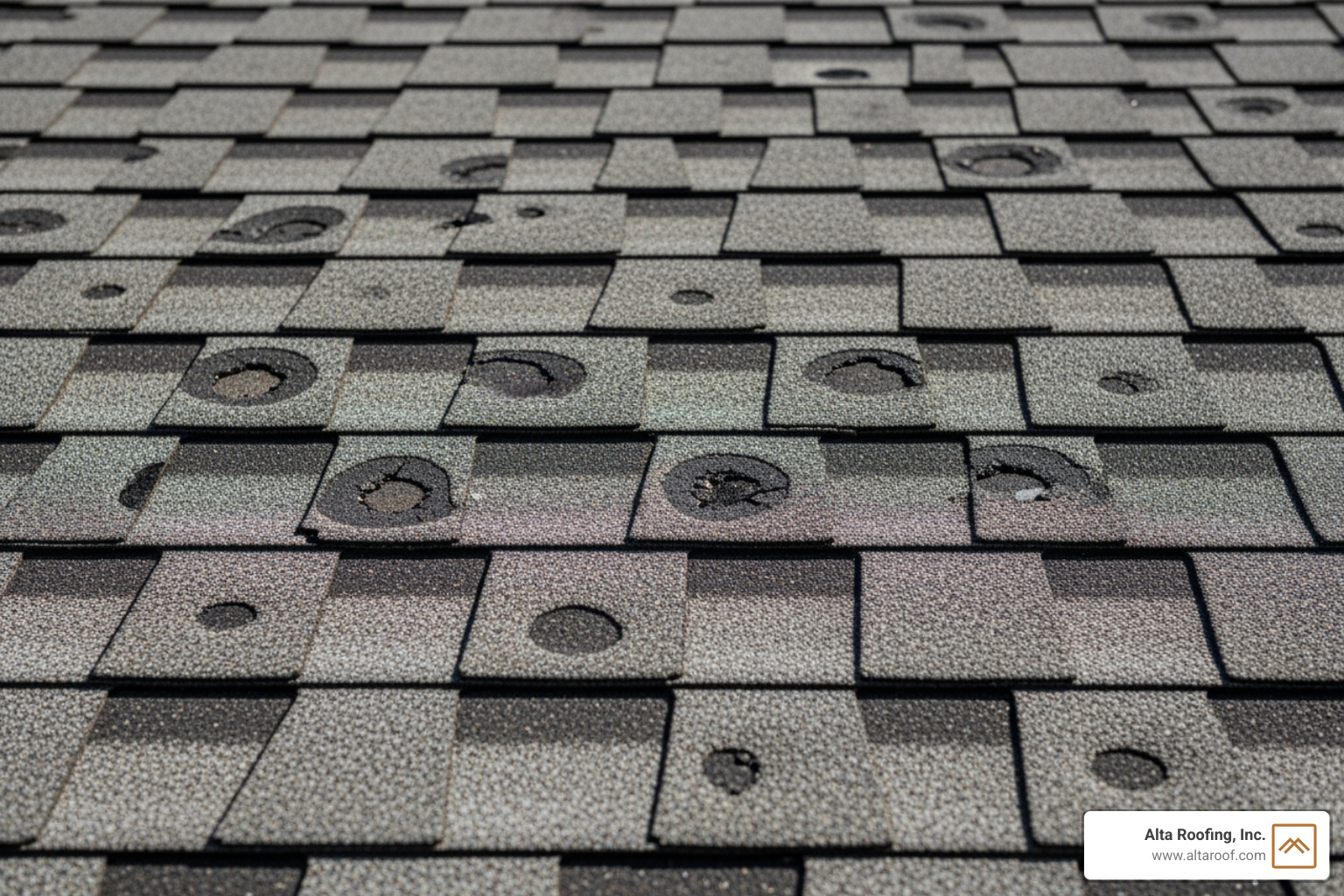
Visual Clues Your Roof Needs Help
Your roof isn't shy about telling you it needs attention—you just need to know how to listen (or, in this case, look!). Here are some common visual cues that suggest it's time to call in the roofers colorado:
- Missing or Cracked Shingles: This is often the most obvious sign. High winds common in areas like Arvada and Englewood can rip shingles off, while extreme temperature fluctuations can cause them to crack.
- Curled Shingle Edges: If your shingles are curling upwards or clawing downwards, it's a sign of aging and moisture damage, indicating they're losing their effectiveness.
- Bald Spots with Missing Granules: Those little ceramic granules on asphalt shingles protect the asphalt from UV rays. If you see dark, smooth patches or a lot of granules in your gutters, your shingles are losing their protective layer.
- Water Stains on Ceilings: This is a clear indicator that water is getting into your home. Don't ignore it! Even a small stain in your Colorado Springs or Denver home could mean significant damage above.
- Sagging Roof Deck: If your roof looks like it's dipping or bowing, it could indicate structural issues or significant water damage to the underlying decking, a serious problem that needs immediate attention.
- Leaks in the Attic After Storms: A tell-tale sign that your roof's integrity has been compromised. After a hail or heavy rain event in places like Thornton or Lakewood, check your attic for any signs of moisture.
Catching these signs early can save you a lot of headache and expense down the road.
How Long Does a Typical Roof Replacement Take?
One of the most common questions we get from homeowners in Denver, Colorado Springs, and other areas is, "How long will my house be a construction zone?" The good news is, a typical residential roof replacement usually takes days, not weeks, to complete under optimal conditions. For an average-sized home, we're often looking at 1 to 3 days.
However, several factors can influence this timeline:
- Weather Dependency: Colorado weather can be unpredictable. We prioritize safety and quality, so work might be paused during heavy rain, snow, or high winds.
- Roof Size and Complexity: Larger homes or roofs with intricate designs (many valleys, dormers, or steep pitches) will naturally take longer.
- Material Choice: While asphalt shingles are quick to install, specialized materials like metal or tile might require more time.
- Permitting Process: Before any work begins, we handle securing the necessary permits from your local municipality (e.g., Denver, Colorado Springs, Aurora). This process can add a few days to a week to the overall project start time.
- Material Availability: While we strive to have materials ready, occasional supply chain issues can cause minor delays.
Rest assured, our team works efficiently to minimize disruption and get your new roof installed correctly and promptly. For more insights and tips on roofing projects, Read our blog for more tips.
How to Choose the Best Roofers in Colorado
Choosing the right roofers colorado is one of the most critical decisions you'll make for your home. With so many options, especially after a major storm, it's easy to feel overwhelmed. We've all heard the horror stories about "storm chasers"—out-of-state contractors who swoop in after a disaster, do shoddy work, and then vanish. To avoid this, focusing on local expertise and a proven track record is key. A reputable local contractor understands Colorado's building codes, climate challenges, and the specific needs of homeowners in areas like Denver, Aurora, and Colorado Springs.
Your Checklist for Vetting Reputable Colorado Roofers
To ensure you're hiring a reliable and trustworthy partner for your roofing project, here's a checklist we always recommend:
- Licensed and Insured: This is non-negotiable. Verify that the contractor holds all necessary licenses for our service areas (e.g., Denver, Colorado Springs, Aurora) and carries comprehensive liability and worker's compensation insurance. This protects you from any accidents or damages during the project.
- Local Physical Address: A real, local office means they're invested in our community and aren't just passing through. This is a strong indicator of long-term commitment and accountability.
- BBB A+ Rating: Look for contractors with a strong rating from the Better Business Bureau. This signifies a commitment to customer satisfaction and ethical business practices. Many reputable roofers colorado in our areas, like Rampart Roofing, Inc. and Elite Roofing & Solar, boast A+ ratings.
- Positive Online Reviews: Check platforms like Google, Yelp, and Angie's List. Look for consistent positive feedback, especially regarding communication, professionalism, and quality of work. For instance, Elite Roofing & Solar has a 4.9 rating from over 350 reviews, and Rampart Roofing, Inc. is rated 4.9 out of 5 stars based on over 500 reviews—these are the kind of numbers you want to see!
- Years in Business: While not the only factor, a company with a long history (like B&M Roofing, protecting Colorado homes since 1947, or Interstate Roofing, Inc., around since 1994) often indicates stability and experience.
- Provides a Detailed Written Estimate: A professional contractor will offer a clear, itemized estimate that details materials, labor, project scope, and payment terms. This helps prevent misunderstandings and hidden costs.
By following this checklist, you can significantly increase your chances of finding a truly excellent roofing partner.
Why Certifications Matter for Roofers in Colorado
When it comes to something as critical as your roof, not all contractors are created equal. Certifications from leading manufacturers, like GAF, provide an extra layer of assurance that you're working with a highly qualified team.
As North America’s largest roofing manufacturer, GAF offers certification programs that equip roofers colorado with specialized knowledge and allow them to offer superior warranties. For example, a GAF Master Elite Contractor like us isn't just a fancy title; it means we've met stringent requirements, including being properly licensed, adequately insured, having a proven reputation, and committing to ongoing professional training.
The benefits of choosing a GAF Master Elite Contractor are significant:
- Access to Improved Warranties: GAF Master Elite contractors can offer the strongest warranties in the industry, such as the GAF Golden Pledge® Limited Warranty. These improved warranties often cover both materials and the contractor's workmanship for an extended period, offering peace of mind that standard warranties simply can't match.
- Factory-Trained Installers: Our teams are trained directly by GAF, ensuring that your roofing system is installed according to the manufacturer's precise specifications. This meticulous installation is crucial for maximizing your roof's lifespan and performance, especially against Colorado's harsh weather.
- Quality Assurance: GAF-certified contractors undergo regular review of their roofing experience and customer feedback, holding them to a higher standard of service and quality.
- Local Building Code Compliance: Certified contractors are well-versed in local building codes and regulations specific to our service areas, from Denver to Colorado Springs, ensuring your new roof meets all requirements.
Choosing a certified contractor means you're investing in proven expertise and robust protection for your home.
Decoding Roof Replacement Costs and Insurance Claims
Let's be honest, few homeowners get excited about spending money on a new roof. But when the time comes, understanding the financial aspects and how to steer insurance claims can turn a potentially stressful situation into a manageable one. We believe in transparency when it comes to costs and guiding you through the often-complex insurance process.
Factors Influencing Roof Replacement Cost in Colorado
The cost of a roof replacement in Colorado can vary widely, but generally, you can expect it to be a significant investment. Based on industry data for our region, the average cost to replace a roof in Denver is around $4 – $5 per square foot for asphalt shingles on an average slope. However, this is just a starting point. Several factors influence the final price:
- Roof Size and Pitch: Larger roofs naturally require more materials and labor. Steeper pitches also increase costs due due to safety equipment and the additional effort required for installation.
- Material Choice: As discussed earlier, materials like impact-resistant asphalt shingles, metal, or tile will have different price points than standard asphalt shingles. The type of material is often the biggest cost differentiator.
- Labor Costs: Skilled labor is essential for a quality installation. Costs can vary depending on the contractor's experience, reputation, and crew size.
- Permit Fees: Local municipalities in areas like Aurora, Lakewood, and Castle Rock require permits for roof replacements, and these fees will be included in the overall cost.
- Debris Removal: Hauling away old roofing materials and other debris is part of the job, and this cost is typically factored into your estimate.
- Accessibility and Complexity: If your roof is difficult to access or has many unique features (skylights, chimneys, complex valleys), it can increase labor time and thus, the cost.
We understand that this is a big decision, which is why we offer an easy way to get an initial estimate. To get a better idea of what your specific project might entail, you can Get an Instant Quote on our website.
Navigating a Storm Damage Insurance Claim
Colorado's "Hail Alley" means many roof replacements are triggered by storm damage, making insurance claims a common reality for homeowners in Denver, Colorado Springs, and surrounding areas. Navigating this process can feel like a maze, but we're here to help you every step of the way.
Here’s our advice for handling a storm damage insurance claim:
- Document Damage with Photos/Video: As soon as it's safe, take clear, well-lit photos and videos of all visible damage to your roof, gutters, siding, and any other affected areas. The more evidence you have, the better.
- File the Claim Promptly: Contact your insurance provider as soon as possible after the storm. There might be deadlines for filing claims, so don't delay.
- Meeting the Insurance Adjuster: Your insurance company will send an adjuster to assess the damage. We highly recommend having your chosen roofing contractor (hopefully us!) present during this inspection. Our team can point out damage that might be missed and ensure a thorough assessment. We specialize in working with adjusters to ensure fair and accurate settlements.
- Understanding Your Settlement (ACV vs. RCV): Familiarize yourself with your policy's terms. Most homeowners insurance policies offer either Actual Cash Value (ACV) or Replacement Cost Value (RCV). ACV policies pay out the depreciated value of your roof, while RCV policies cover the cost of a new roof, less your deductible.
- Choosing a Contractor Who Specializes in Insurance Claims: This is where we shine. As Alta Roofing, Inc., we pride ourselves on handling insurance claims and coordinating all necessary trades. We act as your single point of contact for homeowners, particularly in Colorado Springs and other locations we serve, from the initial inspection and claim filing to the final installation and clean-up. We'll work tirelessly to ensure you get a fair settlement and a high-quality roof replacement.
Our goal is to make the insurance claim process as smooth and stress-free as possible, ensuring your home is restored to its pre-loss condition, if not better!
Conclusion: Partner with Colorado's Storm Restoration Experts
We've covered a lot of ground, from understanding Colorado's unique climate challenges and the best roofing materials to recognizing warning signs and navigating the complexities of insurance claims. The key takeaways are clear: proactive roof maintenance, choosing quality, climate-appropriate materials, and hiring a certified, reputable professional are paramount for protecting your home in our beautiful, yet demanding, state.
Your roof is a significant investment and your home's primary shield against our intense hail, snow, sun, and wind. Don't leave its care to just anyone. For a seamless process from inspection to insurance claim and final installation, a storm restoration specialist like Alta Roofing, Inc. acts as your single point of contact. We pride ourselves on our local expertise, commitment to quality, and unparalleled customer service across Denver, Colorado Springs, Aurora, and all our service areas.
We're not just installing roofs; we're building trust and ensuring the safety and longevity of your home. If you suspect storm damage, see any warning signs, or simply want a professional assessment, don't hesitate. Contact us for a comprehensive roof inspection today and let us be your trusted partner in keeping your Colorado home safe and sound.
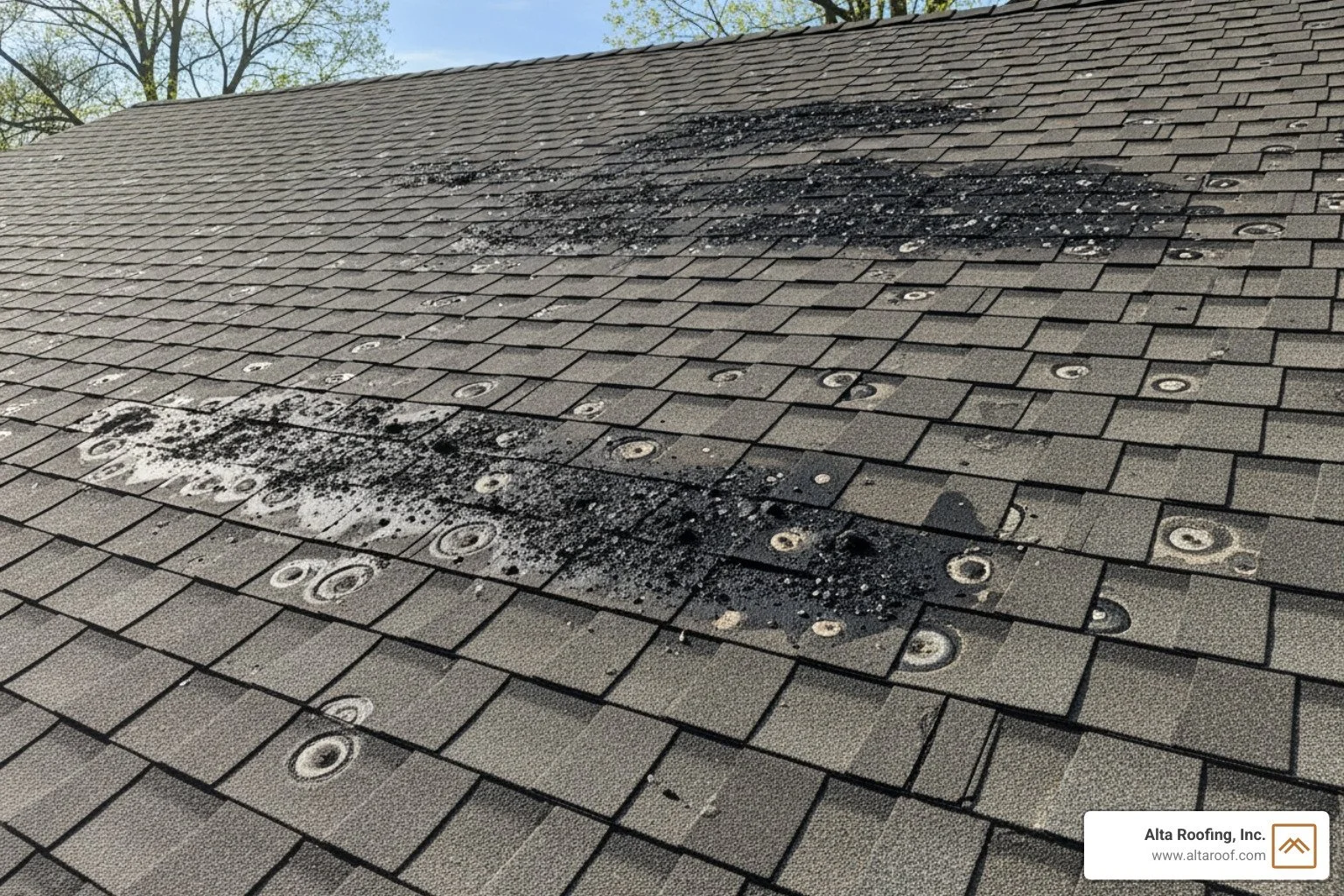
Don't Get Rained Out: Maximizing Your Hail Damage Insurance Payout
Why Understanding the Hail Damage Insurance Claim Process Matters
The hail damage insurance claim process can feel overwhelming after a storm hits your Colorado home, but knowing the essential steps helps you secure the compensation you deserve. Here's what you need to know:
Quick Overview: The Hail Damage Insurance Claim Process
- Document the damage - Take photos and videos immediately after the storm
- Contact your insurance company - Report the claim within 3 business days
- Schedule an adjuster inspection - Meet with the insurance adjuster at your property
- Review the settlement offer - Understand ACV vs. RCV and your deductible
- Get contractor estimates - Compare independent repair quotes with the adjuster's assessment
- Complete repairs - Hire a licensed contractor to restore your property
- Submit final invoice - Receive your depreciation holdback after work is completed
Weather in Colorado can turn severe without warning. Sunny skies quickly transform into thunderstorms that drop hailstones ranging from pea-sized pellets to stones the size of tennis balls. Most hail storms last only 5-6 minutes, but the damage they cause can be extensive and costly. Hail can dent your roof, crack windows, damage siding, and create openings that allow water and pests into your home.
The good news? Hail damage claims are considered no-fault because natural disasters are beyond your control. This means filing a claim typically won't increase your insurance premium. However, the claim process itself requires careful attention to deadlines, documentation, and policy details to maximize your payout.
Many Colorado homeowners struggle with the complexity of coordinating insurance adjusters, understanding policy language, and managing contractors. Without proper guidance, you might accept a settlement that doesn't fully cover your repairs, or worse, have your claim denied due to missing documentation or procedural errors.
I'm Barry Goers, founder of Tarben Ventures Ltd., with experience in the construction industry and helping property owners steer complex restoration projects. Throughout my career, I've seen how understanding the hail damage insurance claim process empowers homeowners to protect their investments and secure fair compensation. This guide will walk you through every step, from those critical first 48 hours after the storm to receiving your final settlement check.
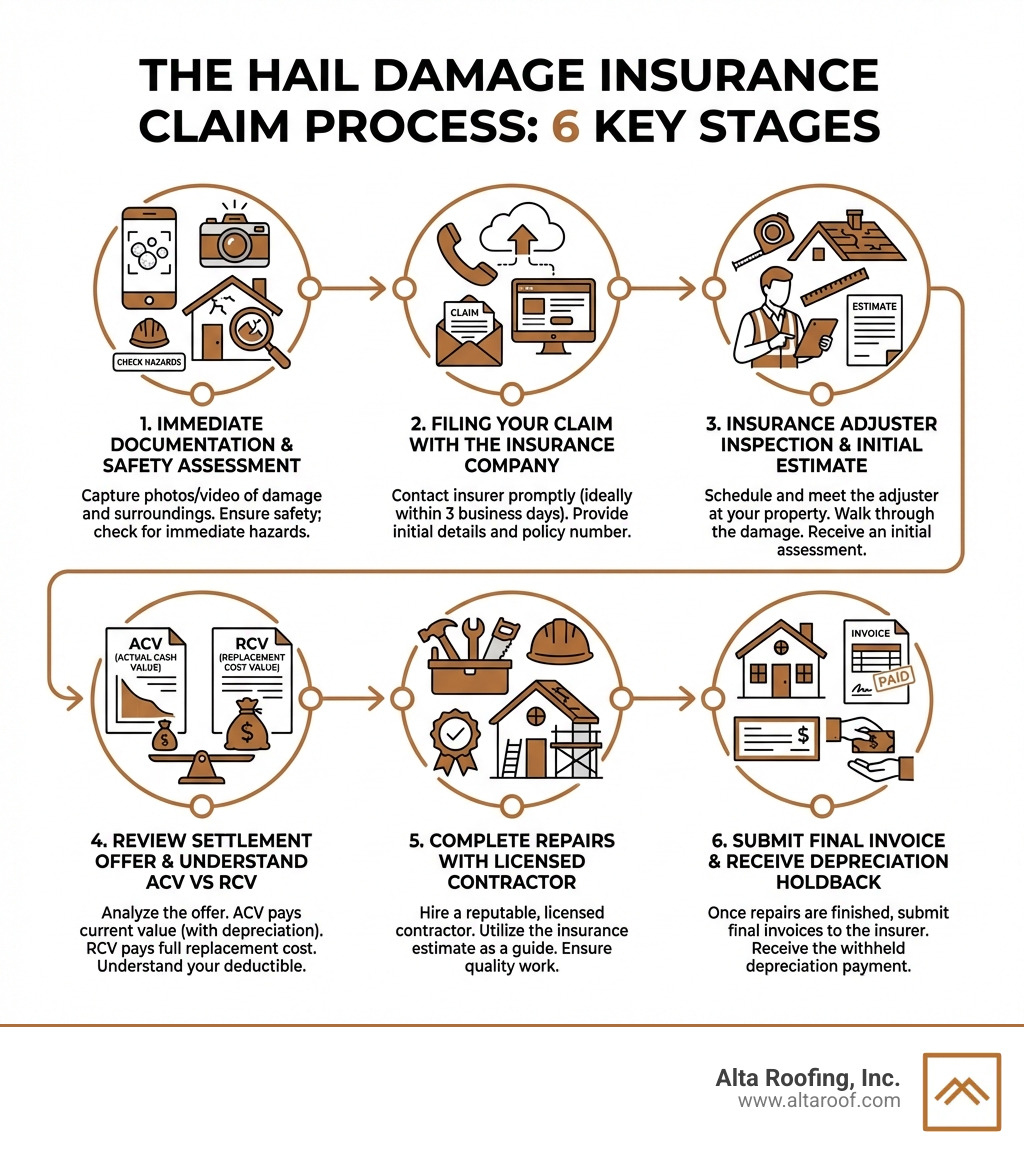
After the Storm: Your First 48 Hours
The hailstones have stopped falling, the wind has died down, and the sun might even be peeking through the clouds. But don't let the calm fool you – the critical work for your hail damage insurance claim process has just begun. These first 48 hours are crucial for ensuring your safety, preventing further damage, and thoroughly documenting everything.
First and foremost, your safety and the safety of your family are paramount. Before you even think about inspecting your roof, check for immediate hazards. Are there downed power lines? Any unstable structures around your home? If you suspect any immediate dangers, evacuate your family and contact emergency services.
Once it's safe to venture outside, it's time to become a meticulous detective. We recommend starting your documentation process immediately. This means taking clear photos and videos of all hail damage and any affected personal property. Be sure to note the date and time of the hailstorm—this detail is vital for your claim. Documenting damage promptly helps prove that the damage was caused by the specific storm you're reporting, preventing potential denials later on due to perceived neglect or wear and tear.
Best Practices for Documenting Hail Damage
Thorough documentation is the bedrock of a successful hail damage insurance claim process. Here's how to do it right:
- Take photos and videos: Use a high-resolution camera or smartphone. Capture overall shots of your property and close-ups of specific damage.
- Use a ruler or coin for scale: For close-up shots of dents, cracks, or granule loss, place a ruler, coin, or even a pen next to the damage. This helps the adjuster understand the size and severity.
- Note date and time: Keep a simple log or use your phone's timestamp feature to record when the photos/videos were taken and when the storm occurred.
- Capture damage from multiple angles: Don't just take one shot. Get different perspectives to fully illustrate the extent of the damage.
- Photograph gutters, siding, and windows: Hail doesn't just hit the roof. Check your gutters for dents, siding for impact marks, and windows for cracks.
- Keep a communication log: From the moment you contact your insurance company to every interaction with adjusters or contractors, write down names, dates, times, and a summary of the conversation. This record can be invaluable if disputes arise.
A detailed inspection report from an experienced roofer often carries far more weight than a homeowner's subjective assessment. While you're documenting from the ground, we can provide a professional inspection to identify damage that might not be visible to the untrained eye.
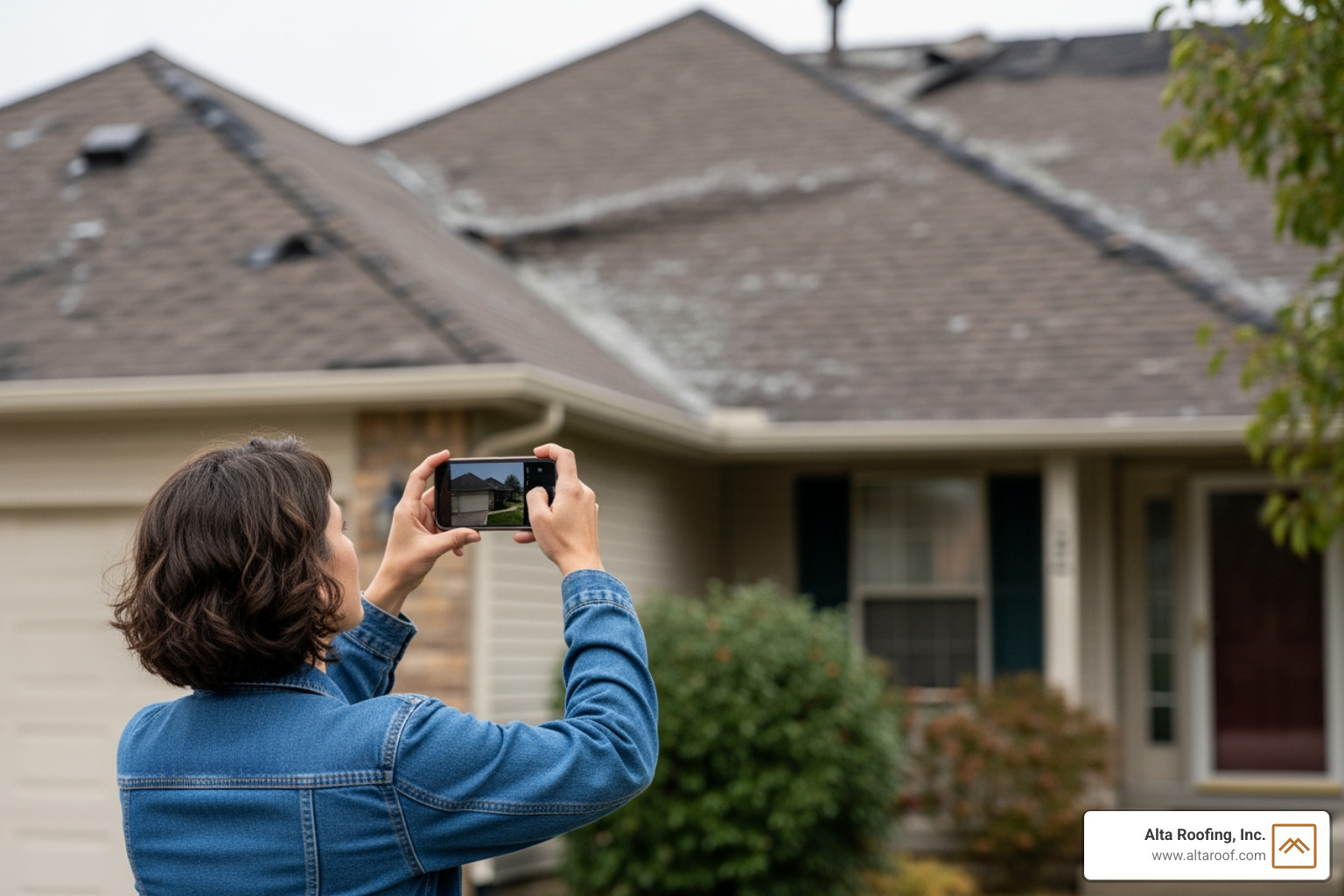
Essential Items for a Damage Documentation Kit:
- Smartphone or camera
- Notepad and pen
- Measuring tape or ruler
- Chalk (for circling hail marks on shingles or pavement)
- Flashlight (for inspecting dark areas like attics if safe)
Making Temporary Repairs to Prevent Further Damage
After documenting, your next step is to prevent further damage to your home. This is often referred to as "mitigation," and it's a responsibility outlined in your insurance policy. You must take reasonable steps to protect your property from additional harm, but do not make permanent repairs before the insurance adjuster inspects the damage.
Here are some temporary measures you can take:
- Tarping the roof: If your roof has obvious holes or missing shingles, a temporary tarp can prevent water from entering your home.
- Boarding up windows: Cracked or broken windows should be boarded up to secure your home and keep out the elements.
- Removing standing water: If water has entered your home, remove standing water and use fans to dry out affected areas to prevent mold growth.
- Saving all receipts: Keep meticulous records of all expenses related to these temporary repairs, including materials and any labor you paid for. These costs are typically reimbursable under your policy.
At Alta Roofing, Inc., we specialize in comprehensive storm damage restoration and can help you with these crucial temporary repairs to prevent further damage. We also offer full-service support throughout the entire claim process.
More info about our storm damage services
The Step-by-Step Hail Damage Insurance Claim Process
Now that you've secured your property and documented the damage, it's time to officially start your hail damage insurance claim process. This might seem like the most intimidating part, but with a clear roadmap, it's manageable. The hail damage roof insurance claim process can seem daunting, but it's usually worth your time and energy.
The first step is to contact your insurance provider. We recommend doing this as soon as possible after the storm, ideally within three business days. While many policies allow up to a year, or even two years in some states, waiting too long can make it harder to prove the damage was caused by the specific hailstorm you're reporting. This delay could lead to denials due to perceived neglect.
When you contact your insurer, have your policy number, the date of the incident, and a brief description of the damage ready. Most insurance companies offer multiple ways to file a claim: by phone, through their website, or via a mobile app. Choose the method that's most convenient for you.
Once you file your claim, your insurance company will likely ask you to complete a "proof of loss" form. This is a crucial document that lists all damaged or lost property or items, along with the estimated value or cost of the damage or loss. You'll need to sign and swear that the statements on this form are true. Be accurate, as untrue statements can void your insurance. Typically, you'll need to complete and return this form within 30 days.
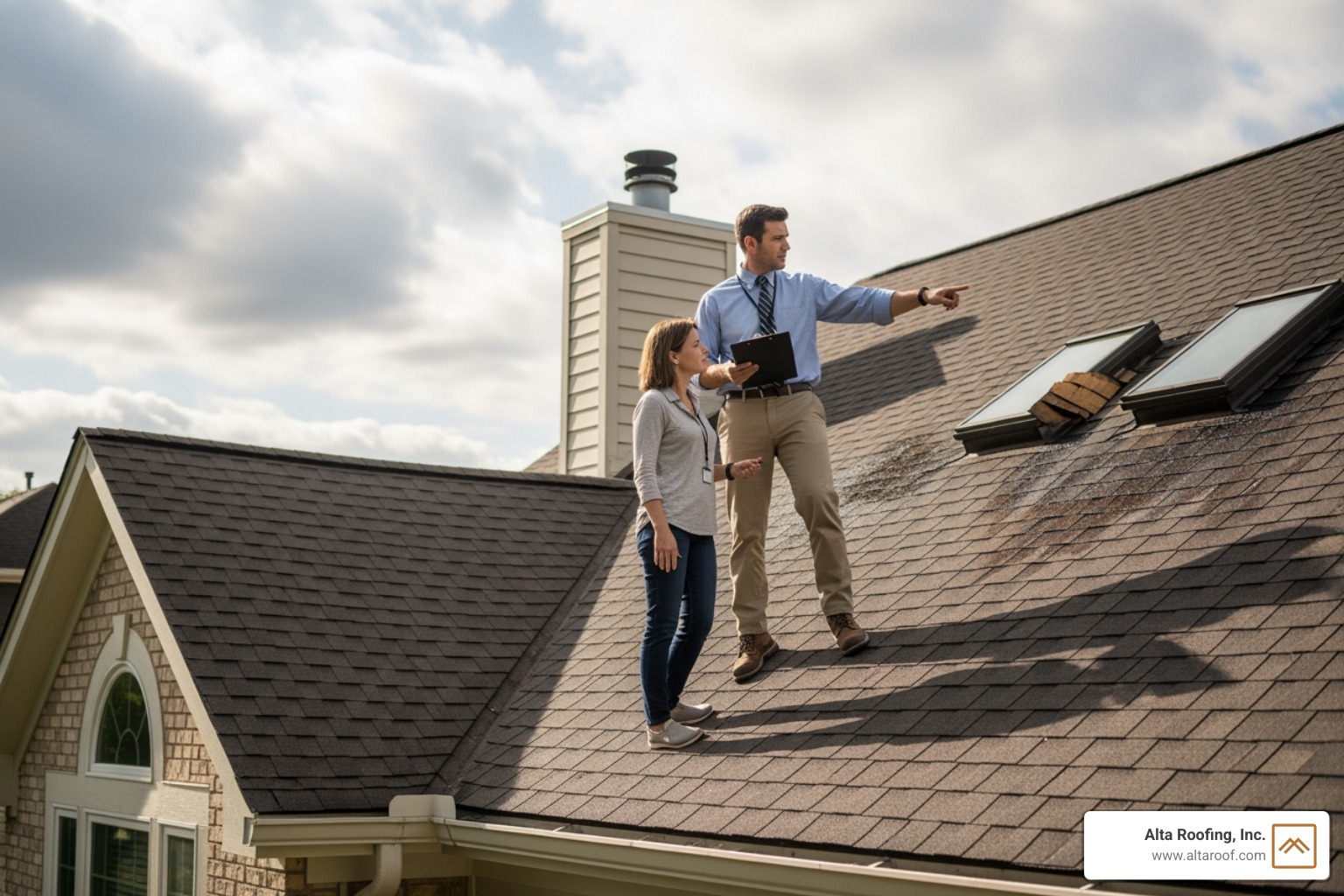
Key steps in the hail damage roof insurance claim process
Navigating a hail damage insurance claim process for your roof can be complex, but here's a breakdown of the key steps we guide our Colorado clients through:
- Contacting your insurer: As mentioned, this is your first official step. Provide them with all the details you've gathered.
- Scheduling the adjuster visit: Your insurer will assign an adjuster to assess the damage. This person works for the insurance company. We highly recommend having your chosen roofing contractor present during this inspection. An experienced roofer, like us at Alta Roofing, can point out all instances of damage that an adjuster might miss, ensuring nothing is overlooked.
- Meeting the adjuster: Be present during the inspection. Walk through the property with the adjuster, highlighting the damage you've documented. Share your photos and videos.
- Reviewing the adjuster's report: After their visit, the adjuster will provide a report and an estimate for repairs. Review this carefully. This is where our expertise becomes invaluable. We can help you understand the report, compare it to our own detailed inspection, and identify any discrepancies or undervalued items.
At Alta Roofing, Inc., we pride ourselves on being your single point of contact throughout this journey. We handle insurance claims and coordinate all necessary trades, particularly for homeowners in Colorado Springs and across our service areas.
Guide to Hail Damage Roof Insurance Claims
The Role of the Insurance Adjuster
The insurance adjuster plays a pivotal role in your hail damage insurance claim process. They are employed by your insurance company to investigate your claim, assess the damage, and determine the cost of repairs. Their job is to ensure the claim is valid and that the proposed repairs align with your policy coverage.
Here's what they typically do:
- Damage assessment: They will inspect your property, often focusing on the roof, siding, and any other structures impacted by hail. They look for direct evidence of hail impact.
- Estimating software: Most adjusters use specialized software like Xactimate (used by about 80% of insurance companies) or Symbility (used by the other 20%) to generate their repair estimates. These programs standardize pricing for materials and labor.
- Policy interpretation: They interpret your policy to determine what is covered, what exclusions apply, and how your deductible will factor into the payout.
- Settlement offer: Based on their assessment and your policy, they will propose a settlement amount.
While adjusters are professionals, they can sometimes miss subtle damage or offer an estimate that doesn't fully cover the actual cost of restoration, especially if you have an older roof. This is where having an experienced roofing contractor on your side, like Alta Roofing, makes all the difference. We can review their assessment, provide our own detailed estimate, and advocate for your best interests.
How to Know When It's Time to Replace Your Roof
Understanding Your Settlement: ACV, RCV, and Deductibles
Deciphering your insurance settlement can feel like reading a foreign language, but understanding the key terms is essential for maximizing your payout during the hail damage insurance claim process. The amount your insurance pays depends on several factors, including your policy type, the extent of the damage, and your deductible.
Hail damage claims are generally considered "no-fault" because they stem from natural disasters beyond your control. This means they typically won't impact your premium. However, the payout itself is carefully calculated based on your policy's terms.
Actual Cash Value (ACV) vs. Replacement Cost Value (RCV)
This is one of the most critical distinctions in your homeowner's policy:
- Actual Cash Value (ACV): An ACV policy pays for the cost of repairing or replacing damaged property minus depreciation. Depreciation is the reduction in value due to age, wear and tear, and obsolescence. If your roof is 15 years old, an ACV policy will pay you the value of a 15-year-old roof, not a brand-new one. This means you'll receive an initial check for the depreciated value, and the remainder of the replacement cost will come out of your pocket.
- Replacement Cost Value (RCV): An RCV policy pays for the cost of repairing or replacing damaged property with new materials of similar kind and quality, without deduction for depreciation. This is generally the preferred coverage for homeowners.
Most RCV policies use a "two-check process" for payouts:
- First Check (ACV): You'll receive an initial payment based on the actual cash value of the damage (replacement cost minus depreciation), minus your deductible.
- Second Check (Recoverable Depreciation): Once repairs are completed and we submit the final invoice, your insurance company will release the "recoverable depreciation"—the amount initially held back for depreciation. This second check covers the remaining cost of repairs, bringing you up to the full replacement cost.
If your policy limit is $15,000 and repairs cost $20,000, you'll still pay the $5,000 difference out of pocket. It's vital to understand your coverage limits.
| Policy Type | Payout Method | Out-of-Pocket for Depreciation |
|---|---|---|
| Actual Cash Value | Repair/replacement cost minus depreciation | Yes |
| Replacement Cost Value | Full repair/replacement cost (no depreciation deduction) | No (after two-check process) |
How Deductibles Work for Hail Claims
Your deductible is the amount you pay out of pocket before your insurance coverage kicks in. For hail damage claims on homes, deductibles can vary significantly:
- Standard Deductible: This is a fixed dollar amount, such as $1,000 or $2,500. If your repairs cost $8,000 and your deductible is $1,000, your insurer would pay $7,000.
- Percentage Deductible: In hail-prone areas like Colorado, some homeowners' policies have a percentage deductible, typically 1% to 5% of your home's dwelling coverage limit. For example, if your home is insured for $300,000 with a 1% hail deductible, you'd pay the first $3,000 of covered damage.
The deductible is subtracted from the total approved repair cost. We will work with you to understand your specific deductible and how it applies to your claim.
When not to file a claim: If the estimated repair costs are minor or less than your deductible, it might not be worth filing a claim. For instance, if repairs are estimated at $5,000 and your deductible is $5,000, filing a claim might not benefit you financially. We can help you assess the damage and determine if filing a claim is the best course of action.
Understanding your insurance policy
When Things Go Wrong: Denials, Low Offers, and Total Loss
Even with careful documentation and prompt filing, the hail damage insurance claim process can sometimes hit a snag. Denials, low settlement offers, or even a total loss declaration can be frustrating, but we're here to help you steer these challenges.
A common reason for disputes or denials involves exclusions. Many policies now include specific limitations:
- Cosmetic damage clauses: Some policies may exclude coverage for purely cosmetic damage, such as minor dents on a metal roof or slight discoloration on siding, if the functionality or integrity of the material is not compromised.
- Wear and tear: Insurance covers sudden, accidental damage. It does not cover damage resulting from normal wear and tear, lack of maintenance, or pre-existing conditions. If your roof was already old and deteriorated, the insurer might argue that hail damage was minimal compared to the existing wear.
What to Do If Your Hail Damage Claim is Denied
A denied claim isn't necessarily the final word. Here's what we recommend:
- Review the denial letter: Understand the specific reason for the denial. Is it due to an exclusion, insufficient damage, or a procedural issue?
- Appeal the decision: You have the right to appeal. Gather any additional evidence you have, such as our detailed inspection reports, contractor estimates, or photos, that directly refutes the reason for denial.
- Provide new evidence: If your contractor (like us!) found significant damage that the adjuster missed, submit that evidence. We can help you build a compelling case.
- Consult a roofing expert: If you've been denied due to "insufficient damage" or "wear and tear," an experienced roofing company like Alta Roofing can provide an expert assessment. Our detailed reports and ability to speak the adjuster's language can often lead to a reversal of the denial. We've seen it happen!
We're proud of Our Work in successfully assisting homeowners with complex claims and getting them the fair compensation they deserve.
How to Negotiate with an Insurance Adjuster
Negotiation is often a key part of the hail damage insurance claim process. Here’s how we recommend approaching it:
- Contractor estimates: Obtain detailed, written estimates from reputable local contractors, like Alta Roofing. These estimates should clearly outline all necessary repairs and their costs. If your estimate is higher than the adjuster's, it's a strong negotiation tool.
- Presenting your documentation: Organize all your photos, videos, and notes. Show the adjuster or claims manager the discrepancies between their assessment and your contractor's findings.
- Sticking to facts: Avoid emotional arguments. Focus on the observable damage, the terms of your policy, and the professional estimates. Don't guess or admit fault; simply present the facts relevant to the claim.
- Escalating to a manager: If you're not making progress with the initial adjuster, ask to speak with their supervisor or a claims manager. Sometimes a fresh pair of eyes can make a difference. If you still disagree, you can consider hiring a public adjuster who works for you, not the insurance company.
What Happens if Your Property is a Total Loss?
In severe cases, particularly with older homes or extensive damage, your property might be declared a "total loss" due to hail damage. This occurs when the cost of repairs exceeds the property's actual cash value (ACV) or a certain percentage of its value, as defined by your policy.
If your home is declared a total loss:
- Settlement calculation: Your insurer will pay you the property's ACV (or RCV, depending on your policy), minus your deductible. This settlement is intended to allow you to rebuild or purchase a comparable property.
- Mortgage company involvement: If you have an outstanding mortgage, the settlement check will likely be made out to both you and your mortgage lender. The lender will often hold the funds in an escrow account and release them as repairs are completed, ensuring their investment is protected. We can help coordinate with your lender during this process.
Frequently Asked Questions about Hail Damage Claims
We often hear similar questions from homeowners navigating the hail damage insurance claim process. Here are some common ones:
Will filing a hail damage claim increase my insurance premium?
Generally, no. Hail damage claims are considered "no-fault" because they result from natural disasters, which are beyond your control. Filing a claim for a natural event like a hailstorm typically won't cause your individual premium to increase. However, if an area experiences a high frequency of severe storms, overall premiums for everyone in that region might eventually rise to cover the increased risk.
Leaving significant hail damage unrepaired can lead to problems. If you don't fix existing damage and another storm hits, your insurer might deny future claims or limit coverage for that specific damage, arguing it was pre-existing or due to neglect.
How long do I have to file a hail damage claim?
The timeframe to file a hail damage insurance claim varies by state and by individual insurance policy. In most cases, you have up to one year to file a claim for hail damage, and some states even extend that to two years.
However, we strongly advise filing your claim as soon as possible after the storm. The longer you wait, the harder it can be to prove that the damage was caused by a specific weather event, potentially leading to a denial. For example, the Colorado Division of Insurance recommends reporting damage promptly.
After a Hail Storm - Insurance FAQs - Colorado Division of Insurance
What kind of damage can hailstorms cause?
Hailstorms can release a variety of damaging effects on your property, depending on the size of the hailstones and the wind's intensity.
- Roof damage: This is the most common and often the most severe. Hail can cause:
- Dents: Impact marks on shingles, vents, and metal components.
- Granule loss: Hail can knock the protective granules off asphalt shingles, exposing the asphalt matting to harmful UV rays and accelerating deterioration.
- Cracks: Shingles can crack, especially older or brittle ones, compromising the roof's integrity.
- Broken shingles: Severe impacts can break shingles, creating entry points for water.
- Water leaks: Even small damage can lead to leaks, allowing water into your attic and home, which can cause mold and structural issues.
- Pest entry: Holes or compromised areas can also allow pests into your home.
- Siding and gutter damage: Vinyl siding can crack or shatter, while metal siding and gutters can be dented.
- Broken windows: Larger hailstones can crack or shatter windows.
- Damage to exterior structures: Sheds, fences, decks, and even outdoor air conditioning units can sustain significant hail damage.
Conclusion
Navigating the hail damage insurance claim process can feel like a daunting task, but with the right knowledge and a trusted partner, it doesn't have to be. We've walked through the crucial steps, from immediate post-storm actions and meticulous documentation to understanding your policy, working with adjusters, and addressing potential challenges like denials or total loss declarations.
Colorado experiences its fair share of hailstorms, making robust preparation and a clear understanding of the claims process essential for homeowners in Denver, Aurora, Colorado Springs, and all our service areas. Proactive protection, such as regular roof inspections and understanding your policy before a storm hits, can save you a lot of stress and expense down the road.
At Alta Roofing, Inc., we specialize in roofing and storm restoration, and our unique selling proposition is handling insurance claims and coordinating all necessary trades. We act as your single point of contact, simplifying the entire process for homeowners right here in Colorado Springs, Aurora, Denver, and beyond. We bring our expertise to every step, ensuring you receive a fair and comprehensive settlement to restore your home to its pre-storm condition.
Don't let hail damage rain on your parade. Let us help you maximize your insurance payout and restore your peace of mind.
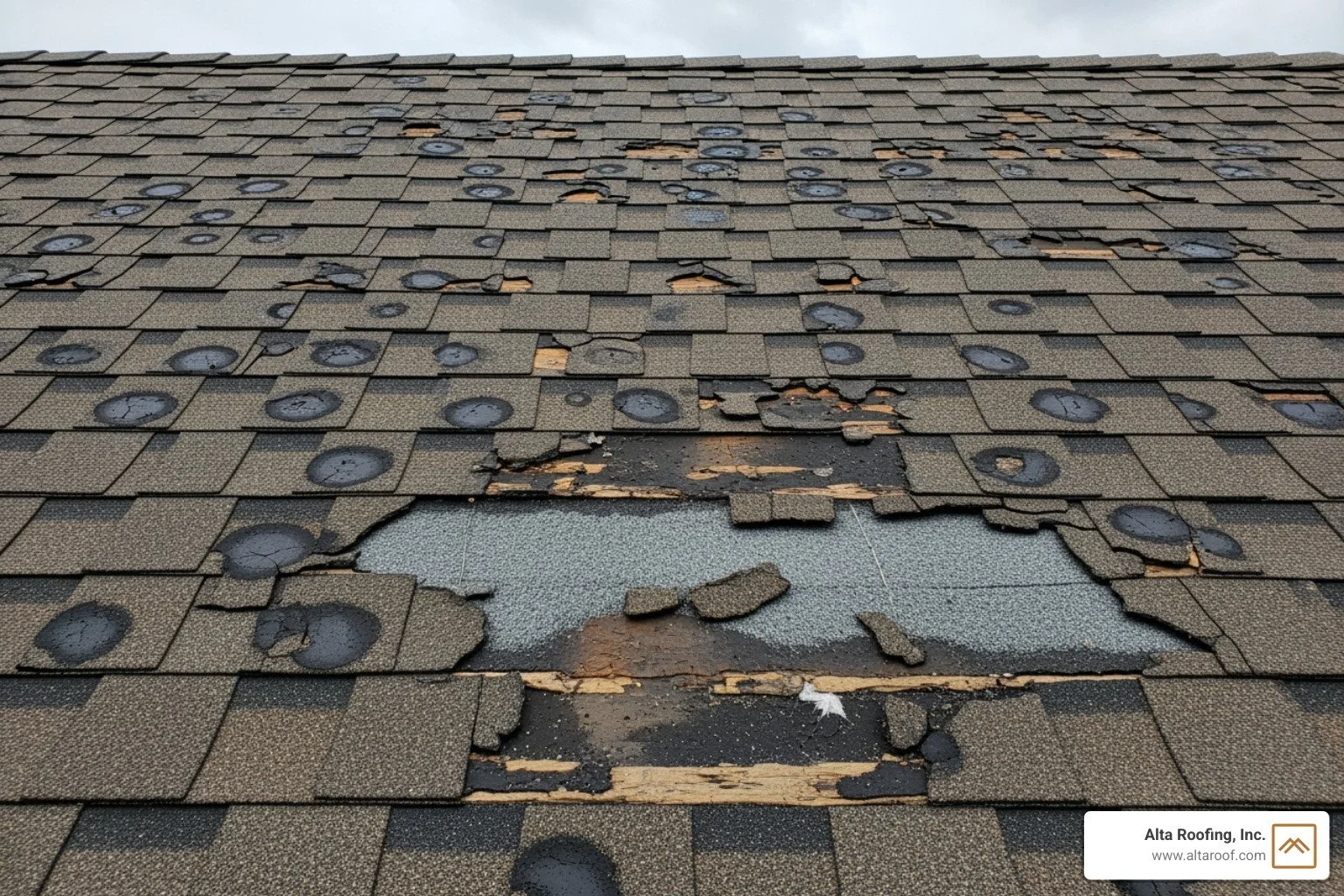
Is Your Roof Hail-Damaged? A Checklist for Homeowners
Why Identifying Hail Storm Roof Damage Quickly Protects Your Home and Investment
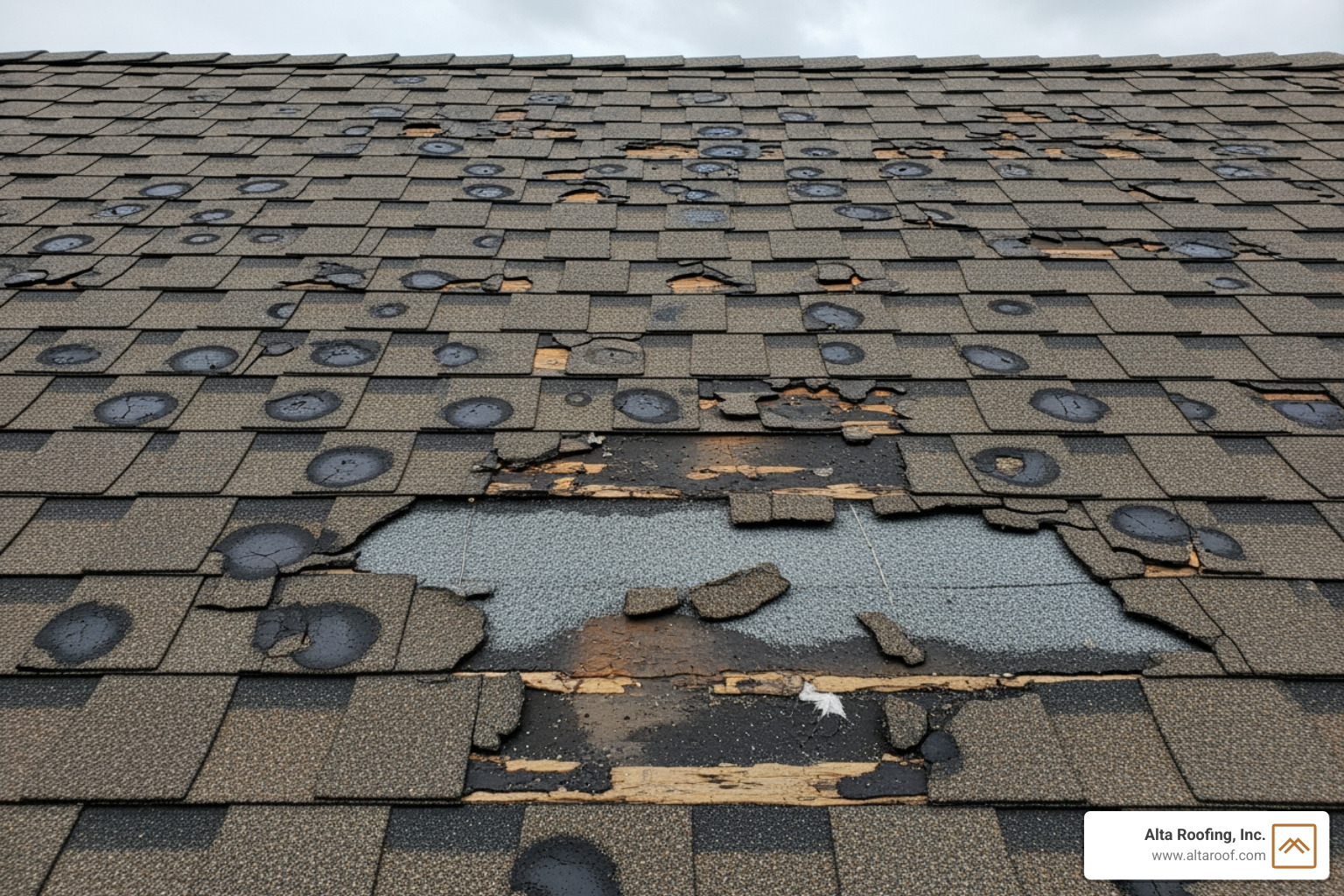
Hail storm roof damage is one of the most common and costly forms of weather-related property damage, causing over $1 billion in losses annually in the United States. When hailstones strike your roof, they can compromise shingles, crack tiles, and dent metal, creating vulnerabilities that lead to leaks, water intrusion, and mold. Understanding how to identify this damage is critical for protecting your home and ensuring a successful insurance claim.
Quick Answer: Key Signs of Hail Storm Roof Damage
- Asphalt Shingles: Missing granules, dark spots or "bruises," cracked or dented shingles, exposed fiberglass mat
- Metal Roofs: Dents and dings on panels, gutters, or vents
- Wood Shakes: Splintering, sharp-edged splits with brown/orange coloring
- Clay/Concrete Tiles: Chipped, cracked, or shattered tiles
- Collateral Damage: Dented gutters, damaged siding, cracked window sills, debris in downspouts
- Interior Signs: Water stains on ceilings or walls, visible attic damage
Hail damage isn't always obvious from the ground. Small dents, granule loss, and weakened seal strips may not be visible but can drastically shorten your roof's lifespan. Colorado homeowners are particularly vulnerable—the state is part of "Hail Alley" and experienced over 150 damaging hail storms in a recent year.
The consequences of ignoring hail damage are serious. Even minor impacts can allow water to seep beneath shingles, leading to rotting wood, compromised structural integrity, and expensive interior repairs. Most insurance policies cover hail damage, but you typically have six months to one year to file a claim and need thorough documentation to support it.
This checklist will walk you through everything you need to know: how to spot damage on different roofing materials, what immediate steps to take after a storm, how to steer the insurance claims process, and when to repair versus replace your roof.
I'm Barry Goers, founder of Alta Roofing, Inc., and I've spent years helping Colorado homeowners steer the complexities of storm restoration. Through our work with hundreds of families dealing with hail storm roof damage, I've learned that early identification and a clear action plan are the keys to a smooth recovery and full insurance reimbursement.
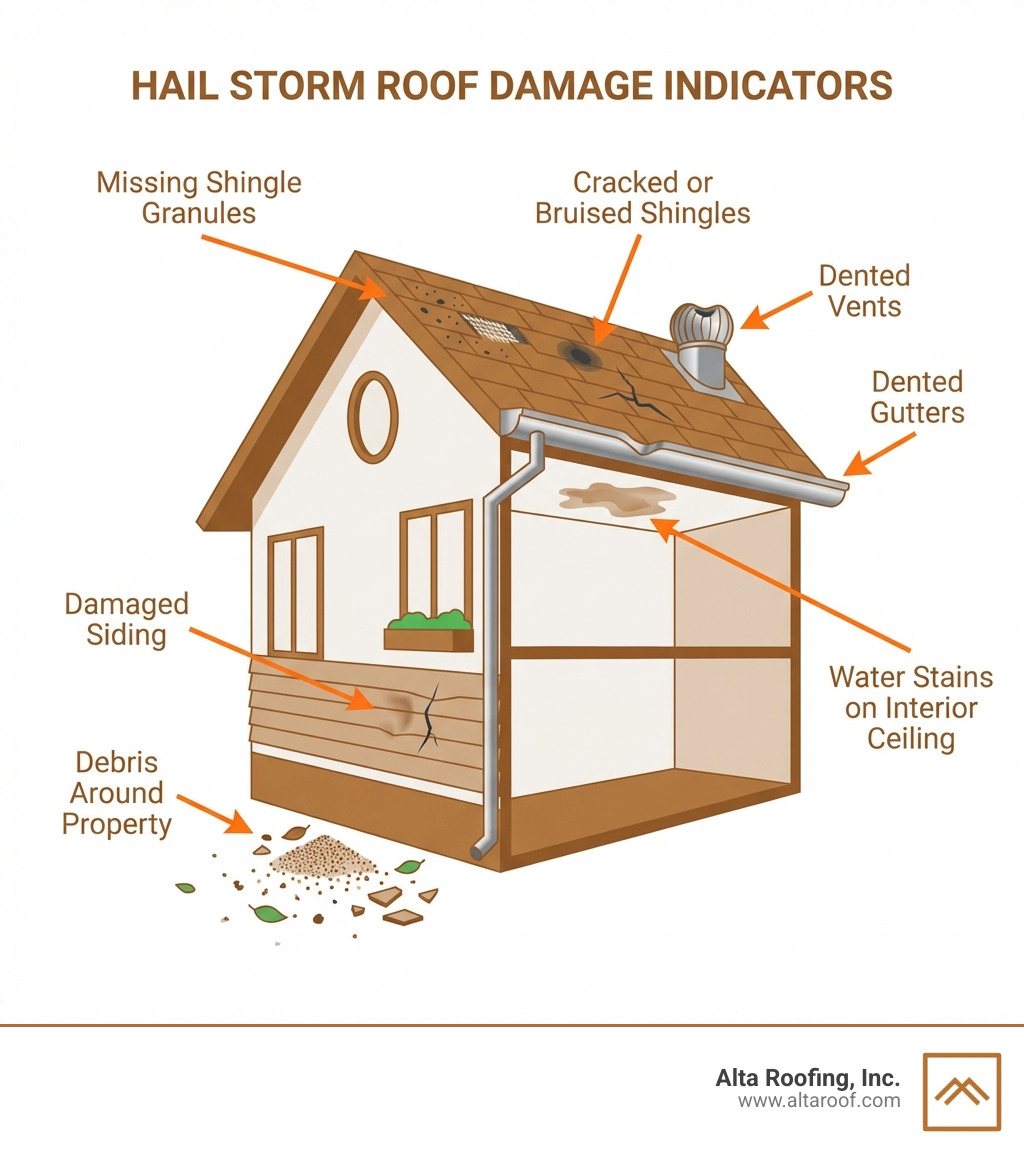
How to Spot Hail Damage on Your Roof (Even the Hidden Signs)
The first step is a thorough inspection from the ground up. Hail damage isn't always obvious, but certain clues can reveal the extent of the problem. Ignoring these signs can lead to costly water damage, mold growth, and structural issues down the line.
Signs of Hail Damage on Asphalt Shingles
Asphalt shingles are the most common roofing material in Colorado and across the U.S., covering about 75% of homes. This means they're often the first line of defense against hailstones, and they show hail storm roof damage in distinct ways.
When hail strikes an asphalt shingle, it dislodges protective granules that shield it from UV rays and weather. This granule loss appears as dark spots or "bruises," and you may find loose granules in your gutters. These spots aren't just cosmetic; they expose the asphalt to sunlight, accelerating its deterioration and shortening the shingle's lifespan.
Beyond granule loss, look for random impact marks that have no discernable pattern. These are often circular or irregular depressions. If you gently press on these areas, they might feel soft or bruised spots, similar to a ripe apple. This "bruising" indicates that the hailstone has fractured the fiberglass mat beneath the asphalt, compromising the shingle's structural integrity.
Other critical signs of hail storm roof damage on asphalt shingles include cracked shingles. These cracks can range from small, hairline fractures to larger, more noticeable breaks. Sometimes, the impact can cause the shingle to lose its seal, leading to exposed fiberglass mat where the asphalt and granules have been completely removed. You might also notice "black hits" or areas where the asphalt appears shiny, indicating that the protective layer is gone.
It's important to differentiate actual hail damage from normal wear and tear. Blistering, cracking from UV degradation, or scuffing from installation can mimic hail damage. However, true hail impact will typically leave a random pattern of strike marks and a detectable "bruise" in the shingle's mat. For a visual guide on what to look for, check out this resource on how to identify hail damage.
Signs of Damage on Wood, Metal, and Tile Roofs
While asphalt shingles are prevalent, many Colorado homes feature other roofing materials, each with its own way of showing hail storm roof damage.
Wood shakes and shingles, for instance, are beautiful but can be vulnerable. Hail impacts on wood can cause splintering and deep cracks. You might observe a split in the shake that looks brown or orange, with sharp corners and edges, and little to no weathering at the edges. These impacts can also lead to missing or dislodged shakes, exposing the underlayment and making your roof highly susceptible to leaks.
Metal roofing, while generally more durable against hail than asphalt, isn't entirely immune, especially to larger hailstones. While normal-sized hail might not leave a mark, extremely large hailstones can create noticeable dents and dings on the panels. These dents can compromise the protective coating, potentially leading to rust and corrosion over time if left unaddressed. We've seen many metal roofs in areas like Denver and Aurora withstand smaller hail with ease, but those softball-sized chunks can still wreak havoc.
For homes with clay or concrete tiles, hail storm roof damage often manifests as chipped or shattered tiles. A severe hailstorm can make a tile roof look like it was hit with a hammer. You might also find tiles that have shifted, slid, or fallen off, which can expose the underlayment to the elements. These tiles are rigid, so instead of bruising, they tend to break upon impact.
If you have any of these roofing types, a careful inspection after a storm is crucial. Our Our Work gallery features examples of how different roofing materials can be affected by severe weather.
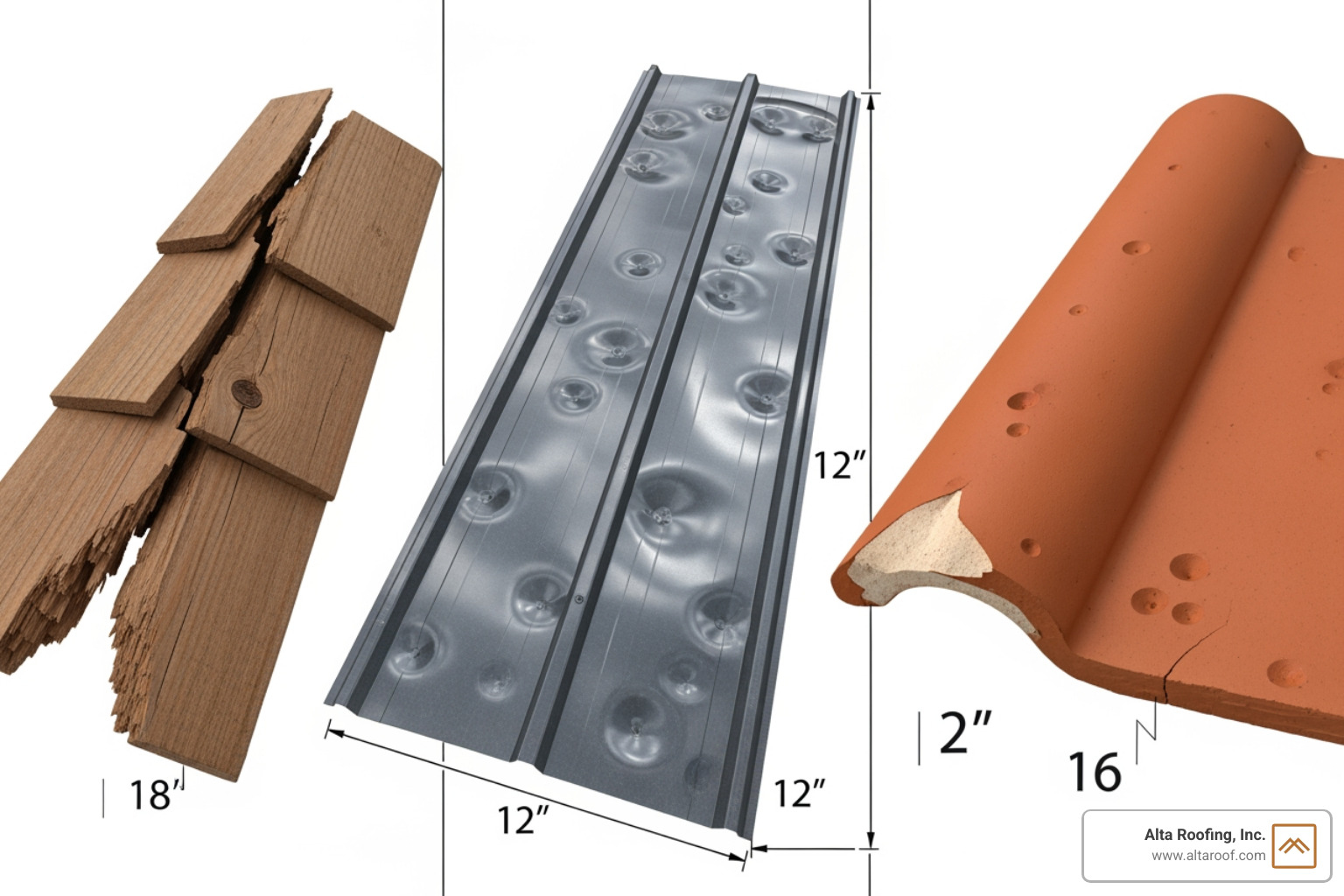
Collateral Damage: Clues from Around Your Property
Sometimes, the most obvious signs of a hailstorm's intensity aren't on the roof itself, but in the surrounding areas of your property. These "collateral damages" serve as strong indicators that your roof likely sustained damage as well.
Look for dented gutters and damaged downspouts. If these metal components, which are typically quite sturdy, show dents, it's a clear sign that hail of a significant size and force fell on your property. The same applies to chipped siding or cracked window sills. Vinyl siding can crack, and aluminum siding can dent from hail impacts. Even seemingly minor issues like paint chips on window frames or dented mailboxes can tell a story of a powerful hailstorm.
Don't forget to check your A/C units for dented fins or covers, and inspect any outdoor furniture, decks, or fences for impact marks. Spatter marks, where hail knocks oxidation or dirt off metal surfaces, are also a good sign that hail occurred, even if not directly damaging the surface. These observations are critical for painting a complete picture of the storm's severity for your insurance claim.
Colorado, being a prominent part of what's known as Hail Alley, experiences these types of widespread damages frequently. If you observe any of these external signs around your home in Colorado Springs, Castle Rock, or any of our service areas, it's highly probable that your roof also experienced significant hail storm roof damage.
Your Immediate Post-Storm Action Plan
After a severe storm, a calm and methodical approach is best. Follow these steps to secure your property and prepare for the restoration process. Your safety is the top priority—never climb on a wet or potentially damaged roof.
Step 1: Document Everything
Thorough documentation is the most crucial step after a hailstorm and the backbone of a successful insurance claim for hail storm roof damage.
Start by taking photos and record videos of all visible damage, both inside and outside your home. This includes your roof (from the ground, using a zoom lens or binoculars if necessary), siding, windows, gutters, outdoor furniture, vehicles, and anything else impacted. Make sure to note the date and time the storm occurred and when you're documenting the damage. If it's safe to do so, try to measure hailstones you find on the ground by placing a ruler or common object (like a coin) next to them for scale in your photos.
Create a detailed inventory of all damaged items, describing the damage clearly. The more evidence you collect, the stronger your claim will be. This shows your insurance provider the full extent of the loss and helps prevent disputes later on.
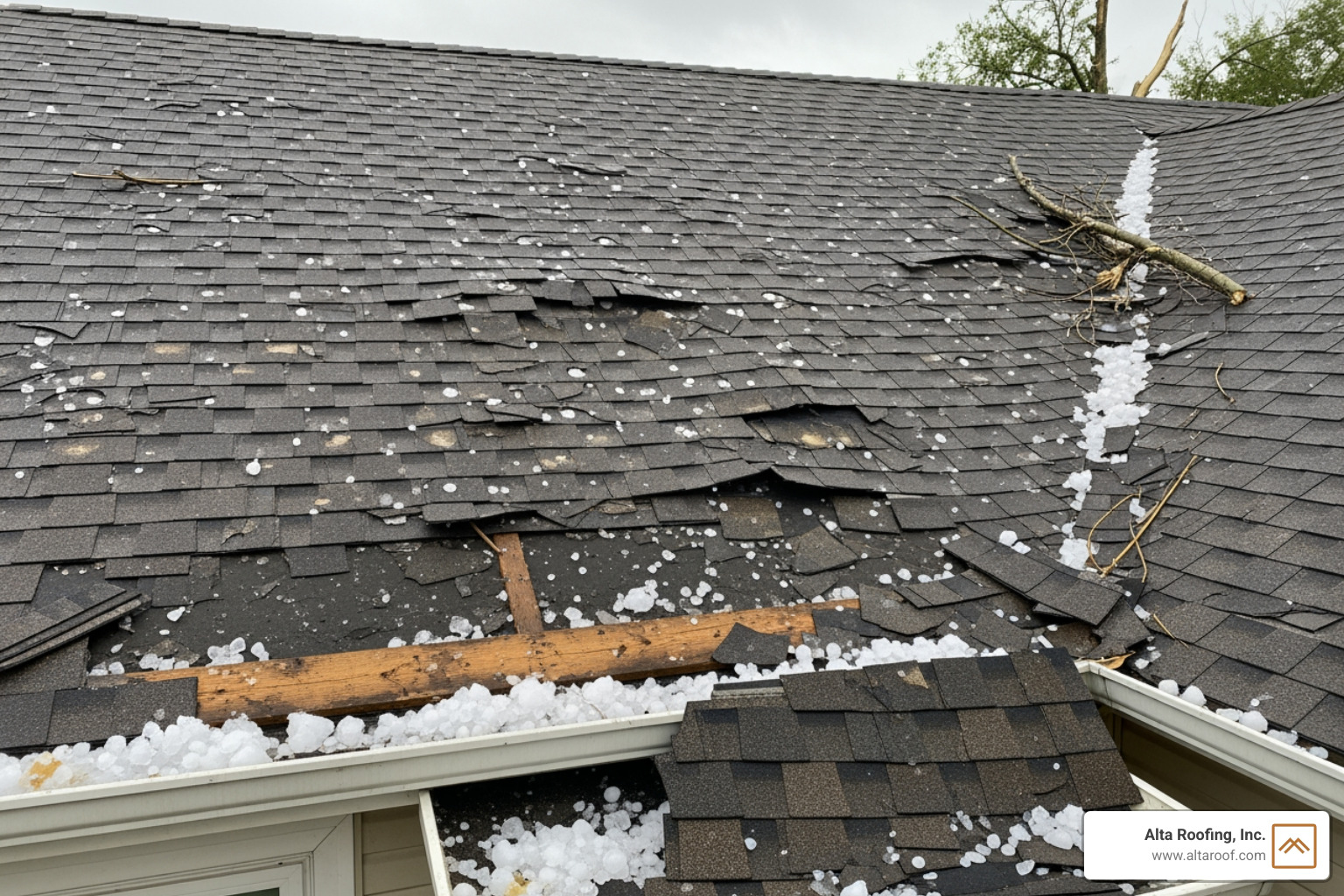
Step 2: Perform Temporary Fixes
Once you've documented the damage, your priority is to prevent further damage. This is often an insurance policy requirement and shows you are actively mitigating the loss.
If you have active leaks inside your home, carefully place buckets or tarps to catch the water. For significant roof damage, such as large holes, you may need to perform tarping leaks. This involves temporarily covering the damaged area with a tarp to prevent more water from entering. If windows are broken, consider boarding broken windows to secure your home.
It's vital to keep all receipts for emergency materials you purchase for these temporary fixes. Your insurance policy will typically reimburse you for these costs. While we don't recommend climbing onto a damaged roof yourself, you can often find professional emergency tarping services to handle this safely.
Step 3: Get a Professional Inspection
Even if you've done a thorough ground-level inspection, a professional assessment is indispensable. We strongly advise against climbing on your roof after a storm due to safety risks and the potential for causing more damage. Instead, contact a qualified roofer as soon as possible.
A professional roofer from Alta Roofing, serving areas like Thornton, Lakewood, and Golden, understands the nuances of hail storm roof damage and can identify hidden damage that might not be obvious to an untrained eye. They can distinguish actual hail damage from normal wear and tear or other types of issues. Our team will provide a detailed damage report and accurate cost estimates for repairs or replacement. This expert assessment is crucial for your insurance claim, as it provides credibility and ensures all damage is accounted for. For more information about our comprehensive storm damage services, including inspections and repairs, visit our dedicated page: More info about our storm damage services.
Navigating the Insurance Maze for Hail Storm Roof Damage
Filing an insurance claim can be intimidating, but understanding the process is key to a successful outcome. Most standard homeowner policies cover hail damage, but the specifics can vary.
Understanding Your Homeowner's Policy
Before filing a claim, understand your homeowner's insurance policy. We encourage all homeowners in Castle Pines, Monument, and throughout Colorado to review their policy documents.
Pay close attention to whether your policy covers damage on an Actual Cash Value (ACV) basis or a Replacement Cost Value (RCV) basis. ACV policies pay out the depreciated value of your roof, meaning they subtract for age and wear, leaving you to cover the difference for a new roof. RCV policies, on the other hand, cover the cost of replacing your roof with a new one of similar quality, without deducting for depreciation.
Also, be aware of your deductibles. Most homeowner policies have a 1-2% deductible, meaning you'll need to pay that percentage of your home's insured value before your coverage kicks in. For example, if your home is insured for $500,000 and you have a 1% deductible, you'll pay the first $5,000. It's usually only worth filing a claim if the damage significantly exceeds your deductible.
Finally, note any filing deadlines and policy exclusions. Most policies give you anywhere from six months to one year to file a claim after the storm event, but some can be shorter. Missing this window could mean your claim is denied. Understanding these aspects allows you to approach your claim with confidence and avoid unwelcome surprises.
The Step-by-Step Process for Filing a Hail Storm Roof Damage Claim
Filing a claim for hail storm roof damage can feel overwhelming, but by breaking it down into manageable steps, we can guide you through it.
- Contact your insurance agent: As soon as you've identified potential damage and performed temporary fixes, call your insurance provider or agent. You can often file a claim through their website or app as well. Provide them with the date of loss and a preliminary description of the damage.
- File the claim promptly: Don't delay. Even if you're within the filing window, prompt action can streamline the process.
- Schedule the adjuster's visit: Your insurance company will assign an adjuster to inspect your roof and assess the damage.
- Have your contractor present during the inspection: This is where our expertise at Alta Roofing truly shines. We recommend that one of our experienced roofing professionals, familiar with Colorado's specific storm patterns, be present when the insurance adjuster inspects your roof. We can point out all the subtle signs of hail storm roof damage that might otherwise be missed, ensuring a comprehensive assessment. This greatly increases the likelihood of a fair and accurate payout.
- Provide your documentation: Share all the photos, videos, and detailed inventory you collected in Step 1 of your action plan with both the adjuster and your contractor.
The goal is to ensure all damage is identified and covered so that your home in areas like Littleton, Lone Tree, or Fountain can be fully restored.
What If Your Claim is Denied or Underpaid?
If your claim for hail storm roof damage is denied or the initial offer seems insufficient, don't despair—you have options.
First, review the adjuster's report carefully. Does it align with what your roofing contractor found? If there are discrepancies, communicate with your insurer to understand why. Ask for specific reasons for the denial or the lower payout.
You have the right to request a second inspection, especially if your contractor believes significant damage was overlooked. We've often found that a second look, particularly with a knowledgeable contractor present, can reveal previously missed damage.
It's also important to understand your right to an independent appraisal. If you and your insurer can't agree on the scope or cost of repairs, your policy may have an appraisal clause, allowing both parties to hire independent appraisers who then select an umpire to resolve disputes.
In more challenging situations, you might consider contacting an attorney specializing in insurance claims or filing a complaint with the Colorado Division of Insurance. For more detailed guidance on navigating difficult claims, this Angi article provides helpful insights: Everything You Need to Know About the Hail Damage Insurance Claim Process.
Repair vs. Replacement: Making the Right Call
Once the damage is assessed, you'll face a critical decision: repair or replace? The right choice depends on the age of your roof, the extent of the damage, and your long-term goals.
When to Repair Your Hail Storm Roof Damage
Sometimes, a full roof replacement isn't necessary. Repairs can be a viable and cost-effective solution for hail storm roof damage when the damage is:
- Minor or localized damage: If only a small section of your roof, or a few scattered shingles, have been impacted, spot repairs might suffice. This is often the case with smaller hailstones or damage concentrated in one area due to wind patterns.
- Newer roof (under 10 years old): A relatively new roof with minor damage can often be repaired without compromising its overall lifespan. Replacing a few shingles is much less disruptive and expensive than a full overhaul.
- Budget constraints: While insurance often covers replacements, if you're paying out-of-pocket or dealing with a high deductible for very localized damage, repairs can be a more immediate financial option.
- Matching shingles are available: For repairs to blend seamlessly and maintain curb appeal, it's crucial to find shingles that perfectly match your existing roof in color and style. If your roof is older, this can sometimes be a challenge due to discontinuation of products or fading of existing materials.
Even with repairs, address them promptly. Small cracks or leaks, left unchecked, can lead to thousands of dollars in water damage and mold growth.
When a Full Roof Replacement is Necessary
While repairs can be a temporary solution, a full roof replacement is often the only prudent course of action for hail storm roof damage, particularly in areas like Centennial, Englewood, and Colorado Springs, where severe hailstorms are common.
- Widespread damage: If hail has impacted a significant portion of your roof, causing numerous bruises, cracks, or granule loss across multiple slopes, a full replacement is usually recommended. Patching many areas can lead to an uneven roof and compromise its overall integrity.
- Older roof (over 15-20 years): Even if the damage seems moderate, if your roof is nearing the end of its typical lifespan (asphalt shingles usually last 20-30 years), a hailstorm can be the final straw. An older roof is more brittle and susceptible to damage, and repairs might not extend its life significantly enough to be cost-effective. In such cases, insurance companies are often more inclined to approve a full replacement.
- Multiple leaks: If your home is experiencing multiple leaks after a hailstorm, it's a strong indicator of widespread compromise that likely requires a complete re-roof.
- Insurance company approves a full replacement: Your insurance company's assessment will play a major role. If their adjuster, often with the input of your roofing contractor, determines that the damage warrants a full replacement, then it's usually the best path forward.
Choosing between repair and replacement can be a complex decision. Our article, How to Know When It's Time to Replace Your Roof, offers more detailed guidance.
Upgrading for Future Protection
When you do opt for a roof replacement, it presents a fantastic opportunity to upgrade your home's protection against future hailstorms, especially here in Colorado. Investing in impact-resistant materials can provide significant long-term benefits.
The gold standard for hail resistance is a Class 4 rating from Underwriters Laboratories (UL 2218 standard) or FM 4473 standard. These materials, often made from specialized composites or modified asphalt, are tested to withstand the impact of steel balls dropped from significant heights. Many insurance providers offer lower premiums for roofs with a Class 4 rating due to their improved durability.
Metal roofing is another excellent option for superior hail protection. Products like DECRA metal roofs carry the highest UL rating for hail impact resistance and are often warranted against damage from hailstones up to 2.5 inches in diameter. Beyond hail, metal roofs offer a host of other benefits:
- Longer Lifespan: Metal roofing lasts two to three times longer than traditional roofing materials, often extending 50 years or more.
- Lower Cooling Costs: By reflecting sunlight, metal roofs can lower cooling expenses by up to 25%, a welcome feature in sunny Colorado summers.
- High ROI and Increased Home Value: Homeowners can recoup up to 85.9% of the installation cost of a metal roof, and it can boost your home's value by up to 6%.
- Insurance Discounts: As mentioned, many insurance providers offer discounts due to their durability and resistance to various weather perils, including hail and fire (Class A fire rating).
Upgrading to these durable materials can provide immense peace of mind and potentially save you money in the long run.
| Material Type | Durability Against Hail | Lifespan (Years) | Average Cost (Installed) |
|---|---|---|---|
| Asphalt Shingles | Moderate (susceptible to granule loss, bruising, cracking) | 15-30 | $5,000 - $15,000 (standard, for average-sized roof) |
| Class 4 Impact-Resistant Shingles | High (designed to withstand larger hail impacts) | 25-50 | $8,000 - $20,000 (for average-sized roof, often with insurance discounts) |
| Metal Roofing | Very High (excellent resistance, often warranted for large hail) | 40-70+ | $15,000 - $40,000+ (varies greatly by style and material, offers long-term savings) |
Frequently Asked Questions about Hail Damage
We understand that homeowners in Colorado have many questions about hail storm roof damage. Here are some of the most common ones we hear:
How long do I have to file a hail damage claim?
This is a critical question. The answer varies by policy, but most require you to file a claim within six months to one year of the storm. Some policies have shorter deadlines, so it's always best to report potential damage as soon as you find it. We recommend checking your policy or contacting your agent immediately after a storm in areas like Parker, Arvada, or Highlands Ranch.
Will my insurance premiums go up if I file a hail claim?
In many states, including Colorado, insurance companies generally cannot single you out for a rate increase solely for filing a claim due to a natural disaster, often called an "Act of God." Hail damage typically falls into this category. However, if there are widespread claims in your area (like after a major hailstorm in Denver or Colorado Springs), overall insurance rates might rise for everyone in that region. Your individual claims history can still influence your rates over time, but one hail claim usually won't cause a direct, individual premium hike.
What's the difference between cosmetic and functional damage?
This distinction is incredibly important when dealing with insurance claims for hail storm roof damage.
- Functional damage impairs the roof's ability to shed water and protect your home. This includes things like fractures in the shingle mat, exposed fiberglass, significant granule loss that leads to accelerated deterioration, or actual holes that could lead to leaks. Functional damage compromises the roof's primary purpose.
- Cosmetic damage, on the other hand, only affects the roof's appearance. This might include minor dents on metal flashing, slight surface scuffs that don't compromise the shingle's integrity, or minor granule loss that doesn't expose the asphalt layer. Many insurance policies will only cover functional damage, meaning they won't pay for repairs if the damage is purely aesthetic and doesn't impact the roof's protective capabilities. This is often a point of contention, and having a knowledgeable roofing contractor, like Alta Roofing, present during the adjuster's inspection can help advocate for what truly constitutes functional damage.
Protect Your Home with a Trusted Partner
Addressing hail storm roof damage requires careful attention to detail. By documenting damage, understanding your insurance policy, and making an informed decision on repairs or replacement, you can restore your home's integrity. Choosing a reputable contractor who specializes in storm restoration is the most important step. A trusted expert like Alta Roofing can manage the entire process—from inspection and insurance negotiation to coordinating all repairs—ensuring your home is protected for years to come.
We understand that dealing with hail storm roof damage can be stressful. That's why we pride ourselves on being a single point of contact for homeowners throughout Colorado, including Woodland Park, Elizabeth, and Monument. Our team handles the complexities of insurance claims and coordinates all necessary trades, so you don't have to. We're here to make your storm restoration as smooth and seamless as possible.
Ready to get a professional opinion on your roof? Contact Us today for a free, no-obligation inspection.
Leaky Roof? Don't Wait! Expert Repair Services Explained
Why Immediate Action on a Leaking Roof Matters

Leaking roof repair service is critical when you notice water stains, dripping sounds, or moisture in your home. Here's what you need to know right away:
- Immediate Action Required: Place buckets under active leaks, move valuables, and turn off electricity to affected areas
- Professional Help Needed For: Widespread damage, structural issues, mold presence, or leaks around chimneys and skylights
- Average Repair Cost: $350-$1,500 for most repairs, with labor running $45-$80 per hour
- DIY vs. Professional: Temporary fixes like tarping can help in emergencies, but professional assessment is essential for long-term solutions
- Replacement Consideration: If repair costs exceed 30% of replacement cost or your roof is nearing end of lifespan (15-20 years for asphalt shingles)
Whether you hear a drip, see a stain, or feel a drop, a roof leak means you need to act fast. Even a small leak can cause serious problems. Water travels along rafters, soaking insulation, rotting wood, and creating ideal conditions for mold. A minor issue can quickly become thousands of dollars in damage to your ceilings, walls, and foundation.
The good news is that most roof leaks can be fixed before causing major damage if you know what to do. This guide covers everything from emergency damage control and repair costs to the crucial decision between repair and replacement. You'll learn how to protect your home and how a professional leaking roof repair service can solve the problem for good.
I'm Barry Goers, and through my work with Alta Roofing and other construction ventures, I've seen how quickly Colorado storms can damage roofs and how critical fast, reliable leaking roof repair service becomes. Understanding both the immediate steps and long-term solutions can save homeowners thousands in potential damage.
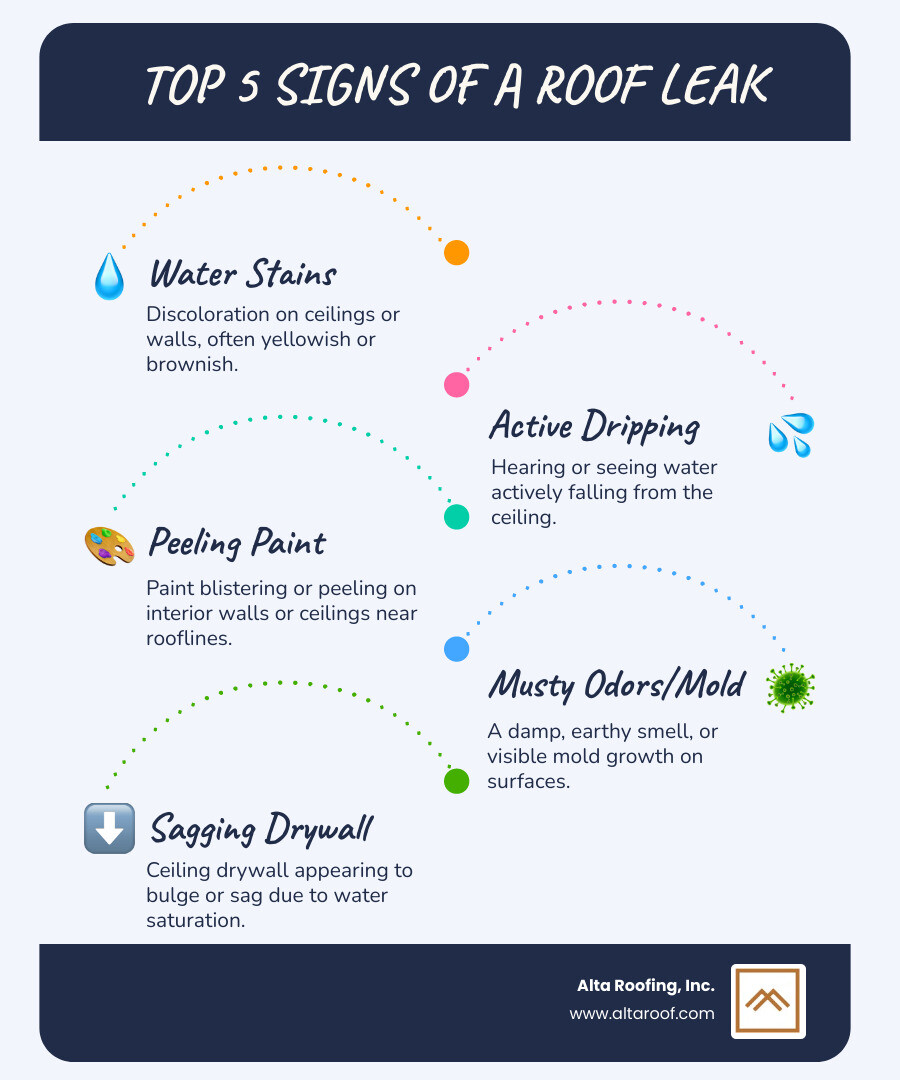
First Response: What to Do When You Spot a Leak
When you spot a leak, your first priority is damage control. Taking immediate, calm action can significantly reduce the potential for damage to your home and belongings.
The very first thing we recommend is to grab a bucket to catch any active drips. If the leak is widespread, a handy trick is to hang a tarp from the ceiling to funnel the water into a single bucket. You can even use a piece of string, tied from the leak point down into the bucket, to guide the water and minimize splashing.
Next, move any valuable furniture, electronics, or personal belongings to a dry area. Cover floors and remaining furniture with plastic sheeting or old towels. Water travels, so the stained spot on your ceiling might not be directly below the leak source.
Perhaps the most critical step, especially if the leak is near light fixtures or electrical outlets, is to prioritize electrical safety. A leaky roof could pose a fire threat from shorted wires in an attic or ceiling. It is highly recommended to turn off electricity to the affected area at your main breaker panel. If you suspect any electrical components have been compromised, do not touch them, and call an electrician immediately. For a comprehensive guide on what to do when your roof leaks, we often refer homeowners to resources like this guide on what to do when your roof leaks.
Signs That Indicate a Roof Leak
Knowing the signs of a leak can help you catch issues early. Look out for:
- Water stains on ceilings or walls: These are often brown or yellow discoloration, sometimes with a distinct ring pattern.
- Active dripping: This is the most unmistakable sign, especially during or after rainfall.
- Peeling paint near rooflines: Water seeping into walls can cause paint and wallpaper to bubble, crack, or peel.
- Musty odors or visible mold: A damp, earthy odor, especially in your attic or upper floors, could indicate hidden moisture and mold growth.
- Sagging ceiling drywall: Accumulated water can saturate drywall, causing it to sag or bulge, indicating a significant amount of water.
- Exterior wall spots: Water can run down inside your walls and show up as stains on the exterior siding.
Common Causes of a Leaking Roof
Understanding the cause of a leak is the first step toward an effective leaking roof repair service. Common factors are often exacerbated by Colorado's weather.
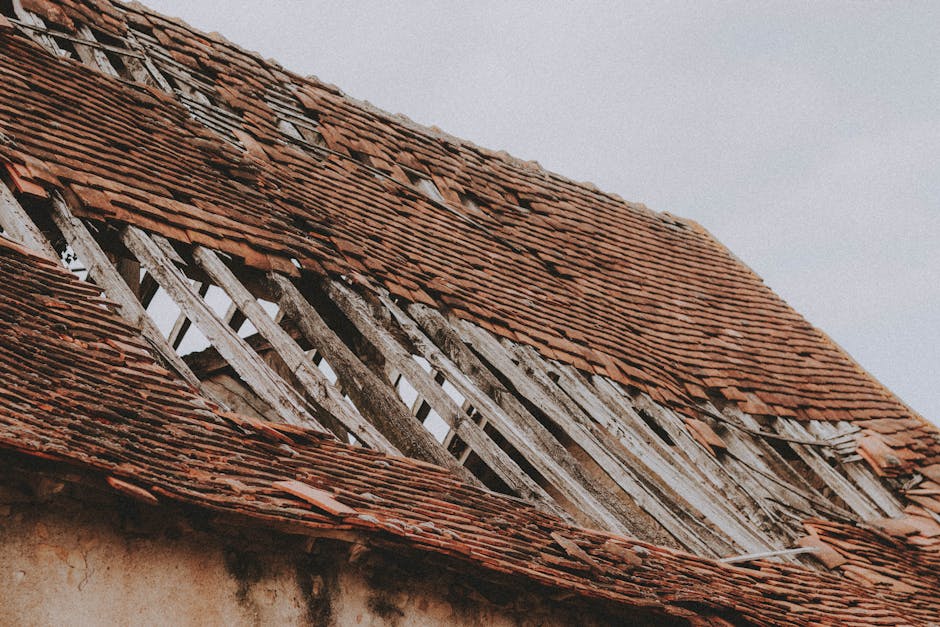
Here are some of the most common culprits we encounter:
- Damaged or missing shingles: High winds, hail, or age can cause shingles to crack, curl, or blow off, creating entry points for water.
- Aged roofing materials: Over time, all roofing materials degrade from UV rays, temperature fluctuations, and exposure, causing them to become brittle and crack.
- Cracked or worn flashing: Flashing, the metal or rubber strips around chimneys, vents, and skylights, is crucial for sealing these areas. If it cracks or pulls away, water will find its way in.
- Ice dams (especially in Colorado): A significant concern in Colorado, ice dams form when snow melts, runs down, and refreezes at the colder eaves. This dam causes water to back up under shingles and seep into your home.
- Clogged gutters: Full gutters cause water to overflow, pool at the roof's edge, and potentially seep under shingles or into your walls.
- Storm damage from wind or hail: Severe weather like hailstorms can crack shingles, while strong winds can lift or tear them away, leaving your roof exposed.
For more information on the various issues that can lead to water intrusion, you can refer to common causes of roof leaks.
Pinpointing the Problem: How to Find the Source of a Roof Leak
Finding the source of a roof leak can be tricky because water travels. A drip on your ceiling might be several feet from the actual entry point, as water runs along rafters and pipes before appearing.
Our process for locating a leak often starts with a thorough attic inspection. Using a flashlight, we look for signs of water intrusion on the underside of the roof decking, rafters, and insulation, such as water stains, wet spots, or mold. Sometimes, daylight is visible through a hole.
If the leak isn't obvious in the attic, we may use the "garden hose test." This involves one person systematically spraying sections of the roof while another person watches for drips inside. We start low and work up, isolating sections until the leak appears. This helps pinpoint the exact area. Always prioritize safety when working on a roof and have a helper.
Here's a list of common leak locations we carefully inspect:
- Vents: Plumbing, exhaust, and attic vents can leak if their seals or flashing become cracked or loose.
- Chimneys: The flashing around a chimney is a very common leak point that can crack, pull away, or deteriorate.
- Skylights: Similar to chimneys, skylights are vulnerable around their perimeters where seals can break down or flashing can fail.
- Valleys: These are the V-shaped channels where two roof planes meet. Damaged or clogged flashing in a valley almost guarantees a leak.
- Flashing points: Any area where the roof meets a vertical surface has flashing. Failure of these critical seals is a frequent cause of leaks.
DIY Fixes vs. Professional Leaking Roof Repair Service
Many homeowners wonder if they can fix a leaky roof themselves. While the DIY spirit is admirable, it's crucial to know the difference between a temporary patch and a lasting solution, and when to call professionals for a reliable leaking roof repair service.
Temporary DIY Fixes for Emergencies
Temporary DIY fixes can prevent further damage while you wait for professional help. These are not long-term solutions, but they can buy you precious time.
- Roof tarping method: This is an effective temporary fix. Use a large, heavy-duty tarp to cover the leaky area, extending several feet beyond it. Secure the tarp by rolling its edges around 2x4 boards and weighing them down or attaching them with ropes. Do not nail the tarp into the roof, as this creates more holes. You can find more detailed instructions on how to make temporary roof repairs.
- Applying roofing cement or sealant: For small, known holes, a dab of roofing cement or silicone sealant can provide a temporary patch after cleaning the area thoroughly. This is a short-term fix.
- Sliding in temporary flashing: If a shingle is missing, you can slide a piece of galvanized sheet metal flashing underneath the damaged area to divert water. This is a stop-gap measure.
When to Call a Professional Leaking Roof Repair Service
While temporary fixes can help, calling a professional leaking roof repair service is essential for your safety and your home's longevity in the following situations:
- Widespread damage: If the leak is due to multiple damaged shingles, large-scale flashing issues, or structural problems, it's beyond a simple DIY patch.
- Leak is difficult to find: If you can't pinpoint the source, a professional has the tools and experience to locate elusive leaks.
- Signs of rotted wood or structural issues: Soft wood or sagging ceilings indicate significant water damage that requires expert assessment to ensure structural integrity.
- Mold is present: Mold is a health hazard and a sign of prolonged moisture. Professionals can address the leak and advise on remediation.
- Leaks around complex structures like chimneys or skylights: These areas require precise flashing and sealing. Improper DIY repairs can cause more damage.
- Safety concerns on steep or high roofs: Working on a roof is dangerous. If your roof is steep, high, or you're uncomfortable with heights, leave it to trained professionals with proper safety gear. Reviewing fall protection safety systems, such as this guide provided by Princeton University, highlights the serious risks involved.
Understanding the Cost of a Leaking Roof Repair Service
Homeowners often ask about the cost of leaking roof repair service. We believe in transparency and fair pricing.
On average, roof repairs in our service areas cost between $350 to $1,500. A minor repair like replacing a few shingles could be as low as $150, while more complex jobs range from $400 to $1,000. Labor costs typically fall between $45 and $80 per hour.
Key factors that influence the cost of your leaking roof repair service include:
- Roof material: Repairing asphalt shingles is generally less expensive than repairing tile, metal, or specialty roofs.
- Accessibility: A leak on a single-story home with an easily accessible roof will cost less to repair than one on a multi-story home with a steep pitch.
- Extent of damage: A small, localized leak is much cheaper to fix than one that has caused extensive damage to the roof deck, insulation, or interior.
- Time of year: Emergency repairs during peak storm season or winter might incur higher costs due to demand and challenging conditions.
For an accurate estimate custom to your specific situation, we offer free inspections and encourage you to get an Instant Quote from our team.
The Dangers of Delay: Why Ignoring a Leak is a Costly Mistake
It's tempting to put off a roof leak, but ignoring it is one of the most expensive mistakes a homeowner can make. A minor inconvenience can quickly escalate into costly problems, impacting your home's structure, your health, and your wallet.
Here are the potential long-term consequences of neglecting a leaky roof:
- Structural damage to rafters and joists: Water saturates and weakens wooden components in your attic and ceiling, leading to rot and instability.
- Ceiling and wall damage: Beyond stains, prolonged leaks cause plaster to bubble, paint to peel, and drywall to sag or collapse.
- Insulation destruction: Wet insulation loses its effectiveness, leading to higher energy bills, and can become a breeding ground for mold.
- Mold and mildew health risks: Mold can spread throughout the home’s structure and HVAC system, invading carpets and furniture. This can lead to serious health issues, including respiratory problems and allergies.
- Fire hazard from shorted wires: If electrical wiring is in a wet attic or ceiling, a leak could cause a fire from shorted wires. Turn off electricity to the affected area and have an electrician examine it.
- Foundation issues from prolonged water exposure: In severe cases, water running down the exterior can saturate the ground near your foundation, leading to erosion and potential cracks.
The initial dangers of a roof leak are damage to the attic and items stored there. If there is no attic, or the leak is large, it will damage the interior ceiling and nearby walls. These are not just theoretical problems; we've seen them in homes across Colorado. For more insights into the severe implications, you can read about the unexpected dangers of a leaky roof. Acting quickly with professional leaking roof repair service can save you from these costly and unhealthy outcomes.
Roof Repair vs. Roof Replacement: Making the Right Call
When we assess a roof leak, one of the most important decisions we help you make is whether a repair is sufficient or if a full roof replacement is the smarter long-term investment. This isn't always an easy choice, but considering several factors can guide us to the best solution for your Colorado home.
Here's a comparison to help you understand the options:
| Feature | Roof Repair | Roof Replacement |
|---|---|---|
| Cost | Lower upfront cost ($300-$3,000 for most repairs) | Higher upfront cost ($5,000-$15,000+) |
| Scope of Work | Addresses localized damage, specific leak sources | Replaces entire roofing system, including underlayment |
| Lifespan Impact | Extends life of existing roof if damage is minor | Provides a completely new lifespan for the roof |
| Warranty | Often limited to repaired section | Full manufacturer and labor warranty on new roof |
| Disruption | Less disruptive, quicker completion | More disruptive, longer completion time |
Here are the key factors we consider with you:
- Roof age: This is often the biggest factor. Most asphalt shingle roofs in Colorado last 15-20 years, though some can go up to 30 with ideal conditions and maintenance. If your roof is nearing or past its typical lifespan, a replacement is often more cost-effective in the long run than continuous repairs. Metal and tile roofs can last 50 years or longer.
- Extent of damage (localized vs. widespread): Is the leak due to a few missing shingles or a small section of damaged flashing? That's a strong candidate for repair. If there are multiple leaks in different areas, widespread shingle damage, or significant structural rot, a replacement makes more sense.
- Frequency of repairs: If you find yourself calling for leaking roof repair service every year for new issues, those recurring costs can quickly add up and even exceed the cost of a new roof. This is a clear sign that your roof's overall integrity is compromised.
- Long-term plans for the home: Are you planning to sell your home in the next few years? A new roof can significantly boost curb appeal and resale value. If you plan to stay long-term, investing in a replacement now can provide decades of peace of mind.
- Cost (30% rule): A good rule of thumb is the "30% rule." If the cost of repairs climbs to around 30 percent or more of what a full replacement would cost, investing in a new roof is often the smarter long-term decision.
We're here to help you weigh these factors and make an informed decision that protects your home and your investment. For a deeper dive into this crucial decision, we recommend reading our article on How to Know When It's Time to Replace Your Roof.
Frequently Asked Questions about Roof Leaks
Here are some of the most common questions we hear from Colorado homeowners about roof leaks.
How can I prevent future roof leaks?
Proactive maintenance can significantly reduce your risk. We recommend:
- Regular professional inspections: Schedule a professional roof inspection at least once a year (ideally in spring and fall) to spot potential issues early.
- Keep gutters clean: Clogged gutters cause water to back up under shingles. Clean them in the spring and fall.
- Trim overhanging tree branches: Branches can wear down or damage shingles. Keep them trimmed away from your roofline.
- Ensure proper attic ventilation: Good ventilation helps regulate temperature and moisture, preventing condensation and ice dams.
- Address minor issues promptly: Don't let a curled shingle or small crack escalate into a bigger problem.
How long does a roof repair take?
The duration of a roof repair depends on the damage.
- Simple repairs: Replacing a few shingles or sealing a small crack can often be done in 2-5 hours.
- More complex repairs: Issues involving flashing, the roof deck, or widespread damage might take a full day or longer, depending on weather and accessibility.
We always strive for efficient, timely repairs without compromising on quality.
Will my homeowner's insurance cover a roof leak?
Coverage depends on the cause of the leak.
- Typically covers sudden, accidental damage: Most policies cover leaks from unforeseen events like storms (wind, hail) or falling trees.
- Often excludes damage from lack of maintenance or old age: Policies generally do not cover leaks from gradual wear and tear or a roof's natural aging.
- Important note: Many policies also exclude damage that could have been prevented if the initial leak was addressed promptly, reinforcing the need for immediate action.
We have extensive experience working with insurance companies in Colorado and can help you steer the claims process with detailed documentation.
Your Partner in Roof Protection
We hope this guide has shed some light on the importance of addressing roof leaks promptly and effectively. From the moment you hear that dreaded drip, to the decision between repair and replacement, our goal is to empower you with the knowledge to protect your most valuable asset – your home.
The key steps are always: contain the immediate damage, identify the source of the leak, and then choose the most appropriate leaking roof repair service solution. Acting fast can save you significant money and prevent a host of headaches down the line.
At Alta Roofing, Inc., we are a Colorado-based roofing and storm restoration company specializing in roof replacement, repairs, and comprehensive storm damage restoration. We understand the unique challenges that homes in Denver, Aurora, Colorado Springs, and all our service areas face, from relentless hail to heavy snow. Our unique selling proposition is handling insurance claims and coordinating all necessary trades, acting as a single point of contact for homeowners, particularly here in Colorado. We're here to make the process as seamless and stress-free as possible.
Don't let a small leak turn into a big problem. For a comprehensive inspection and expert leaking roof repair service, contact our team today. Let us be your trusted partner in keeping your home safe and dry, no matter what the Colorado weather throws its way.
The Best Colorado Roofing Companies: Quality & Trust
Why Finding the Right Colorado Roofing Company Is So Important

Colorado roofing company choices matter more than in most states — and for good reason.
Colorado's climate is relentless. Hailstorms, heavy snowfall, high winds, and wildfire risk can all take a serious toll on your roof. One bad storm can leave you scrambling to find a trustworthy contractor, navigate a complex insurance claim, and coordinate multiple repairs — all at once.
Here's a quick look at the top factors to consider when choosing a Colorado roofer:
| Factor | Why It Matters |
|---|---|
| Licensing | Must hold a General Contractor and/or Roofing Contractor license |
| Insurance | Should carry General Liability and Workman's Compensation Insurance |
| Local Experience | Familiarity with Colorado weather, codes, and materials is essential |
| Reviews & Ratings | Look for A+ BBB ratings and strong Google review scores |
| Services Offered | Top roofers handle everything from storm damage to gutters and siding |
This guide walks you through exactly what to look for — from materials and credentials to insurance claims and storm restoration — so you can make a confident, informed decision.
I'm Barry Goers, an entrepreneur and investor with a deep focus on the construction industry, including the colorado roofing company landscape. My background gives me a front-row seat to what separates reliable roofing contractors from the rest. Let's get into it.
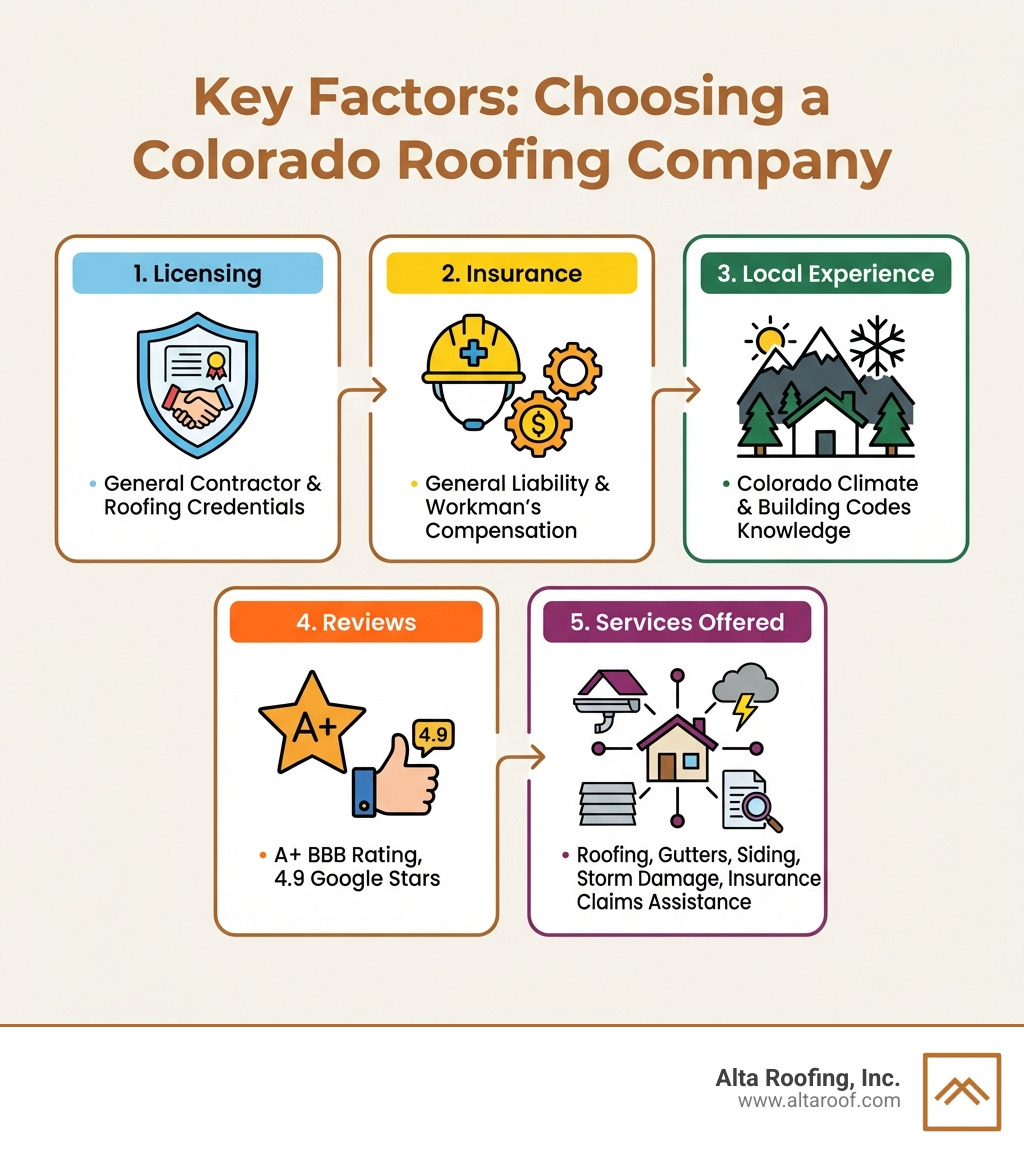
What to Expect from a Top-Tier Roofing Contractor
When you begin your search for a colorado roofing company, it is important to realize that the best in the business offer much more than just swinging a hammer. A top-tier contractor acts as a full-service exterior consultant. Because many of us in the Colorado industry have backgrounds in residential home building, we understand the "bones" of your house. We don't just look at the shingles; we look at the ventilation, the decking, and how the roof interacts with your siding and gutters.
Quality craftsmanship is the baseline, but a truly professional company provides a seamless end-to-end client experience. This includes transparent communication, organized project management, and a clean job site. Whether you are looking for residential protection or commercial durability, you should expect a team that treats your property with the same respect they would their own. You can explore the full range of what we provide by visiting our Services page.
Comprehensive Roofing and Exterior Solutions
A common mistake homeowners make is hiring one company for the roof, another for the gutters, and a third for the siding. In Colorado, where a single hailstorm can damage every facet of your home’s exterior, this creates a logistical nightmare.
The most reliable colorado roofing company options will offer a "one-stop-shop" approach. This includes:
- Full Roof Replacement: Tearing off old materials and installing a system built for the Front Range.
- Targeted Roof Repair: Fixing leaks or replacing missing shingles to extend the life of your current roof.
- Storm Damage Restoration: Comprehensive repair of everything hit by wind or hail.
- Detailed Roof Inspections: 10-point inspections that look for structural issues, not just surface wear.
- Gutters & Downspouts: Installing seamless systems that can handle heavy snow melt.
- Siding, Windows, & Painting: Updating your home's envelope for better energy efficiency and curb appeal.
- Solar Panel Integration: Ensuring your roof is solar-ready or coordinating panel removal and re-installation during a reroof.
To see the standard of quality we maintain across these different areas, take a look at Our Work.
Essential Roofing Materials for Colorado's Climate
Choosing the right material is a balance of aesthetics, budget, and durability. In Colorado, we have to worry about Class 4 hail (the big stuff) and high fire-risk zones.
| Material | Durability | Cost | Hail Resistance | Fire Rating |
|---|---|---|---|---|
| Asphalt Shingles | Moderate | $ | Varies (Class 4 available) | Class A |
| Metal Roofing | High | $$$ | Excellent | Class A |
| Concrete Tile | Very High | $$$ | Good | Class A |
| Synthetic/Composite | High | $$ | Excellent | Class A |
| Wood Shakes | Moderate | $$$ | Poor | Poor (unless treated) |
Asphalt Shingles are the most common choice due to affordability. However, we always recommend "Impact Resistant" (IR) shingles for Colorado homeowners, as many insurance providers offer premium discounts for these. Metal Roofing is an incredible upgrade; it sheds snow easily, preventing ice dams, and is virtually fireproof. For those in high-wind areas or mountain communities, Synthetic materials or Concrete tiles provide heavy-duty protection with a high-end look.
Hallmarks of a Trusted Professional
How do you separate the "storm chasers" from the established professionals? Look for specific credentials that prove a company is invested in the long haul.
- GAF Master Elite Contractor: Only about 2% of roofers nationwide hold this status. It requires high credit ratings, a strong local reputation, and ongoing training.
- CRA Membership: Being a member of the Colorado Roofing Association means the company adheres to a strict code of ethics and stays updated on local building codes.
- BBB A+ Rating: While no one is perfect, an A+ rating shows that the company resolves issues fairly and maintains high service standards.
- Warranties: You should receive two types of protection—a manufacturer’s warranty on the materials and a workmanship warranty from the contractor. At Alta Roofing, we pride ourselves on standing behind every nail we drive. You can learn more about our commitment to these standards on our About page.
Navigating Storms and Insurance Claims in Colorado
If you live in Denver, Colorado Springs, or anywhere along the Front Range, it’s not a matter of if a storm will hit, but when. Severe weather is the leading cause of roof failure in our state. Hail can bruise shingle mats, leading to leaks months later, while high winds can peel back entire sections of roofing.
Expert Storm Damage Assessment and Repair
When a storm passes, the damage isn't always obvious from the ground. A professional colorado roofing company will perform a comprehensive wind and hail damage analysis. We look for "bruising"—soft spots in the shingle where the fiberglass mat has fractured—and excessive granule loss in your gutters.
For our neighbors in mountain communities like Woodland Park or Monument, we also have to account for snow load and ice damming. If your roof isn't properly ventilated or lacks a "water and ice" shield at the eaves, melting snow can back up under your shingles and rot your roof deck. If you're wondering about the state of your home, check out our guide on How to Know When It's Time to Replace Your Roof.
Mastering the Insurance Claim Process
The most stressful part of a roof project isn't the construction; it's the paperwork. Navigating an insurance claim requires a specialized skill set. A quality roofer acts as your advocate, meeting the insurance adjuster on-site to ensure every bit of damage is documented and included in the scope of work.
Our USP at Alta Roofing is acting as a single point of contact. We don't just fix the roof; we coordinate the gutter guys, the painters, and the window installers so you don't have to manage five different schedules. For a deeper dive into this process, check out this Tips For Hiring a Roofing Contractor & Filing an Insurance Claim (video).
Proactive Maintenance for Year-Round Protection
You shouldn't wait for a leak to call a colorado roofing company. Proactive maintenance can add years to your roof's lifespan. This includes:
- Gutter Cleaning: Ensuring water flows away from your foundation.
- Heat Cable Systems: Installing RIM (Roof Ice Melt) systems to prevent dangerous ice buildup.
- Professional Snow Removal: Safely clearing heavy accumulations after a blizzard to prevent structural sagging.
- Annual Inspections: Catching small issues like cracked flashing or popped nails before they become expensive repairs.
If you want to get ahead of the next storm season, Contact us to set up a maintenance review.
How to Vet and Hire the Right Colorado Roofing Company
Choosing the wrong contractor can lead to "roofing scams"—a major issue in Colorado following big hailstorms. Unscrupulous companies may take a deposit and disappear, or perform "tailgate" repairs that fail within a year.
Your Vetting Checklist for a Reputable Colorado Roofing Company
Before signing any contract, run through this checklist:
- Verify Licenses: Ensure they are licensed in your specific municipality (e.g., Colorado Springs or Denver).
- Check Insurance: Ask for up-to-date certificates for General Liability and Workman's Comp. If a worker gets hurt on your property and the roofer isn't insured, you could be liable.
- Read Local Reviews: Don't just look at the star rating; read the comments. Are they responsive? Do they clean up the yard?
- Get a Written Estimate: Avoid "handshake" deals. A professional bid should detail materials, labor, disposal fees, and timelines.
- Consumer Resources: Use the Re-Roofing Checklist for Consumers provided by the CRA to ensure you aren't missing any red flags.
Why Local Expertise Matters for a Colorado Roofing Company
A "storm chaser" from out of state doesn't understand Colorado building codes. For example, many areas in the Denver Metro and Colorado Springs regions have specific requirements for "drip edge" installation and ice barrier protection that differ from other states.
A local company knows the regional weather patterns. We know that a roof in Castle Rock needs to be tougher than a roof in a milder climate. We are part of the community, serving areas from Arvada and Aurora to Fountain and Elizabeth. Being local means we’ll still be here in five years if you have a question or a warranty claim. You can book a time to speak with a local expert through our Appointments page.
Evaluating Customer Service and Financial Options
A roof is a major investment, often costing between $4 and $5 per square foot for standard asphalt shingles in the Denver area. Because of this, a great colorado roofing company should offer flexibility.
- Financing: Look for options like "same-as-cash" or low-monthly-payment plans through industry-leading lenders.
- Special Offers: Many companies offer discounts for seniors, military members, or seasonal promotions (like 10% off during slower months).
- Communication: Do they use a modern portal? Do they provide photo updates? Seamless communication is the hallmark of a company that genuinely cares.
If you are curious about what your project might cost, you can get an Instant Quote through our online tool.
Frequently Asked Questions about Colorado Roofers
How much does it cost to replace a roof in Colorado?
On average, replacing a standard asphalt shingle roof in Colorado costs between $10,000 and $20,000, though this varies wildly based on square footage. Factors that drive up the price include a steep roof slope (which requires more safety equipment), the choice of high-end materials like metal or tile, and the complexity of the roof's design (lots of valleys and dormers). Always ensure your quote includes the cost of tearing off the old roof and disposing of the debris.
How do I know if my roof has hail damage?
Aside from obvious leaks, look for "dents" in your gutters, downspouts, or soft metal vents on the roof. If you see a lot of shingle granules (which look like coarse sand) washing out of your downspouts after a storm, that’s a sign your shingles are losing their protective layer. "Bruising" on the shingles is the most common sign, but it usually requires a professional to spot. You can find more visual aids in this Guide: Hailstorms and Your Roof.
Can I put solar panels on an old roof?
We generally recommend that if your roof is more than 10 years old, you should replace it before installing solar. Solar panels are meant to last 25+ years; if your roof fails in 5 years, you will have to pay thousands of dollars just to detach and reset the panels to fix the roof underneath. Many homeowners choose to bundle these projects to save on labor and take advantage of federal tax credits.
Conclusion: Partnering with a Trusted Colorado Roofer
Your roof is the first line of defense for your most valuable asset. In a state where the weather can change in an instant, choosing a colorado roofing company isn't just about finding the lowest price—it's about finding a partner you can trust.
From Denver to Colorado Springs and everywhere in between, look for a company that is licensed, insured, and deeply familiar with our unique climate. A "good deal" isn't a bargain if the roof leaks during the first spring thaw or the company disappears when you need a warranty repair.
At Alta Roofing, we are proud to be a storm restoration specialist that puts the homeowner first. By acting as a single point of contact for all your exterior needs—from insurance claims to solar and siding—we take the stress out of home maintenance.
Ready to protect your home with a roof built for the Rockies? Explore Our Comprehensive Roofing Services and let us show you the Alta difference.
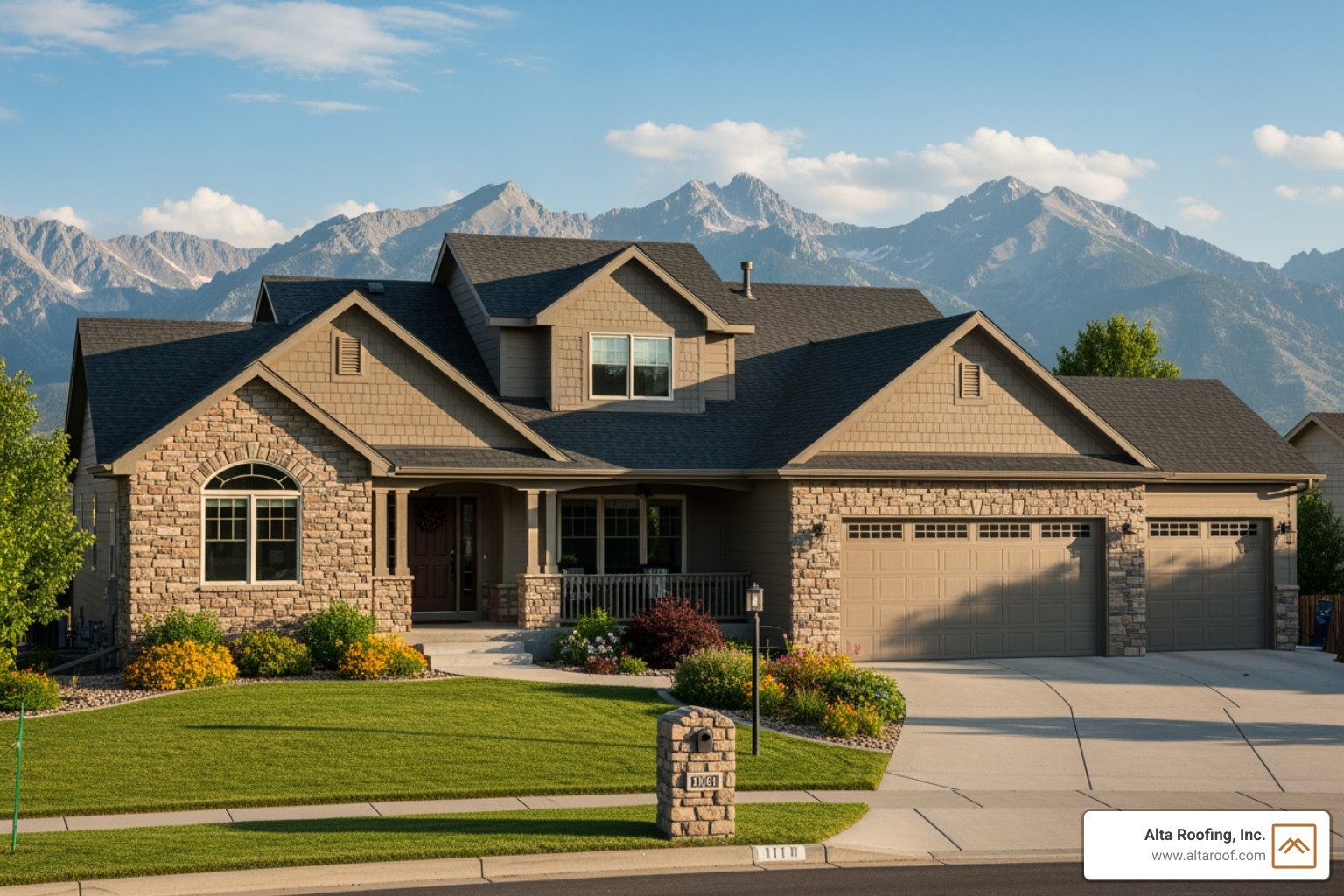
Don't Get Shingled: Choosing a Licensed Roofer in Your Area
Why Finding Qualified Roofing Services Near Me Matters
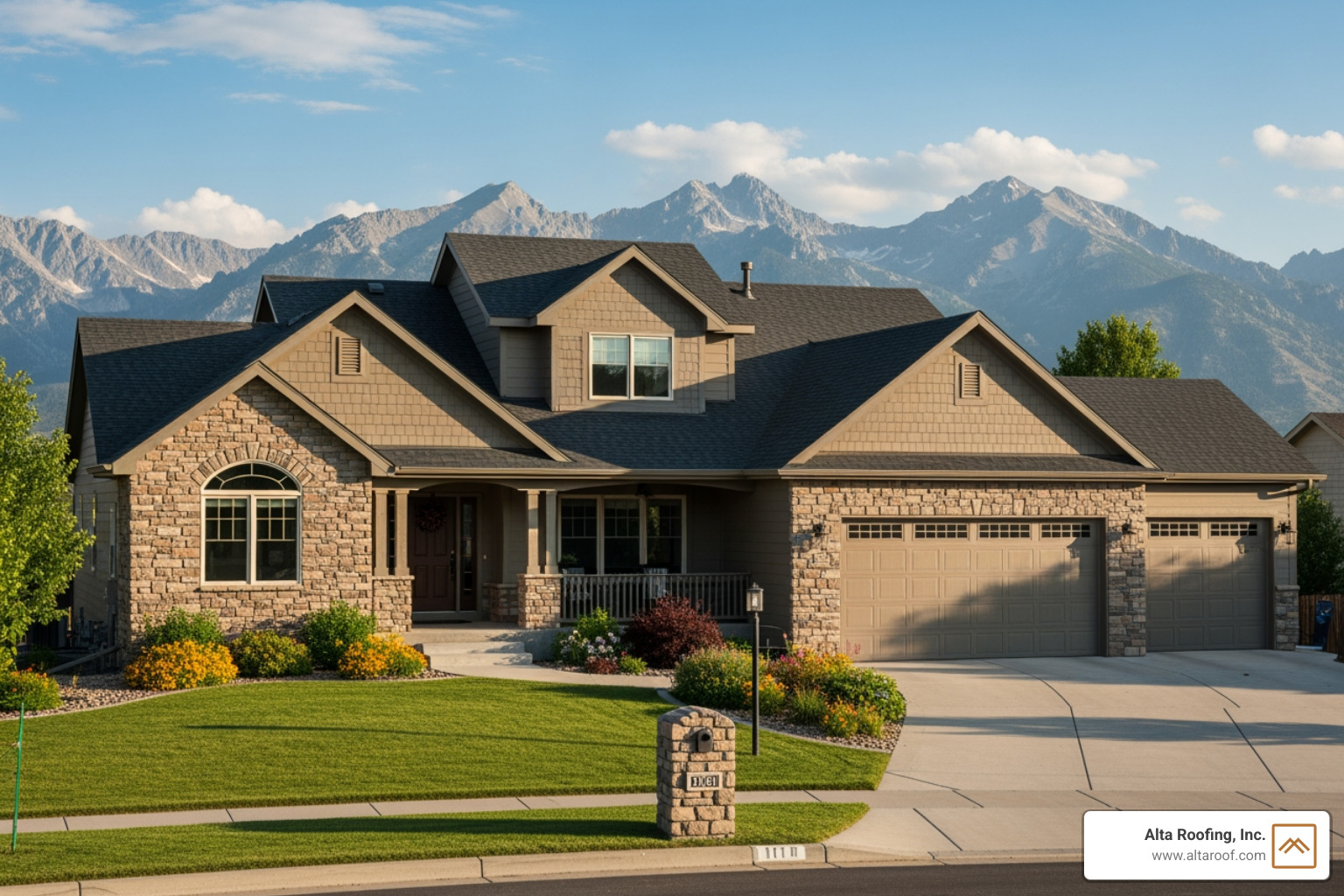
Your roof is your home's first line of defense against the elements. When you're searching for roofing services near me, you're looking for a partner to protect your most significant investment. The quality of roofing contractors can vary dramatically, so choosing the right one is critical, especially in a state with weather as demanding as Colorado's.
Quick Guide to Finding Roofing Services Near Me:
- Verify Licensing and Insurance: Always confirm they have at least $2 million in liability coverage and proper worker's compensation.
- Check Certifications: Look for credentials like GAF Master Elite, which only 2% of North American roofers achieve.
- Read Local Reviews: See what your neighbors are saying on Google, the BBB, and other local forums.
- Get Multiple Quotes: Compare detailed, itemized estimates from at least two or three licensed contractors.
- Ask About Warranties: Understand both the manufacturer's warranty on materials and the contractor's warranty on workmanship.
From intense hailstorms and 90 km/h wind gusts to heavy snowfall and drastic temperature swings, Colorado's climate puts your roof to the test. A compromised roof isn't just about a few leaks; it can lead to structural damage, high energy bills, and mold growth. The challenge is finding a trustworthy local contractor who can handle everything from inspection and insurance claims to a flawless installation and cleanup.
Many homeowners feel overwhelmed after storm damage, unsure of the next steps. One homeowner shared, "What started as a few missing shingles turned into attic water damage and a $15,000 problem." This guide will walk you through finding, vetting, and hiring a qualified roofer, with a focus on Colorado's unique needs.
I'm Barry Goers, founder of Tarben Ventures Ltd. with a focus on the construction industry. Through my work with Alta Roofing, I've seen how the right contractor can turn a stressful situation into a smooth, worry-free experience. We're here to help you protect your home.
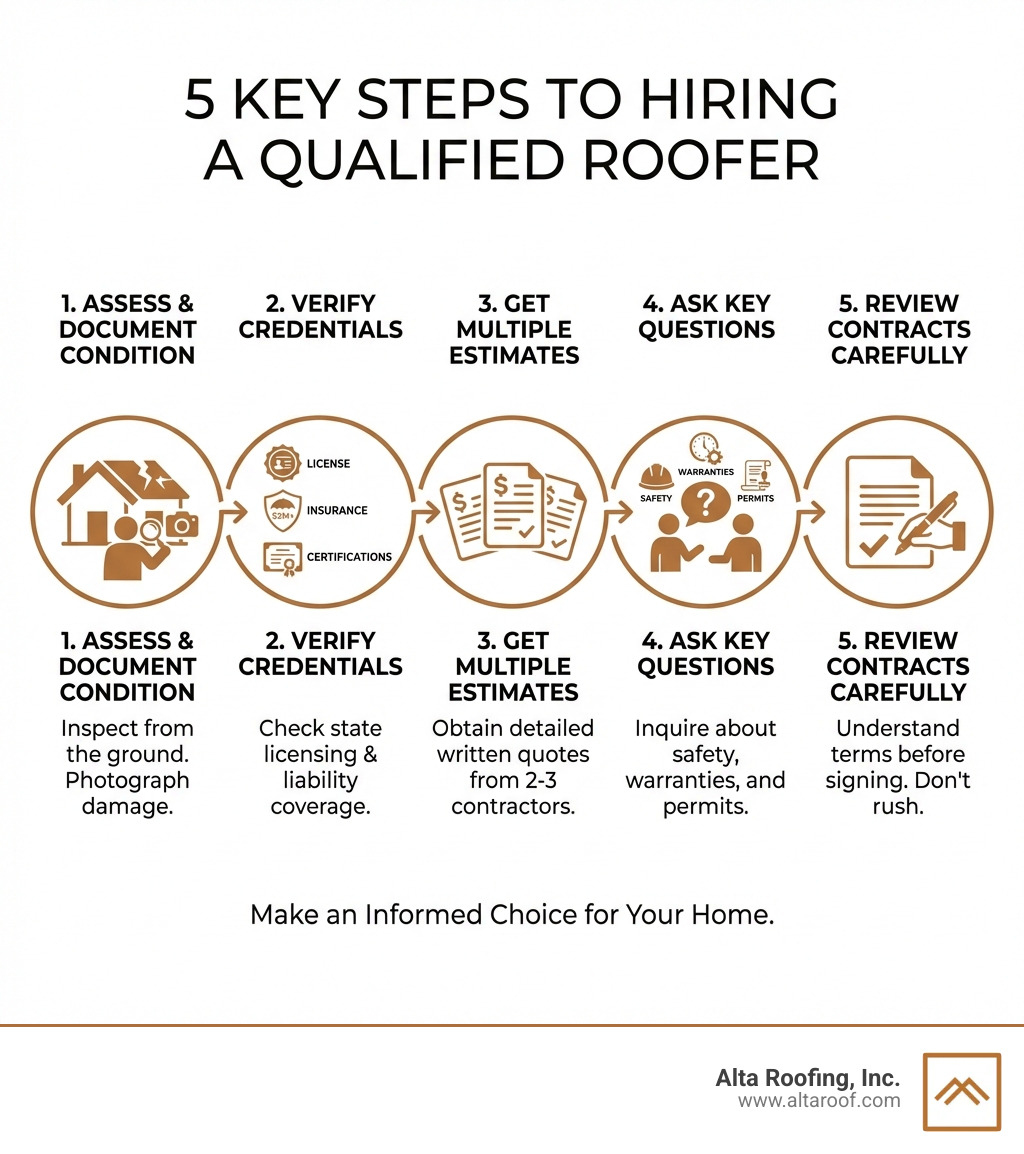
First Steps: Assessing Your Roof's Condition and Needs
Before you start searching for roofing services near me, it's wise to understand your roof's current condition. A quick assessment, especially after a major storm, can help you determine if you need a professional inspection and prevent small issues from becoming costly disasters.
Telltale Signs Your Roof Needs Attention
Your roof is constantly exposed to the elements. Here are common red flags that indicate it might need professional help:
- Damaged Shingles: Look for shingles that are cracked, curled at the edges, or missing entirely. This is often a result of wind, hail, or age.
- Granules in Gutters: Asphalt shingles have a granular surface that protects them from UV rays. Finding a large amount of these granules in your gutters means your shingles are aging and losing their protective layer.
- Sagging Roof Deck: A visible sag or dip in your roofline is a serious red flag, often indicating structural issues from moisture damage. This requires immediate professional attention.
- Interior Water Damage: Water stains on your ceilings or walls are a clear sign of a roof leak. Even small stains can point to significant hidden damage.
- Roof Age: Most asphalt shingle roofs last 20-25 years. If your roof is approaching this age, it's time for a professional inspection, even if there are no obvious signs of damage.
Repair vs. Replacement: Making the Right Call
One of the most common questions we get is whether to repair or replace a roof. The answer depends on the age of your roof and the extent of the damage.
- Roof Repair: This is a good option for localized damage, like a few missing shingles or a minor leak in a specific area. Repairs are cost-effective for addressing isolated problems and can extend the life of your existing roof. A small repair might cost between $350 and $1,000.
- Roof Replacement: This is necessary for widespread damage, multiple leaks, or when a roof has reached the end of its lifespan. While a larger investment, a new roof provides a long-term, reliable solution and is often more cost-effective than a series of recurring repairs.
A professional assessment from a reputable contractor can help you make an informed decision. For more details, you can explore our repair and replacement services.
What to Do After a Colorado Hailstorm
Colorado is no stranger to severe weather, especially hailstorms. If your home has been hit, here’s what to do:
- Safety First: Only inspect your property after the storm has passed and it's safe to be outside.
- Visual Inspection (from the ground): Look for obvious signs of damage like dented gutters, pockmarks on siding, or missing shingles. Hail can bruise asphalt shingles, which isn't always visible from the ground but can lead to future leaks.
- Document Everything: Take photos and videos of any damage you can see. This documentation is crucial for your insurance claim.
- Contact a Storm Restoration Specialist: This is where we come in. At Alta Roofing, we specialize in storm damage restoration across Colorado, from Denver to Colorado Springs. We provide a free, no-obligation inspection and can guide you through the entire insurance claims process, even meeting with your adjuster to ensure all damage is properly documented. Our goal is to make the restoration process as smooth and stress-free as possible.
The Free Inspection and Estimate Process
When you're ready for a professional opinion, the first step is a free inspection and estimate. Here’s what to expect from us:
- Thorough Roof Assessment: We don't just glance at your roof. Our team conducts a comprehensive inspection of shingles, flashing, vents, and gutters, often using drone technology for a detailed view. We document our findings with photos so you can see exactly what we see.
- Detailed Quotes: We provide a detailed, written quote that outlines the full scope of work, materials, labor costs, and any additional services like tear-off and disposal. We believe in full transparency.
- No-Obligation Estimates: Our estimates are always free. We provide the information you need to make the best decision for your home, without any pressure.
Ready to see what your roof needs? Get an Instant Quote today.
Understanding Common Roofing Services and Materials

Choosing the right roofing services near me also means understanding the services and materials that best fit your home, budget, and Colorado's challenging climate. Let's break down the options.
From Minor Repairs to Full Installations
A reputable roofing company offers a range of services to keep your home protected:
- Roof Repair: Ideal for fixing localized issues like missing shingles, small leaks, or damaged flashing.
- Full Roof Replacement: A complete overhaul that includes tearing off old materials, inspecting the roof deck, and installing a new, durable roofing system.
- New Construction Roofing: We provide expert installation for new homes across Colorado, from Highlands Ranch to Castle Pines, ensuring a quality roof from the start.
- Gutter Services: Your gutters are crucial for water management. We offer installation, repair, and cleaning to protect your home's foundation.
A standard roof replacement with us includes a complete tear-off and disposal of old materials, a thorough deck inspection, installation of a new underlayment (like an ice and water shield), and a final assessment of your attic's ventilation to ensure longevity.
Choosing the Best Roofing Material for Colorado's Climate
Colorado's weather demands materials that can handle intense sun, heavy snow, and hail. Here’s a comparison of popular choices:
| Material Type | Pros | Cons | Lifespan | Hail/Wind Resistance |
|---|---|---|---|---|
| Asphalt Shingles | Cost-effective, wide variety of styles and colors, easy to repair. | Shorter lifespan than other materials, can be damaged by severe hail. | 20-30 years | Good; Class 4 impact-resistant options available. |
| Metal Roofing | Extremely durable, long-lasting, energy-efficient, and fire-resistant. | Higher upfront cost, can be noisy during rain if not properly insulated. | 50+ years | Excellent; often comes with high wind ratings. |
| Synthetic Slate/Tile | Mimics the look of natural slate or tile at a lower cost, very durable, and impact-resistant. | Higher initial cost than asphalt, requires specialized installation. | 50+ years | Excellent; many are Class 4 rated for hail. |
For a closer look at how these materials perform on real homes, you can view our past projects.
The Unseen Hero: Why Attic Ventilation Matters
Proper attic ventilation is critical for the health of your roof and your home. A balanced system of intake (soffit) and exhaust (ridge) vents helps:
- Prevent Moisture and Mold: It allows damp, warm air to escape, preventing condensation that can lead to rot and mold.
- Reduce Energy Bills: In summer, it pushes hot air out, reducing the load on your AC. In winter, it keeps the roof deck cool to prevent ice dams.
- Extend Your Roof's Life: By regulating temperature and moisture, proper ventilation prevents shingles from deteriorating prematurely and can be a requirement for manufacturer warranties.
How to Find the Best Roofing Services Near Me
Once you know what your roof needs, the next step is finding the right team for the job. Vetting contractors thoroughly is the key to a successful project and long-term peace of mind.
Vetting Local Contractors: What to Look For
Not all roofing companies are created equal. Here’s a checklist to help you identify a reliable, professional contractor:
- Local and Established: Do they have a physical office in your area? A local presence in places like Denver, Colorado Springs, or Aurora means they're accountable to the community and understand regional challenges.
- Licensed and Insured: Ask for proof of licensing and, crucially, general liability insurance (we recommend at least $2 million in coverage) and worker's compensation. This protects you from any liability in case of accidents on your property.
- Positive Reviews: Check their reputation on Google, Yelp, and the Better Business Bureau (BBB). Consistent positive feedback is a great sign.
- Years in Business: A company with a long track record has proven its stability and commitment to quality work.
The Power of Certification: GAF Master Elite and More
Manufacturer certifications are a strong indicator of a contractor's expertise and reliability. For example, Alta Roofing is a GAF Master Elite® Contractor, a status held by only the top 2% of roofing contractors in North America. This means:
- We are properly licensed and insured.
- We have a proven reputation for providing quality roofing services.
- We are committed to ongoing professional training to ensure quality installation.
This certification allows us to offer the best warranties available, like the GAF Golden Pledge® Warranty, which provides superior protection for your investment. You can learn more about GAF certification and what it means for you.
Key Questions to Ask Before You Hire
Before signing a contract, make sure you're comfortable with the answers to these questions:
- Who will be my main point of contact or project manager?
- Are your installation crews in-house employees or subcontractors?
- What steps do you take to protect my property (landscaping, driveway, etc.) during the project?
- Can you provide references from recent projects in my area?
- What does your workmanship warranty cover, and for how long?
- Will you handle the necessary permits for the job?
Finding Reputable Roofing Services Near Me in Your Neighborhood
Start your search close to home. Ask friends, family, and neighbors for recommendations. A drive through your neighborhood can also be revealing—look for yard signs of companies that are already trusted by people near you. A local contractor will not only be more responsive but will also have a vested interest in maintaining a good reputation in the community they serve, whether it's in Littleton, Castle Rock, or Fountain.
Navigating the Roofing Project: Costs, Timelines, and Warranties
Understanding the logistics of a roofing project can help you plan accordingly and avoid surprises. Here’s a breakdown of what to expect regarding cost, duration, and long-term protection.
Budgeting for Your Roof: Typical Costs in Colorado
Roofing costs can vary significantly based on the size and pitch of your roof, the materials you choose, and the extent of any underlying damage. Here are some general estimates:
- Minor Repairs: For issues like replacing a few missing shingles or sealing a small leak, you can typically expect to pay between $350 and $1,000.
- Major Repairs: More extensive work, such as repairing a larger section of damaged decking or addressing significant flashing issues, can range from $1,000 to $5,000.
- Full Roof Replacement: A complete replacement is a major investment. For a standard 2,000 sq. ft. home in Colorado, the cost can range from $10,000 to $25,000+, depending heavily on the materials selected. A detailed estimate from a qualified contractor is the only way to get an accurate figure for your specific home.
Project Timelines and How to Prepare Your Home
Time is money, and we know you want your home back to normal as quickly as possible.
- Repair Timeline: Most minor repairs can be completed in just a few hours, often within a single day.
- Replacement Timeline: A full roof replacement on an average-sized home typically takes 1 to 3 days, weather permitting.
To help the process go smoothly, we recommend a few simple preparations:
- Clear the Area: Move cars from the driveway and clear patios, decks, and the immediate perimeter of your home of any furniture, grills, or potted plants.
- Protect Valuables: The work can cause vibrations, so it’s a good idea to remove any fragile items from walls and shelves inside your home.
- Inform Your Neighbors: A quick heads-up about the upcoming work is a courteous gesture, as there will be some noise and activity.
Understanding Warranties and Financing Options
A new roof is a significant investment, and it should be protected. There are two types of warranties to consider:
- Manufacturer's Warranty: This covers the roofing materials themselves against defects. The length and coverage vary by product, with some premium shingles offering lifetime limited warranties.
- Workmanship Warranty: This is provided by the contractor and covers the installation. It’s a sign of the roofer’s confidence in their work. At Alta Roofing, we stand behind our installations with a robust workmanship warranty.
We also understand that a new roof can be an unexpected expense. That's why we offer flexible financing options, including 0% interest plans and deferred payments, to help make your project more manageable. You can learn more about our company and our commitment to customer satisfaction on our website.
Frequently Asked Questions about Local Roofing
Can you help with my insurance claim after hail damage?
Absolutely. This is one of our specialties. As a storm restoration expert, we guide homeowners through the entire insurance process. We start with a thorough inspection, document all storm-related damage, and meet with your insurance adjuster on-site to ensure a fair and accurate assessment. Our goal is to make sure your claim covers all necessary repairs to restore your home to its pre-storm condition.
What is the best time of year to replace a roof in Colorado?
The ideal seasons for roof replacement in Colorado are typically late spring and early fall. The moderate, dry weather during these times is perfect for shingles to seal properly and for our crews to work safely and efficiently. While we can and do work year-round, we avoid extreme heat, heavy rain, or snow whenever possible to ensure the highest quality installation.
How long does a typical roof last in Colorado?
The lifespan of a roof in Colorado depends heavily on the material and the quality of the installation.
- Asphalt Shingles: Standard architectural shingles generally last 20-25 years.
- Impact-Resistant (Class 4) Shingles: These are a popular choice for hail-prone areas and can last significantly longer.
- Metal or Synthetic Roofs: These premium materials can last 50 years or more, offering superior durability against Colorado's harsh weather.
Regular maintenance and prompt repairs can also help extend the life of any roofing system.
Finding Your Perfect Match: Top Local Roofers Near Colorado Springs
Understanding Roof Restoration and Why It Matters for Colorado Springs Homeowners
Roof restoration Colorado Springs is a specialized service that brings aging or damaged roofs back to optimal condition without the need for complete replacement. Here's what you need to know:
Quick Answer: What is Roof Restoration?
- Roof Restoration: A comprehensive process that repairs, cleans, and applies protective coatings to extend your roof's lifespan by 5-15 years
- Cost: Up to 85% less expensive than full roof replacement
- Best For: Roofs aged 8-15 years with surface damage, granule loss, or minor leaks
- Not Right For: Roofs with severe structural damage, widespread leaks, or extensive deterioration
Key Differences at a Glance:
- Repair: Fixes isolated problems (damaged shingles, small leaks)
- Restoration: Treats the entire roof system to restore performance and appearance
- Replacement: Removes and installs a completely new roof
Living in Colorado Springs means your roof faces some of the harshest weather conditions in the country. From hail alley storms that pummel shingles with ice to intense UV exposure at our high altitude, your roof takes a beating year after year. Add heavy snow loads and powerful wind gusts, and it's no wonder Colorado homeowners often face difficult decisions about their roofs earlier than expected.
The good news? Roof restoration offers a middle ground between constant repairs and costly replacement. It's a proven solution that can add years to your roof's life while protecting your home and your investment.
I'm Barry Goers, and through my work with construction companies under Tarben Ventures Ltd., I've seen how roof restoration Colorado Springs homeowners choose can save them thousands while delivering reliable, long-term protection. In this guide, I'll walk you through everything you need to know to make the right decision for your home.
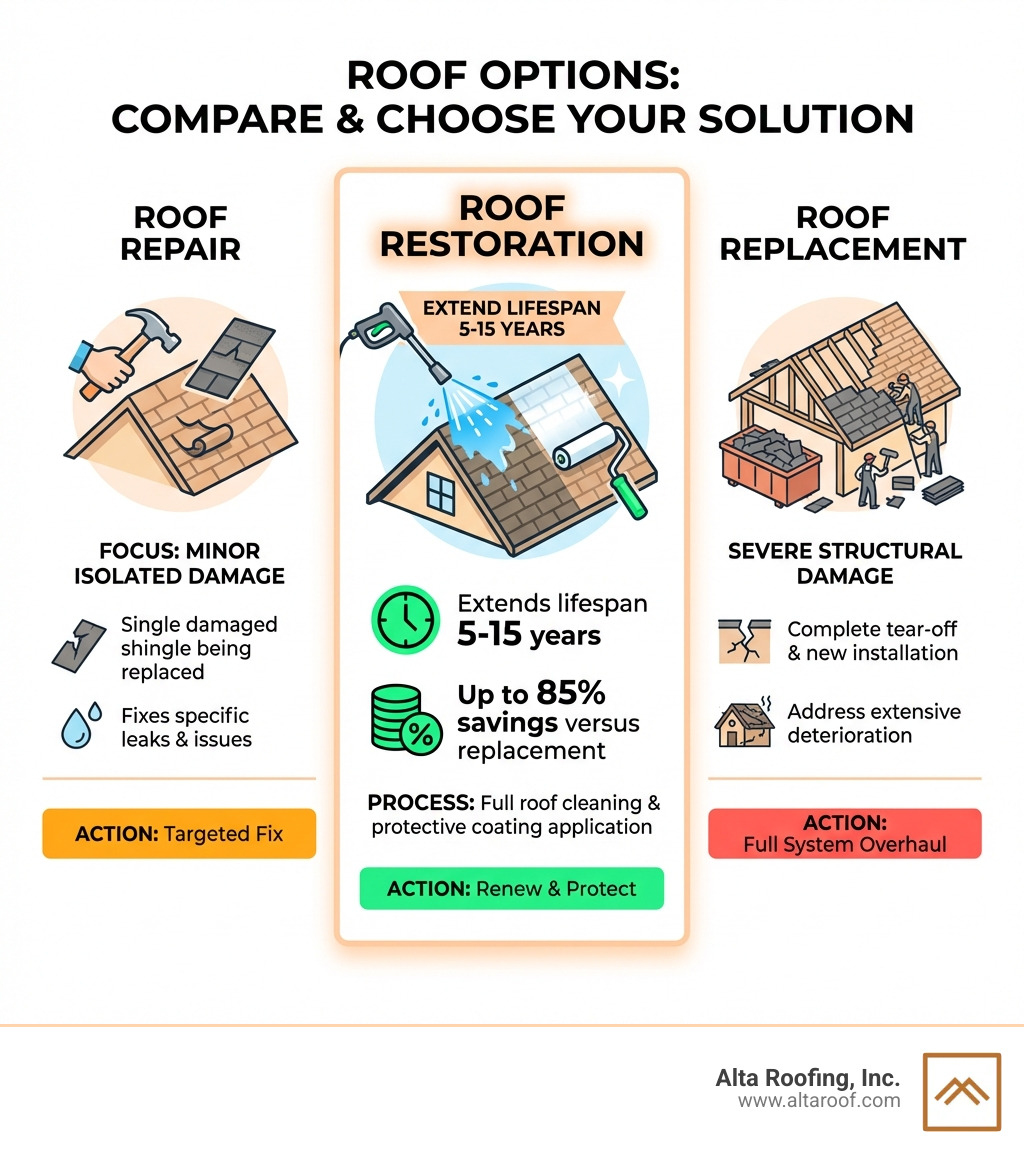
Why Your Colorado Springs Roof Needs Special Attention
If you've lived in Colorado Springs for any length of time, you know our weather can be, shall we say, enthusiastic. Our roofs bear the brunt of Mother Nature's moods, making roof restoration a particularly wise investment here.
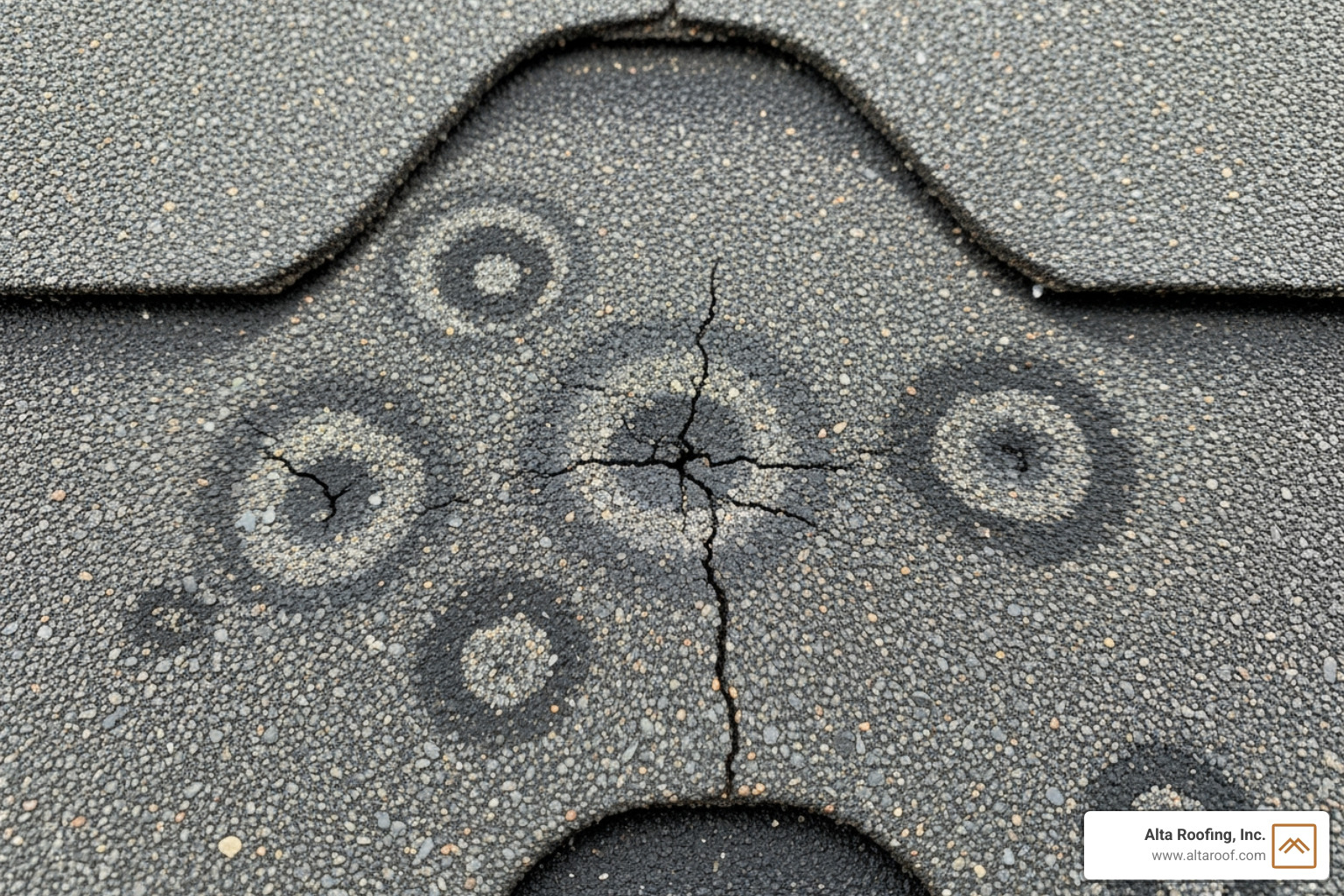
Colorado's Climate Impact:
- Hail Alley: Colorado Springs is unfortunately situated in "Hail Alley," a region notorious for severe hailstorms. As we've seen, hail damage can be highly destructive, and sometimes not even visible from the ground. Even small hail can compromise your roof's integrity, leading to missing shingle granules or tiny cracks that become big problems later.
- Heavy Snow Loads: Our beautiful Colorado winters bring heavy snowfall, which can place immense weight on your roof. This constant stress can weaken the structure, leading to sagging, leaks, and accelerated wear.
- Intense UV Exposure: At our elevation, the sun's ultraviolet (UV) rays are incredibly powerful. This intense exposure breaks down roofing materials, especially asphalt shingles, causing them to dry out, become brittle, and lose their protective granules. Essential oils in asphalt shingles dry up over time, causing granular loss and potential cracking, typically after 8-10 years.
- Wind Damage: Colorado's gusty winds can lift, tear, and even completely remove shingles, leaving your roof vulnerable to water intrusion.
These harsh conditions mean that our roofs age faster and face more damage than those in milder climates. That's why being proactive with roof care, especially through restoration, is so crucial.
Benefits of Restoration for Colorado Springs Homeowners
Choosing roof restoration Colorado Springs offers a multitude of advantages for homeowners:
- Extends Roof Life: Perhaps the most compelling benefit, restoration can add 5 to 15 years to your roof's lifespan. Instead of facing a full replacement every 15-20 years, you could potentially get 20-35 years or more out of your existing roof system with timely restoration treatments. Springs Roof Rejuvenation, for example, highlights how their treatment can add 5 to 15 years to a roof's life.
- Prevents Water Damage: A restored roof forms a protective barrier, sealing minor cracks and preventing water from seeping into your home. This proactive measure safeguards against costly interior water damage, mold growth, and insulation loss, which can compromise your home's structural integrity.
- Increases Home Value: A well-maintained and restored roof significantly boosts your home's curb appeal and overall value. Properly maintained roofs are noticed by buyers and appraisers, making restoration a smart investment if you plan to sell. Integrity Roofing and Painting emphasizes that taking care of your roof protects and increases your home's value.
- Improves Energy Efficiency: Many restoration coatings reflect sunlight, reducing the amount of heat absorbed by your roof. This can lead to lower attic temperatures and, consequently, reduced cooling costs during our warm summer months. Addressing issues like poor attic ventilation or ineffective attic insulation, often part of a thorough inspection process, further improves energy efficiency.
We believe that protecting your roof isn't just about repairs; it's about maintaining the value and integrity of your entire property. For more information about how we approach these challenges, explore More info about our work.
Common Damage Addressed by Restoration
Roof restoration Colorado Springs is an excellent solution for a range of common roofing issues that don't yet warrant a full replacement. We often encounter problems like:
- Missing Shingle Granules: Those little sandy bits you find in your gutters? They're the protective layer of your asphalt shingles. Their loss exposes the asphalt to UV rays, accelerating deterioration. Springs Roof Rejuvenation notes that essential oils in asphalt shingles dry up over time, causing granular loss.
- Cracked or Curling Shingles: As shingles age and endure our harsh climate, they can crack, curl, or become brittle, losing their ability to shed water effectively.
- Minor Leaks: If you have small, isolated leaks, especially around flashing or vents, restoration can often seal these points and prevent further water intrusion. Integrity Roofing and Painting notes that roofs can develop leaks years before a total replacement is required.
- Damaged Flashings: Flashings, the metal or rubber seals around chimneys, vents, and skylights, are critical for waterproofing. Minor damage or wear to these can be repaired and sealed during restoration.
- Faded Metal Panels: Metal roofs, while durable, can fade or chalk over time. Restoration can involve cleaning and recoating to restore their appearance and protective qualities.
- Dry or Brittle Materials: The intense Colorado sun can dry out various roofing materials, making them less flexible and more prone to cracking. Restoration treatments can re-introduce flexibility and protective elements.
The Value of a Restored Roof
Investing in roof restoration Colorado Springs isn't just about fixing problems; it's about enhancing your home's overall health and value.
- Longevity: As mentioned, restoration treatments can add 5 to 15 years to your roof's life. This significantly delays the need for a costly and disruptive full replacement. Springs Roof Rejuvenation states that their treatment can add 5 to 15 years to the life of a roof, with repeat applications possible.
- Property Value: A sturdy, well-maintained roof is a major asset when it comes to your home's market value. Restoration ensures your roof looks good and performs optimally, which is a huge plus for potential buyers. Home roof restoration services are considered a smart investment, especially if you plan to sell, as properly maintained roofs are noticed by buyers and appraisers.
- Curb Appeal: A clean, restored roof instantly improves your home's aesthetic appeal. It can look like a brand-new roof without the brand-new price tag!
- Prevents Costly Future Repairs: By addressing minor issues before they escalate, restoration acts as a preventative measure, saving you from more extensive and expensive repairs down the line. Timely repairs prevent further issues.
- Peace of Mind: Knowing your roof is robustly protected against Colorado's unpredictable weather allows you to rest easy, knowing your home and family are safe.
The Roof Restoration Colorado Springs Process: What to Expect
When you choose roof restoration Colorado Springs, you're starting on a systematic process designed to maximize your roof's lifespan and performance. We believe in transparency and thoroughness every step of the way.
Step 1: Professional Inspection
The journey begins with a comprehensive roof inspection. This isn't just a quick look from the ground; it's a detailed assessment of your entire roofing system. Reputable companies like ours offer free roof inspections, often including photos and an easy-to-understand report. Some companies, like Restoration Colorado Roofing, even perform a 25-point inspection.
During this inspection, our experts will look for:
- Missing shingle granules
- Loose or cracked shingles
- Damaged flashings around chimneys, vents, and skylights
- Cracked valleys
- Damaged storm collar seals
- Signs of dry rot
- Blocked or loose gutters
- Poor attic ventilation and ineffective attic insulation
- Issues with attic intake vents
- Cracked chimney mortar or missing caulking around chimneys and vents
- Any signs of hail damage on the roof or exterior elements like fences or sidewalks
This crucial step helps us determine if your roof is a good candidate for restoration or if a replacement is truly necessary. We provide clear next steps and an honest assessment of how urgent each issue is, allowing you to plan with confidence.
Step 2: Surface Preparation & Repairs
Once restoration is deemed appropriate, the next phase involves carefully preparing your roof. This includes:
- Cleaning: Removing dirt, debris, moss, and algae to ensure proper adhesion of restoration materials.
- Minor Repairs: Addressing any localized issues identified during the inspection. This might involve sealing loose shingles, repairing damaged pipe boots, securing pop-up nails, or fixing minor flashing problems. Springs Roof Rejuvenation includes minor roof maintenance like these as part of their service.
- Drying: Ensuring the roof surface is completely dry before applying any coatings.
Step 3: Restoration Application
With the surface prepared, we proceed with the core of the restoration process: applying specialized coatings and sealants.
- Coatings & Sealants: This is where the magic happens! Depending on your roof type and its condition, we apply high-performance restoration coatings. For asphalt shingles, this often involves bio-based rejuvenators that penetrate the shingles, replacing essential oils that have dried out. This restores flexibility, improves granule adhesion, improves waterproofing, and can even reduce hail impact. Springs Roof Rejuvenation uses a USDA-certified bio-based rejuvenator that has been used for decades to protect oil in roads and parking lots, now redeveloped for roofing. For other roof types, like flat roofs, silicone coatings (such as Gaco Silicone Roofing Products, as offered by Fixin's Home Services) are often used to create a seamless, waterproof membrane.
The application process is typically quick and efficient, with many treatments taking just a few hours. Within about 72 hours, your roof's flexibility and waterproof protection return, ready to face Colorado's elements once again.
Ready to see how affordable roof restoration Colorado Springs can be for your home? Get an Instant Quote from us today.
Signs You Need Roof Restoration in Colorado Springs
Deciding between restoration and replacement can be tricky. Here are some key indicators that your roof is a prime candidate for restoration:
- Widespread Surface Damage, Not Structural: If you see extensive granule loss, fading, or minor cracking across your roof, but no major structural issues or widespread leaks, restoration is likely a good fit.
- Granule Loss in Gutters: This is a clear sign your asphalt shingles are deteriorating and losing their protective layer.
- Roof Age (8-15 years): Asphalt roofs typically show signs of aging after 8-10 years. If your roof is within this age range but not severely damaged, restoration can significantly extend its life.
- Multiple Small Leaks: If you're experiencing several isolated leaks, restoration can often seal these trouble spots effectively. However, if leaks are widespread or indicate a compromised decking, replacement might be necessary.
- Faded or Chalky Appearance: This indicates that your roofing material is breaking down due to UV exposure, and a restorative coating can bring it back to life.
To help you visualize the decision, here's a quick comparison:
| Feature | Signs for Roof Restoration | Signs for Roof Replacement |
|---|---|---|
| Damage Type | Granule loss, minor cracks, fading, dry/brittle materials | Significant structural damage, widespread leaks, sagging roof |
| Roof Age | 8-15 years (showing wear but structurally sound) | 20+ years (beyond typical lifespan), severe storm damage |
| Leak Severity | Isolated, small leaks | Numerous, widespread leaks; water stains on ceilings/walls |
| Material Condition | Shingles curling/cupping, but still mostly intact | Shingles missing in large sections, rotten decking |
| Cost Consideration | Cost-effective solution, up to 85% less than replacement | Higher upfront cost, but necessary for compromised structure |
| Goal | Extend lifespan, restore appearance, improve protection | Complete overhaul, long-term solution for severely damaged roof |
Materials Best Suited for Restoration
Roof restoration Colorado Springs can be applied to a variety of roofing materials, each benefiting from specific treatments:
- Asphalt Shingles: These are excellent candidates for rejuvenation treatments that restore flexibility and protect against UV degradation and granule loss. Springs Roof Rejuvenation specializes in this, using a bio-based rejuvenator.
- Metal Roofs: While incredibly durable, metal roofs can benefit from cleaning, minor repairs, and protective coatings to prevent rust, fading, and extend their already long lifespan.
- Tile Roofs: Concrete and clay tiles can sometimes be restored by cleaning, repairing individual damaged tiles, and applying sealants to improve water resistance and appearance.
- Flat Roof Systems (TPO, EPDM): Commercial and residential flat roofs often benefit greatly from restorative coatings, such as Gaco Silicone Roofing Products or other specialized membranes, which can create a seamless, waterproof layer and significantly extend their service life. Fixin's Home Services lists expertise in EPDM, Torchdown (TPO), and Gaco Silicone Roofing Products.
How to Choose the Right Restoration Company
Selecting the right company for your roof restoration Colorado Springs project is paramount. You want a team that understands our local climate, has a proven track record, and prioritizes your peace of mind. Here's what to look for:
- Local Expertise: Choose a company that deeply understands Colorado Springs' unique weather challenges. They should be familiar with local building codes and the specific impacts of hail, snow, and sun on different roofing materials. Look for established companies with years of experience serving the local community.
- Licensed & Insured: Always verify that any contractor you consider is fully licensed and insured. You can check for licenses with the Pikes Peak Regional Building Department. This protects you from liability in case of accidents or subpar work.
- Certifications (GAF, Owens Corning): Industry certifications from leading manufacturers like GAF and Owens Corning indicate a high level of training and commitment to quality. A certified roofer demonstrates adherence to top industry standards.
- Insurance Claim Assistance: Given Colorado's frequent storm activity, expertise in navigating insurance claims is invaluable. Our company, Alta Roofing, Inc., prides itself on handling insurance claims and coordinating all necessary trades, acting as a single point of contact for homeowners. Look for a company with proven proficiency in this area.
- Online Reviews and Reputation: Check online reviews and ratings. Look for companies with consistently high ratings and positive feedback on trusted platforms like the Better Business Bureau (BBB), Angi, Yelp, and Google. An A+ rating from the BBB, for example, is a strong indicator of a reputable business.
- Community Involvement: A company that gives back to the community often demonstrates a higher level of integrity and care. Some companies are proud to partner with organizations like Beautiful Redemption, which provides vital support for vulnerable children in crisis. This commitment to community reflects a broader dedication to service and excellence.
Frequently Asked Questions about Roof Restoration
We know you have questions, and we're here to provide clear, straightforward answers about roof restoration Colorado Springs.
How much does roof restoration cost compared to replacement?
This is often the first question on homeowners' minds, and for good reason! The cost difference is significant.
- Cost Savings: Roof restoration is a far more economical option than a full roof replacement. Some companies, like Springs Roof Rejuvenation, claim that restoration can save you up to 85% off the cost of a total roof replacement. On average, a full roof replacement in Colorado can cost approximately $5.00 per square foot. For an average residential roof of 2,000 square feet, that's around $10,000. Restoration offers a fraction of that cost.
- Factors Influencing Cost: While restoration is significantly cheaper, the exact cost will depend on several factors:
- Roof Size and Pitch: Larger or steeper roofs naturally require more materials and labor.
- Material Type: Different roofing materials require different restoration techniques and products, which can affect pricing.
- Extent of Repairs Needed: While restoration handles surface damage, any underlying repairs (e.g., minor decking issues) will add to the overall cost.
- Specific Restoration Product: The type and quality of the restorative coating or treatment used will also impact the price.
Many reputable companies offer financing options to make restoration even more accessible.
Will my homeowner's insurance cover restoration?
Navigating insurance claims can be complex, but it's often a viable option for roof restoration Colorado Springs, especially after severe weather.
- Sudden vs. Gradual Damage: Homeowner's insurance typically covers damage that is "sudden and accidental," such as damage from hail, wind, or fallen trees. It generally does not cover damage resulting from neglect, lack of maintenance, or normal wear and tear. If your roof's condition is due to gradual aging, restoration may be an out-of-pocket expense, though a significantly smaller one than replacement.
- Hail Damage Claims: Given Colorado Springs' location in "Hail Alley," hail damage is a common and often covered peril. Many local roofing companies, including ours, specialize in helping homeowners with hail damage claims. If your roof has sustained hail damage, even if it's not immediately visible, it's crucial to get a professional inspection.
- Importance of a Claims Specialist: Dealing with insurance companies can be daunting. A reputable roofing company will often have dedicated insurance claim specialists who can guide you through the process, assist with documentation, and ensure you receive a fair settlement. Restoration Colorado Roofing, for instance, highlights over 15 years of experience with insurance claims, and their team has over 30 years of combined experience working with residential and commercial insurance companies. Our team at Alta Roofing, Inc. acts as a single point of contact, managing the entire insurance claim process for you.
How long does a restored roof last?
The primary goal of roof restoration Colorado Springs is to extend the life of your existing roof, and it's remarkably effective.
- Lifespan Extension: A properly restored roof can add an impressive 5 to 15 years to its functional life. This means you can significantly delay the need for a full replacement, getting more value out of your initial roofing investment. Springs Roof Rejuvenation explicitly states that their treatment can add 5 to 15 years to the life of a roof.
- Warranty Details: Reputable restoration companies will offer warranties on their work and the products they use. For example, Springs Roof Rejuvenation offers a 5-year limited warranty that covers the loss of shingle flexibility and even a "Natural Damage Guarantee" under certain conditions. Always ask about the warranty specifics, including what's covered and for how long.
- Maintenance Tips: To maximize the lifespan of your restored roof, regular maintenance is key. This includes:
- Annual Inspections: Catching small issues early prevents them from becoming big problems.
- Gutter Cleaning: Keeping gutters clear ensures proper drainage and prevents water backup.
- Trim Overhanging Branches: Minimize debris and potential damage from falling limbs.
- Prompt Repair of New Damage: If your roof sustains new damage (e.g., from a storm), address it quickly to protect the restoration.
Conclusion: Protect Your Home with a Trusted Partner
In Colorado Springs, where our homes face the relentless challenges of hail, snow, sun, and wind, proactive roof care is not just an option—it's a necessity. Roof restoration Colorado Springs offers a smart, cost-effective alternative to premature roof replacement, providing significant benefits that extend your roof's life, improve your home's value, and give you priceless peace of mind.
We've explored how restoration differs from simple repairs and full replacements, the specific ways Colorado's climate impacts your roof, and the clear signs that your roof might be a perfect candidate for restoration. We've also detailed the process, from our meticulous inspections to the application of advanced restorative coatings, and discussed the crucial factors in choosing a trustworthy local company.
A restored roof isn't just a repaired roof; it's a refreshd, protected asset that can serve your home for many more years, often at a fraction of the cost of replacement. With potential savings of up to 85% compared to a full tear-off, and the ability to add 5 to 15 years to your roof's lifespan, the value proposition is clear.
For a comprehensive approach, from the initial inspection to meticulous project completion, and with specialized expertise in navigating insurance claims and coordinating all necessary trades, consider partnering with a team that truly understands your needs.
Protect your home, save your money, and invest in a durable future. Contact us today to schedule your free inspection and find how roof restoration Colorado Springs can be the perfect solution for your home.

Peak Performance: Choosing a Commercial Roofer in Colorado Springs
Why Colorado Springs Commercial Properties Demand Specialized Roofing Expertise

Commercial roofers Colorado Springs businesses need must understand the unique challenges of our high-altitude climate. If you're searching for a commercial roofing contractor, here's what you should prioritize:
Top Qualities to Look For:
- Local Experience: 15+ years serving Colorado Springs specifically
- Climate Expertise: Proven track record with hail, UV, and freeze-thaw cycles
- Full Service: Handles everything from inspection to insurance claims
- Proper Credentials: Licensed, insured, and manufacturer-certified (GAF Master Elite)
- Storm Restoration: Experience coordinating all trades as a single point of contact
Colorado Springs sits in "hail alley," experiences intense high-altitude UV exposure, and endures dramatic temperature swings that can wreak havoc on commercial roofing systems. Your commercial roof isn't just overhead protection—it's a critical business asset that demands specialized attention.
The stakes are high. A failing commercial roof means disrupted operations, damaged inventory, unhappy tenants, and costly emergency repairs. Yet many business owners struggle to steer the complex world of commercial roofing: understanding which materials withstand Colorado's climate, interpreting insurance policies after storm damage, and coordinating multiple contractors during restoration projects.
This guide cuts through the confusion. You'll learn exactly what to look for when choosing commercial roofers, how different roofing systems perform in our unique climate, what preventative maintenance actually involves, and how the right contractor becomes your advocate during insurance claims.
I'm Barry Goers, and through my experience as an entrepreneur and investor focused on the construction industry, I've learned that selecting quality commercial roofers Colorado Springs businesses can trust requires understanding both technical expertise and project management capabilities. This article will help you make that informed choice.
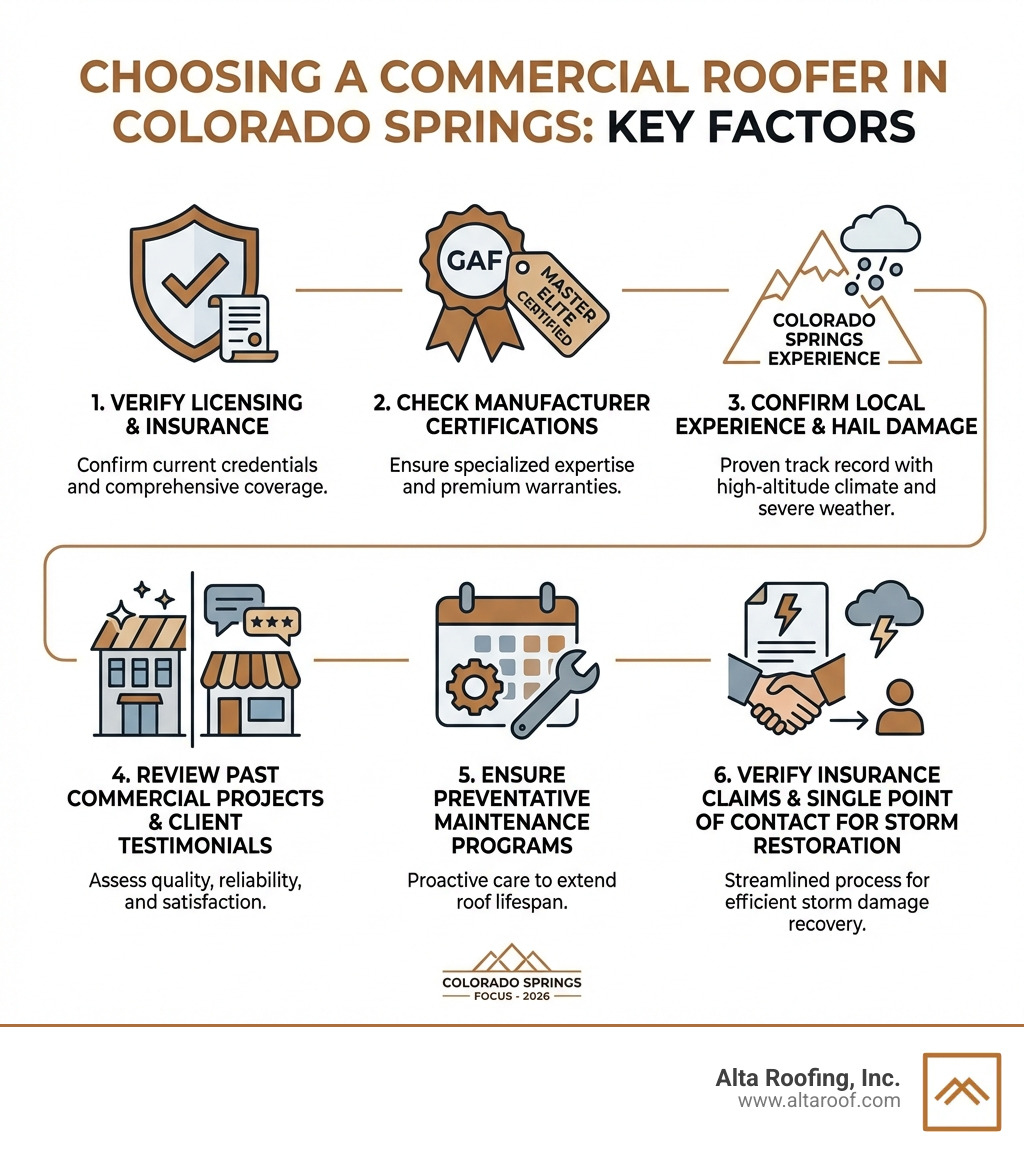
Understanding Commercial Roofing Needs in Colorado's Climate
Colorado's climate presents unique challenges for commercial roofing. Located in "hail alley," properties in Colorado Springs are frequently exposed to damaging hailstorms, especially between April and September. This, combined with high-altitude UV exposure, significant temperature swings, and heavy snow loads, means your roof is under constant stress. The intense sun can cause materials to degrade faster, while freeze-thaw cycles can create and widen cracks, leading to leaks. These factors make choosing the right materials and a knowledgeable local roofer crucial for the longevity of your commercial property.
Common Signs Your Commercial Roof Needs Attention
Don't wait for a small issue to become a major expense. Be on the lookout for these common signs of roof damage:
- Leaks and Water Stains: The most obvious indicator, often appearing on ceilings or walls.
- Bubbling or Blistering Membranes: This suggests trapped moisture, which can lead to ruptures.
- Damaged Flashing: Check the seals around vents, skylights, and parapet walls for cracks or looseness.
- Ponding Water: Water that remains on your roof for more than 48 hours after rain can degrade materials and add stress.
- Clogged Drains: Blocked drainage systems can cause water to back up and lead to significant problems.
- Visible Cracks or Tears: These are direct entry points for water and should be addressed immediately.
- Increased Energy Bills: A sudden spike in heating or cooling costs can indicate a loss of insulation due to roof damage.
If you notice any of these signs, it's time to act. Schedule an Appointment for an inspection to get a professional assessment.
Core Services Offered by Commercial Roofers
When you partner with professional commercial roofers Colorado Springs businesses can rely on, you're looking for a comprehensive suite of services that address every aspect of your commercial roof's lifecycle. We pride ourselves on offering a full range of solutions to meet your needs:
- Roof Replacement: Whether your existing roof has reached the end of its lifespan, suffered irreparable storm damage, or you're looking to upgrade to a more energy-efficient system, full roof replacement is a primary service. We handle tear-offs and new installations for various commercial roofing systems.
- Roof Repair: From minor leaks and punctures to damaged flashing or membrane issues, timely roof repairs are essential. Our teams are equipped to diagnose problems and execute precise repairs to extend your roof's life and prevent further damage.
- New Construction Roofing: For new commercial builds, we work with contractors and developers to design and install robust, high-performance roofing systems custom to the building's specifications and Colorado's climate.
- Storm Damage Restoration: As experts in storm damage, we specialize in assessing, repairing, and replacing roofs damaged by hail, wind, and heavy snow.
- Gutter Installation and Repair: We offer seamless gutter installation and repair services to ensure proper drainage and protect your property.
For more detailed information on how we can help protect your commercial property, explore our More info about our Services.
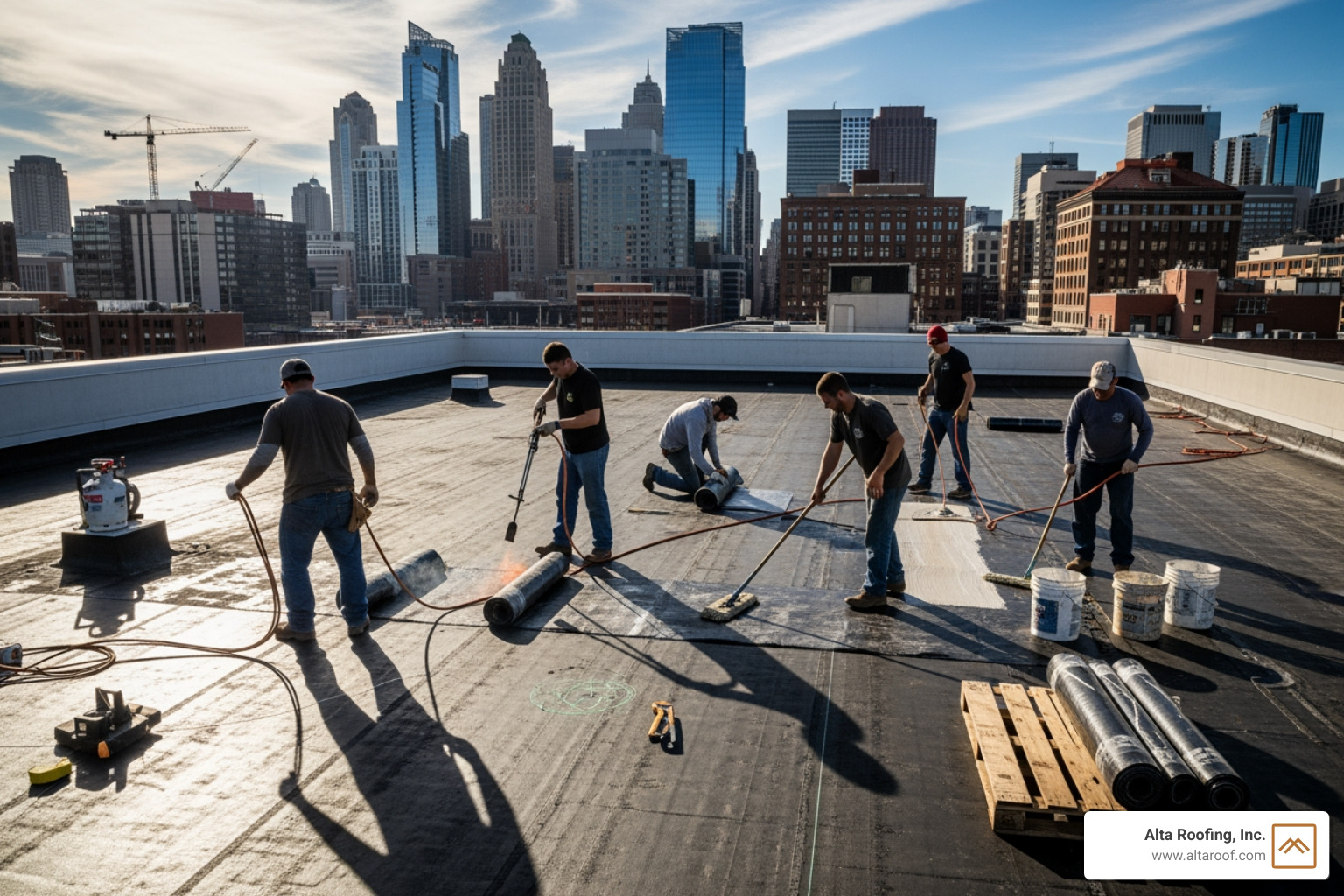
The Value of Preventative Roof Maintenance
A proactive maintenance plan is a wise investment for any business, extending your roof's lifespan and preventing costly emergency repairs. A typical plan includes bi-yearly inspections, debris removal, and clearing of drains and gutters. This not only catches minor issues before they escalate but also helps you budget for future needs and ensures your manufacturer's warranty remains valid.
Specialized Services: From Coatings to Custom Metal Work
Beyond standard repairs and replacements, we offer specialized services to improve your building's performance and longevity:
- Roof Coatings: A cost-effective alternative to a full replacement, these fluid-applied solutions can extend your roof's life, reduce energy costs, and provide a new warranty.
- Custom Sheet Metal Fabrication: For intricate architectural details, flashing, or gutters, custom work ensures a perfect fit and superior protection.
- Skylight Installation and Repair: We handle new installations and repairs, ensuring proper flashing and sealing to prevent leaks.
- Underdecking Systems: For multi-level properties, underdecking creates usable, dry outdoor space and protects your building's foundation.
Navigating Commercial Roofing Materials and Costs
Choosing the right commercial roofing material is a critical decision that impacts your building's durability, energy efficiency, and long-term costs. When selecting a system for your Colorado Springs property, consider its resistance to hail and UV rays, its energy efficiency, your budget, and the building's roof slope.
Popular Commercial Roofing Systems & Cost Factors
Here’s a look at common commercial roofing materials and their characteristics:
- TPO (Thermoplastic Olefin): A popular, energy-efficient, and cost-effective single-ply membrane. Its white surface reflects sunlight, reducing cooling costs, and its seams are heat-welded for superior strength.
- EPDM (Ethylene Propylene Diene Monomer): A durable synthetic-rubber membrane known for its long lifespan and excellent resistance to weathering, UV radiation, and temperature extremes.
- Metal Roofing (Standing Seam): Offers exceptional longevity, fire resistance, and energy efficiency. While the initial cost is higher, its durability and low maintenance needs make it a cost-effective long-term investment.
- Modified Bitumen: A multi-ply system that provides excellent waterproofing and durability, making it a good choice for roofs with high foot traffic.
- Cool Roof Coatings: These reflective coatings can be applied over existing roofs to lower surface temperature, reduce energy consumption, and extend the life of the roof.
When selecting, consider Class 4 impact-resistant materials, which are designed to withstand hail damage better than standard options and may qualify you for insurance discounts.
What is the Typical Cost for Commercial Roofing in Colorado Springs?
The cost of a commercial roof in Colorado Springs varies based on several factors:
- Material Type: Costs differ significantly between materials like TPO and premium metal roofing.
- Roof Size and Complexity: Larger or more intricate roofs with many vents and HVAC units require more labor and materials.
- Tear-off Requirements: Removing an old roof before installing a new one adds to the project's cost.
- Permit Fees & Accessibility: Local permit fees and challenges with accessing the roof can also influence the price.
We provide transparent and accurate estimates based on a thorough inspection of your property. For a detailed quote, Get an Instant Quote through our easy-to-use tool. We also offer financing options for roof replacement or repair through our partner, Hearth.
The Insurance Claim Process for Commercial Roof Damage
Dealing with commercial roof damage, especially after a major hailstorm or wind event, can be daunting. The insurance claim process for commercial roof damage in Colorado Springs involves several steps, and understanding them can make a world of difference. It's crucial to avoid "storm-chasing" roofers who appear after a weather event, as they often lack local accountability and may perform subpar work. Always choose a trusted, local roofer.
How a Roofer Can Be Your Advocate
Our unique selling proposition at Alta Roofing is our comprehensive approach to storm restoration, where we act as your single point of contact. This means we handle insurance claims and coordinate all necessary trades. Here's how we become your advocate:
- Professional Damage Assessment: We conduct thorough inspections to identify all storm-related damage, even subtle issues. We document all findings with photos and detailed reports for your insurance claim.
- Meeting with the Adjuster On-Site: We meet directly with your insurance adjuster on your property. Our expertise helps ensure that the adjuster identifies and properly assesses all damage, preventing oversights that could lead to an underfunded claim.
- Negotiating for a Fair Settlement: We leverage our experience with insurance claims to advocate on your behalf, ensuring you receive the full coverage you're entitled to.
- Coordinating All Trades: Storm damage often extends beyond the roof. We manage and coordinate all necessary trades, from gutter replacement to siding repair, ensuring a seamless restoration process.
We've helped countless businesses steer complex claims and restore their properties. You can see examples of our dedication and quality craftsmanship by reviewing See Our Work on past restoration projects.
Key Steps in a Commercial Roofing Insurance Claim
While every claim has its nuances, here are the general key steps we guide our commercial clients through:
- Emergency Tarping/Repairs: If your roof has suffered severe damage, our emergency teams respond quickly to stabilize and protect your building from further water intrusion.
- Filing the Claim Promptly: We assist you in filing your insurance claim as soon as possible after the damage occurs.
- Scheduling the Adjuster Meeting: We coordinate with your insurance company to schedule a meeting with their adjuster at your property, and we'll be there to represent your interests.
- Reviewing the Scope of Work: We carefully review the insurance company's scope of work to ensure it accurately reflects all necessary repairs and that the pricing is fair.
- Supplementing for Missed Items: It's common for adjusters to miss damages. We identify any discrepancies and submit supplements to your insurance company to ensure a complete restoration.
- Project Commencement and Completion: Once the scope and funding are approved, we schedule and execute the project with minimal disruption to your business, providing digital documentation and photo updates throughout the process.
How to Choose the Right Commercial Roofers in Colorado Springs
Choosing the right commercial roofers Colorado Springs has to offer is a decision that will impact your business for years to come. It’s not just about getting a new roof; it’s about protecting your investment, ensuring business continuity, and gaining peace of mind. Vetting contractors thoroughly is essential.
Essential Qualifications for Commercial Roofers
Not all roofing contractors are equipped for commercial projects. The scale, materials, and regulations are vastly different from residential work. Ensure your chosen contractor has:
- A Local and Established Presence: A long-standing local company understands Colorado's unique climate challenges and is accountable to the community.
- Specialized Commercial Experience: Look for a portfolio of completed commercial projects. Commercial roofs, often flat or low-slope, require specific expertise in systems like TPO, EPDM, and metal roofing, as well as knowledge of commercial building codes and OSHA safety standards.
- Proper Licensing and Insurance: Verify that the contractor is licensed and insured. This includes both general liability and workers' compensation to protect your business. You can check licensing with the Pikes Peak Regional Building Department.
- Manufacturer Certifications: Certifications from major roofing material manufacturers (like GAF Master Elite) indicate a high level of training and allow the contractor to offer improved warranties.
- Positive Online Reviews and a Strong BBB Rating: Check customer satisfaction rates and reviews. Look for consistent positive feedback regarding communication, craftsmanship, and professionalism.
Understanding Commercial Roofing Warranties
Warranties are a critical component of any commercial roofing project, offering peace of mind and protection for your investment. It's important to understand the different types:
- Manufacturer Warranties (Materials): These warranties cover defects in the roofing materials themselves. The duration and coverage can vary widely depending on the material and manufacturer.
- Contractor Workmanship Warranties (Labor): This warranty covers the quality of the installation and the contractor's labor. A reputable contractor will stand behind their work with a solid workmanship warranty.
- NDL (No Dollar Limit) Warranties: These are comprehensive warranties, often offered by manufacturers, that cover both materials and labor for a specified period, without a dollar limit on repairs or replacement due to covered defects.
- The Role of Preventative Maintenance: Many manufacturer warranties stipulate that the roof must undergo regular preventative maintenance to remain valid. Neglecting maintenance can void your warranty, leaving you exposed to full replacement costs if an issue arises.
Conclusion
Protecting your commercial property in Colorado Springs requires a strategic approach to roofing. We've seen how Colorado's unique climate, with its hail, intense UV, and dramatic temperature swings, demands more than just a basic roof – it demands expertise and resilience. Choosing the right commercial roofers Colorado Springs businesses trust is about finding a partner who understands these challenges and offers comprehensive solutions.
We've explored the importance of preventative maintenance in extending your roof's lifespan and preventing costly repairs. We've digd into the various commercial roofing materials, understanding their pros and cons in our specific environment. Crucially, we've highlighted the immense value of having an experienced, specialized roofer as your advocate through the often-complex insurance claim process, especially after a storm.
At Alta Roofing, we understand these needs implicitly. Our role as a single point of contact for storm restoration, handling insurance claims and coordinating all necessary trades, simplifies what can otherwise be a stressful and disruptive experience for your business. We believe in quality, integrity, and ensuring your commercial property has the peak performance roofing it deserves.
Ready to protect your commercial property? Explore our comprehensive roofing Services or Contact Us today for a free, no-obligation inspection. Let us help you safeguard your investment and ensure your business operations continue smoothly, no matter what Colorado's weather throws our way.
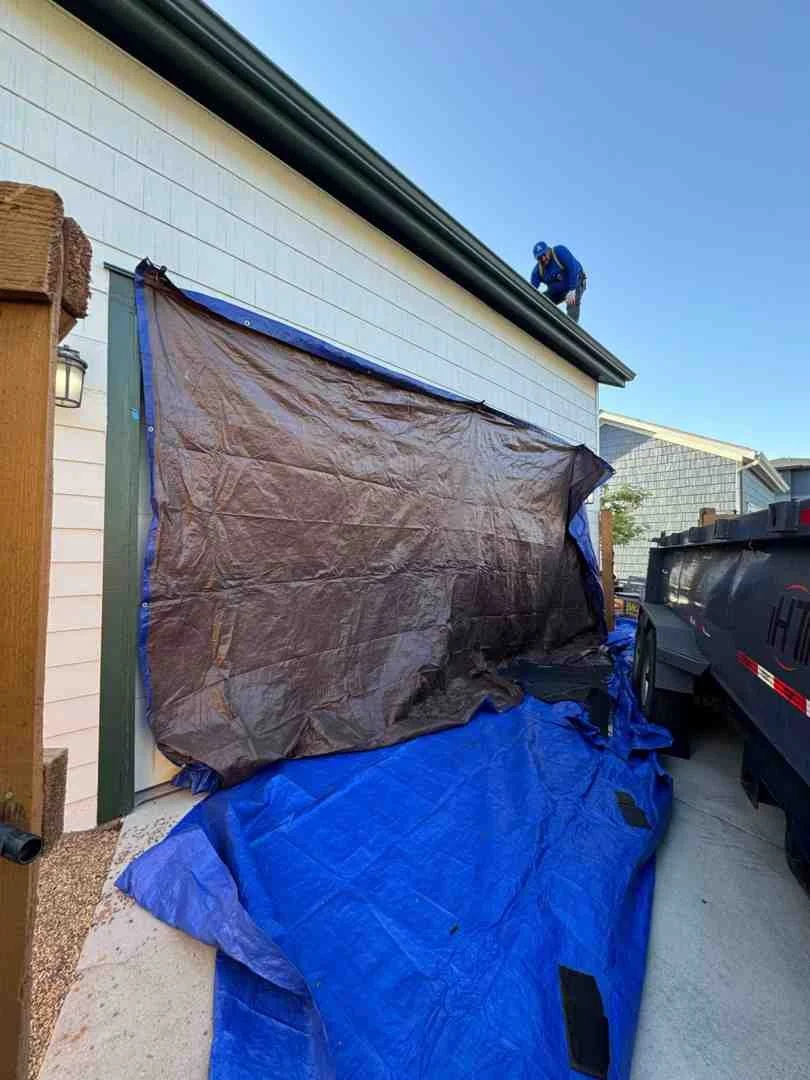
Navigating Roof Insurance Claims with Contractors
Why Insurance Claim Roof Contractors Make All the Difference

Insurance claim roof contractors are roofing professionals who specialize in navigating the complex insurance claims process for homeowners dealing with storm damage or other covered losses. Here's what you need to know:
- Expert Damage Assessment - They identify all damage, including hidden issues insurance adjusters might miss
- Documentation Support - They provide detailed inspection reports, photos, and estimates that strengthen your claim
- Insurance Negotiation - They speak the adjuster's technical language and advocate for fair compensation
- Streamlined Process - They handle coordination between you and your insurance company, reducing your stress
- Quality Repairs - They complete work that meets both insurance requirements and industry standards
Finding roof damage after a Colorado hailstorm is stressful enough without the added burden of insurance paperwork and coordinating repairs. Many homeowners worry they'll miss critical damage or accept a low settlement. The good news? You don't have to handle this alone.
Working with experienced insurance claim roof contractors transforms a confusing process into a manageable one. They act as your advocate, understanding how to document damage and negotiate with insurance companies to ensure you receive fair compensation.
A typical roof replacement can cost $9,000 to $15,000 or more. With so much on the line, an expert contractor makes a significant difference by spotting hidden damage, providing detailed documentation, and negotiating with adjusters when initial estimates fall short.
This guide walks you through the roof insurance claims process, from identifying damage and understanding your policy to choosing the right contractor and handling challenges. Whether you're dealing with Replacement Cost Value (RCV) or Actual Cash Value (ACV) coverage, a denied claim, or just trying to understand your deductible, we've got you covered.
I'm Barry Goers, founder of Tarben Ventures Ltd. I've helped countless Colorado homeowners steer storm damage restoration. I've seen how the right insurance claim roof contractors turn claim denials into approvals and transform overwhelming situations into successful outcomes.
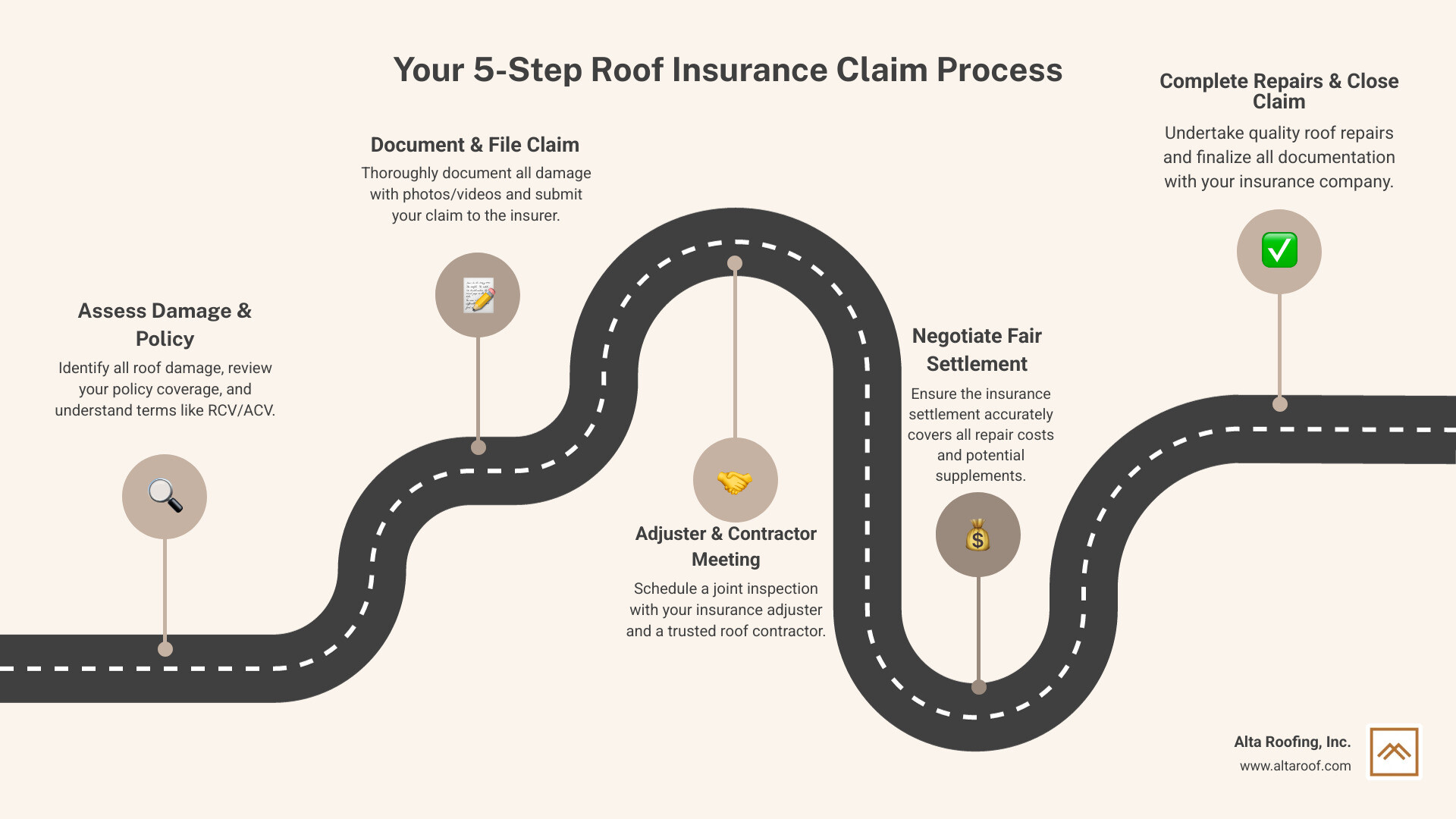
Step 1: Identifying Damage and Understanding Your Policy
When a powerful Colorado storm rolls through, it can leave behind damage that isn't always obvious. The first step in the insurance claim process is to understand the damage to your roof and the details of your insurance policy.
Signs of Roof Damage to Look For
After a weather event in areas like Denver or Colorado Springs, a professional inspection is always best, but here are some signs homeowners can look for:
- Hail Damage: Look for "bruising" or dents on shingles. Check for collateral damage like dents in gutters, downspouts, or dings on garage doors, as these are strong indicators of roof damage. For asphalt shingles, 9 to 10 hail bruises per 10x10 foot area often justifies a full replacement.
- Wind Damage: Strong winds, common in places like Castle Rock, can lift, crease, or tear off shingles. Look for any loose or missing shingles. Even if they appear flat, their seals may be broken, leaving your roof vulnerable to leaks.
- Granule Loss: If you see excessive granules from your asphalt shingles in your gutters, it could indicate hail damage or advanced wear, signaling a shortened roof lifespan.
- Interior Water Stains or Leaks: Water spots in your attic or stains on ceilings are clear indicators of a roof leak. Hidden leaks can cause significant rot and mold before they become visible.
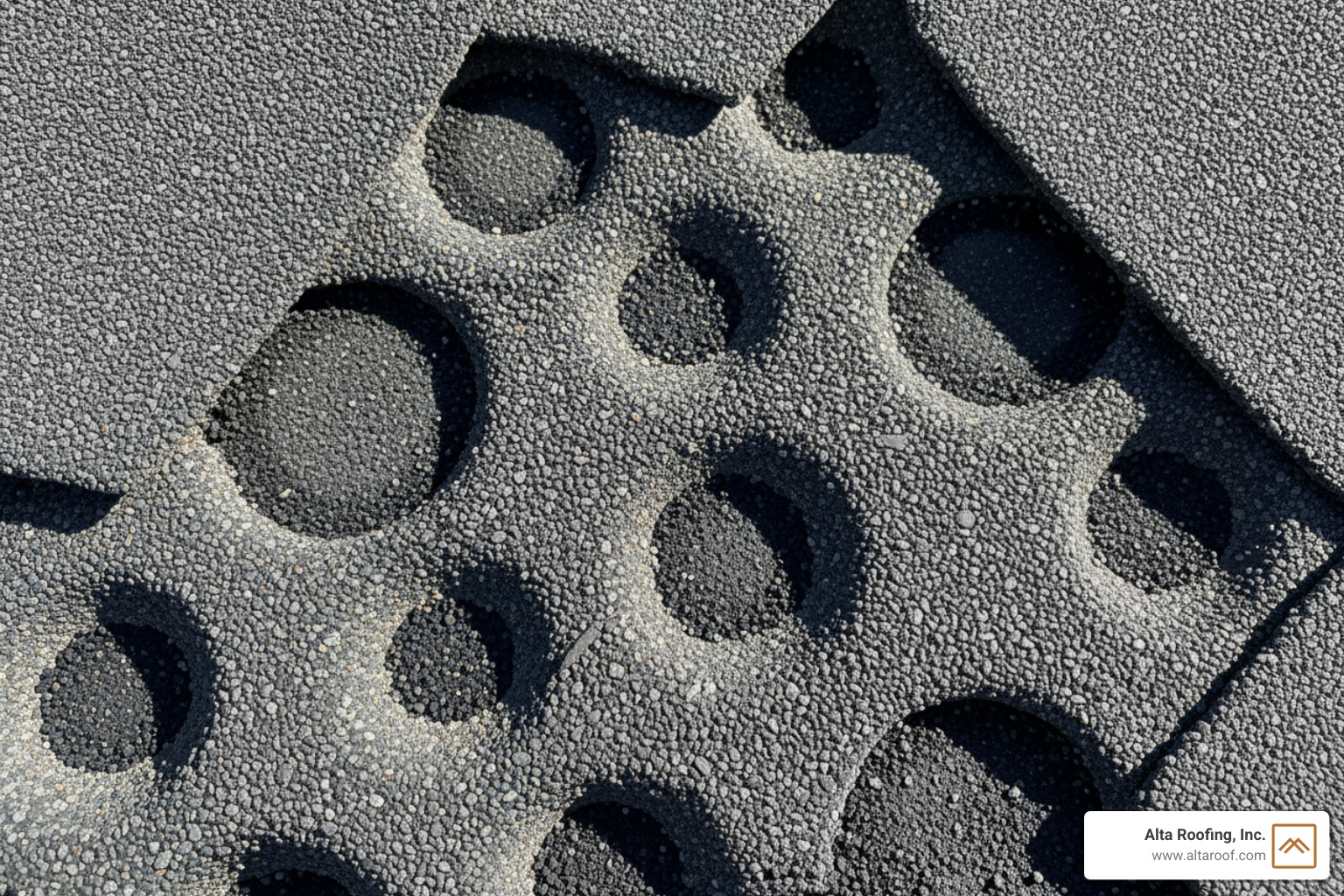
Distinguishing Storm Damage vs. Wear and Tear
This is a critical distinction. Insurance covers sudden, accidental damage from events like storms, not normal aging. An older roof (15-20 years) will naturally show wear like cracking or curling. If your roof was already in poor condition, a claim might be denied. This is why a professional assessment from experienced insurance claim roof contractors is invaluable. We can accurately differentiate wear from new storm damage, providing detailed reports with photos to serve as powerful evidence.
As we help homeowners across Colorado, from Manitou Springs to Golden, we know what evidence is needed to prove damage was caused by a covered event. For more on navigating this, you can learn more about How to File a Home Insurance Claim for Roof Damage.
Decoding Your Homeowners Insurance Policy
Before calling your insurer, you must understand your policy. It's a contract, and knowing the terms is key to a smooth claims process.
Here are the crucial elements to review:
- Replacement Cost Value (RCV) vs. Actual Cash Value (ACV): This is a critical distinction for roof claims.
- Replacement Cost Value (RCV): An RCV policy covers the full cost to replace your roof with new, similar materials, minus your deductible. Depreciation isn't factored into the final payout. You often receive an initial check for the ACV, and a second check (recoverable depreciation) after repairs are complete.
- Actual Cash Value (ACV): An ACV policy only covers the depreciated value of your roof, minus your deductible. The older your roof, the less you receive, leaving you with a larger out-of-pocket expense. ACV policies typically pay out 20-25% less than RCV policies.
| Feature | Replacement Cost Value (RCV) | Actual Cash Value (ACV) |
|---|---|---|
| Payout Basis | Cost to replace with new, similar quality materials | Depreciated value of the roof at time of loss |
| Depreciation | Not factored into final payout; recoverable after repairs | Subtracted from replacement cost; homeowner pays this |
| Out-of-Pocket | Deductible + any upgrades | Deductible + depreciation + any upgrades |
| Typical Payout | Often in two installments (ACV first, then recoverable depreciation) | Single payout for depreciated value |
- Deductibles: This is the amount you pay out-of-pocket before your insurance coverage kicks in. Deductibles can be a fixed dollar amount (e.g., $500 to $2,000 or more) or a percentage of your home's insured value.
- Policy Limits: Every policy has a maximum amount it will pay for a covered loss. Ensure your limits are adequate to cover a full roof replacement.
- Exclusions: Pay close attention to what your policy doesn't cover. Common exclusions include damage from wear and tear, failure to maintain the property, and sometimes specific catastrophic events like floods or earthquakes.
- Ordinance and Law Coverage: This often-overlooked coverage is incredibly important. If your roof needs replacement, current building codes might require upgrades (e.g., new ventilation, ice and water shield) that weren't part of your original roof. Ordinance and Law coverage helps pay for these code-mandated upgrades.
Step 2: The Essential Guide to Filing Your Roof Insurance Claim
Once we understand our policy and have a clear picture of the damage, it's time to take action. This step focuses on gathering evidence, formally initiating the claim, and effectively communicating with our insurance company and their adjuster.
Documenting Everything: Your Most Crucial Step
Think of yourself as a detective building a case. The more evidence you have, the stronger your claim. Documentation is paramount, and it's best done immediately after you suspect damage.
- Photo Evidence: Take clear, high-resolution photos and videos of all damaged areas on your roof, siding, gutters, and any interior damage. Capture wide shots for context and close-ups to detail specific issues. Date and time-stamped photos are ideal.
- Contractor's Inspection Report: This is where experienced insurance claim roof contractors truly shine. A professional inspection by our team at Alta Roofing will provide a comprehensive report detailing the cause and full extent of the damage, distinguishing new storm damage from pre-existing wear.
- Temporary Repair Receipts: If you've had to make temporary repairs (like tarping a leak in Arvada) to prevent further damage, keep all receipts. Many policies cover these mitigation costs.
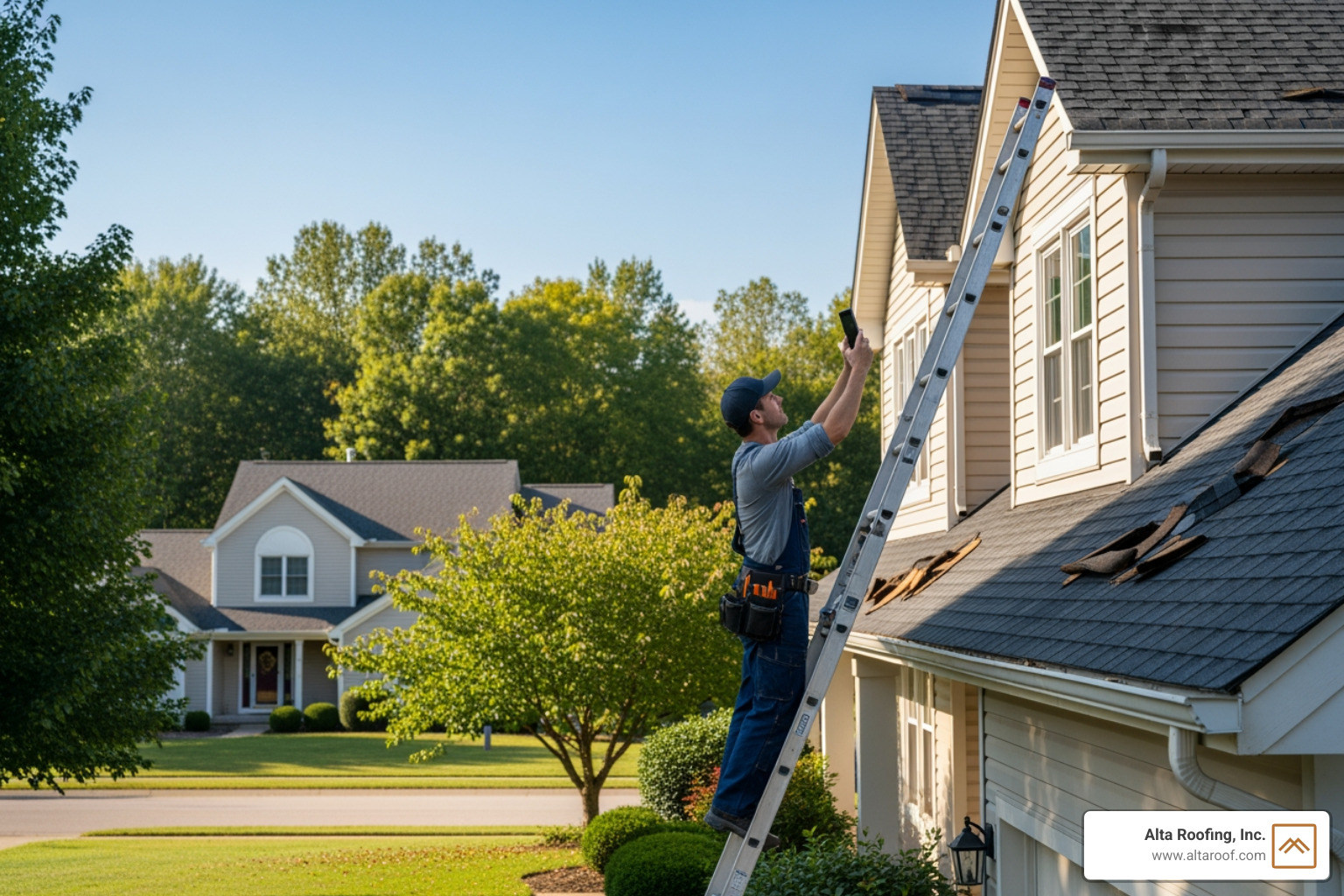
Need an initial idea of repair costs to prepare your documentation? You can get an Instant Quote for repairs through our website.
Initiating the Claim and Working with the Adjuster
With the right preparation and partnership, this step doesn't have to be stressful.
- When to Call Your Insurer: We recommend calling a reputable insurance claim roof contractor like Alta Roofing before your insurance company. Our professional inspection confirms if you have damage worth filing a claim for. Filing a "zero-pay" claim (where damage is below your deductible) can negatively impact your insurance record. Once we confirm significant damage, you can contact your insurer to open a claim.
- Contractor's Role During Inspection: When your insurance adjuster schedules their visit, ensure your contractor is present. Our Colorado team has extensive experience meeting with adjusters. We point out all identified damage, explain the technical aspects, and ensure nothing is overlooked. This collaborative approach helps prevent disputes and ensures a fair assessment. For a deeper dive, check out Your expert guide to identifying hidden damage.
- Advocating for the Homeowner: Adjusters may not be roofing experts and can miss subtle damage. Our contractors act as your advocate, ensuring all legitimate damage is accounted for. We can use an Assignment of Claim (AOC) form, which allows us to communicate directly with your insurer to streamline the process.
Maximizing Your Claim Settlement
The goal is a settlement that fully covers quality repairs or replacement. This often requires careful negotiation.
- Accurate Estimates: Our detailed estimates include all necessary line items and align with industry-standard pricing, often using software like Xactimate that insurers also use. This helps bridge gaps between our quote and the adjuster's assessment.
- Overhead and Profit: Initial insurance estimates often omit contractor overhead and profit (O&P). These are legitimate business expenses, and we work to ensure they are included in your settlement.
- Supplementing the Claim: If an initial estimate is too low, we can help "supplement" the claim. This involves providing additional documentation and revised estimates to justify a higher payout. We have helped countless Colorado homeowners successfully supplement their claims.
- Negotiation Tactics: Our experience with various insurance providers means we know how to effectively negotiate on your behalf. We present clear evidence to ensure you receive fair compensation. A roof replacement can cost from $9,000 to $15,000 or more, so thorough negotiation is essential.
Step 3: Choosing the Right Insurance Claim Roof Contractors
Selecting the right partner for your roof repair or replacement is just as important as identifying the damage itself. In the aftermath of a storm, our communities in Colorado can sometimes see an influx of less-than-reputable companies. We need to be vigilant and choose wisely.
Criteria for Vetting the Best Insurance Claim Roof Contractors
You need a team skilled in both roofing and insurance claims. Here’s what to look for in top-tier insurance claim roof contractors:
- Local and Established: Prioritize contractors with a long-standing presence in your Colorado community. Local companies like Alta Roofing understand regional building codes and are available for follow-up.
- Licensed and Insured: This is non-negotiable. Verify the contractor has proper licenses and carries both liability and workers' compensation insurance to protect you.
- Positive Online Reviews and BBB Rating: Check Google, Yelp, and the Better Business Bureau (BBB). A strong rating indicates a commitment to customer satisfaction. You can learn about BBB accreditation to understand its importance.
- Experience with Insurance Claims: Ask about their specific experience with claims. A dedicated claims specialist is a good sign. This is our specialty at Alta Roofing.
- Transparent Communication: A good contractor keeps you informed, explaining the process, timelines, and answering your questions clearly.
- References and Portfolio: Ask for references and to see previous work. We're always happy to show you our craftsmanship; you can even View our past projects online.
The Dangers of 'Storm Chasers'
Unfortunately, severe weather events often attract "storm chasers"—out-of-state contractors who follow storms, solicit business aggressively, and then disappear once the work is done, leaving homeowners with shoddy repairs and no recourse. We've seen them come and go in places like Highlands Ranch and Lone Tree.
Here are red flags to watch out for:
- High-Pressure Sales Tactics: They demand you sign a contract immediately or offer deals that seem too good to be true.
- Out-of-State License Plates: While not always a red flag, be wary if their vehicles indicate they're not local.
- Offers to Cover Your Deductible: This is a major red flag and constitutes insurance fraud. It's illegal for a contractor to waive your deductible or offer a rebate that covers it.
- No Local Office: They might operate out of a P.O. Box or temporary setup. A reputable local contractor will have an established physical address.
- Cash-Only Deals: This can be a sign they're trying to avoid taxes or operate without proper licensing.
- Lack of Warranty Information: They might offer vague promises but no written warranty for their work.
Always choose a local, reputable company that stands behind its work.
The Benefits of Hiring Experienced Insurance Claim Roof Contractors
Partnering with experts like Alta Roofing provides benefits beyond just a new roof.
- Expert Advocacy: We speak the insurance company's language and advocate for your best interests, which is crucial in complex disputes.
- Streamlined Process: We act as your single point of contact, coordinating everything to reduce your stress and save you time.
- Accurate Scope of Work: Our expertise ensures all necessary repairs, including hidden damage and code upgrades, are included in the claim to prevent surprise costs.
- Quality Materials and Craftsmanship: We use high-quality materials suited for Colorado's weather and our certified installers ensure the work is done right the first time.
- Peace of Mind: Knowing an expert team is managing the entire process allows you to focus on your family and home.
Ready to experience the difference? Schedule an Appointment with us today.
Step 4: Navigating Claim Denials and Post-Approval Steps
Even with the best preparation, sometimes claims are underpaid or denied. But don't despair! A denied or underpaid claim is often a starting point for negotiation, not a final decision.
Handling Underpaid or Denied Claims
- Reviewing the Denial Letter: Calmly review the denial letter to understand the specific reasons cited, such as wear and tear or damage below the deductible. Many homeowners operate under Common misconceptions about roof repair claims that can lead to denials.
- Getting a Second Opinion: If your claim was denied based on the adjuster's assessment, get a second opinion from a reputable insurance claim roof contractor. A detailed report with new photo evidence can often contradict the initial assessment.
- The Appeals Process: Most insurers have an appeals process. This is where you submit new evidence, like our detailed inspection report or a revised estimate, to argue why the initial decision was incorrect. We can help you build a compelling case.
- Providing New Evidence: This might include proof of maintenance, receipts from prior repairs, or expert testimony from our roofing professionals.
- Consider a Public Adjuster or Attorney: If the appeals process fails, you might consider a public adjuster or an attorney. Public adjusters work for you and typically charge a percentage of the settlement, proving invaluable in complex disputes.
From Approval to New Roof: The Repair Process
Once your claim is approved, the work begins.
- Receiving Insurance Checks: With RCV policies, you typically get two checks. The first covers the Actual Cash Value (ACV), minus your deductible, allowing work to begin.
- Recoverable Depreciation: The second check, for recoverable depreciation, is released after we complete the work and submit proof to your insurer. This brings your total payout to the full Replacement Cost Value.
- Working with Your Mortgage Company: If you have a mortgage, the check may be co-payable to you and your lender. We can guide you through getting their endorsement to release the funds.
- Scheduling the Work: Once funds are available, we'll schedule the work, help you select materials, and handle all necessary permits for your Colorado location.
- Final Inspection: After the work is complete, we conduct a thorough final inspection with you to ensure your satisfaction.
- Final Payment and Closing the Claim: Once you're happy, the final payment is processed, and we ensure your claim is officially closed with the insurance company.
Upgrading Your Roof After a Claim
A roof replacement after a storm provides an excellent opportunity to upgrade your roofing system, offering improved protection and potential savings.
- Impact-Resistant Shingles: Consider upgrading to Class 3 or Class 4 impact-resistant shingles. These are designed to withstand hail better than standard shingles. Many Colorado insurance companies offer premium discounts for homes with these durable materials.
- Potential Insurance Discounts: Other upgrades can lead to savings. Installing a FORTIFIED Roof™, which meets construction standards designed to make homes more resilient, can qualify you for insurance discounts or other incentives. You can find more information at FORTIFIED Home incentives.
- Improved Property Value: A new, upgraded roof not only offers superior protection but also improves your home's curb appeal and increases its overall property value.
Frequently Asked Questions about Roof Insurance Claims
We get a lot of great questions from homeowners in Colorado. Here are some of the most common ones we hear:
Should I call a roofer or my insurance company first?
We strongly advise contacting a reputable insurance claim roof contractor like Alta Roofing first. Here's why:
- Unbiased Damage Assessment: We conduct a thorough inspection to confirm if you truly have covered storm damage. We work for you, not the insurance company.
- Avoid Unnecessary Claims: If damage is minor or below your deductible, we can advise you not to file, protecting your insurance record from a "zero-pay" claim.
- Professional Documentation: Our detailed inspection report and photos provide solid evidence to support your claim from the very start.
- Strengthens Your Position: Having a professional assessment before you call your insurer gives you leverage and ensures all damage is identified.
What is the difference between Replacement Cost Value (RCV) and Actual Cash Value (ACV)?
This is a critical distinction that we covered earlier, but it's worth repeating.
- Replacement Cost Value (RCV) means your policy pays the full cost to replace your damaged roof with new, similar materials (minus your deductible). You typically get an initial check, then a second "recoverable depreciation" check after the work is done.
- Actual Cash Value (ACV) means your policy only pays the depreciated value of your roof. This payout will be less than the cost of a new roof, leaving you to cover the difference plus your deductible.
Will filing a roof claim increase my insurance premiums?
This is a valid concern. While filing a claim can lead to premium increases, it's not guaranteed, especially for storm damage in Colorado.
- "No-Fault" Claims: Storm-related claims are often considered "no-fault" incidents because you can't prevent a hailstorm. A single storm claim might not directly cause your individual premiums to rise.
- Regional Rate Increases: More often, insurers raise rates across an entire region after a major storm, regardless of whether you personally filed a claim.
- Not Filing Can Be Costlier: The alternative to filing a legitimate claim is paying for a full roof replacement yourself, which can cost thousands. Unaddressed damage can also lead to more expensive problems like leaks and mold, which may not be covered later.
Conclusion
Navigating roof damage and an insurance claim can feel overwhelming, but with the right knowledge and partner, it becomes a manageable path to a restored home.
Remember these key takeaways:
- Proactive Documentation is Power: Detailed photos and a contractor's report are your strongest allies.
- Understand Your Policy: Know your RCV vs. ACV coverage, deductible, and exclusions before you file.
- Partner with an Expert: Choose local, experienced insurance claim roof contractors to advocate for you and deliver quality repairs.
At Alta Roofing, Inc., we're your dedicated partner in storm restoration. From Denver to Colorado Springs, our mission is to simplify the insurance claims process and provide you with a durable, beautiful roof. We act as your single point of contact, coordinating all trades to ensure a smooth, stress-free experience.
Don't let roof damage and insurance paperwork overwhelm you. Let our expertise be your guide. Explore our storm damage restoration services and see how we can help you get back to normal, faster.