
Don't Get Rained Out: Maximizing Your Hail Damage Insurance Payout
Why Understanding the Hail Damage Insurance Claim Process Matters
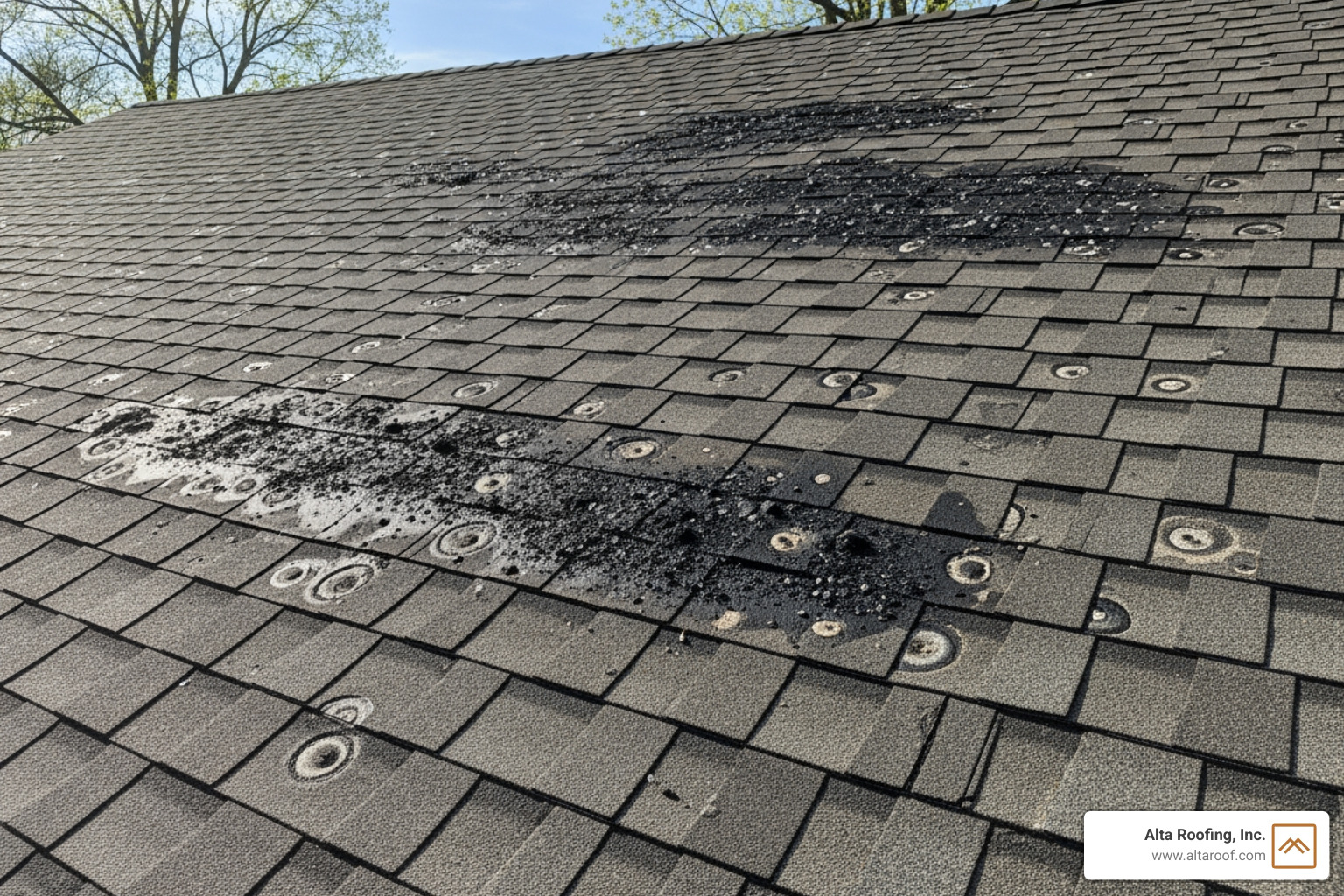
The hail damage insurance claim process can feel overwhelming after a storm hits your Colorado home, but knowing the essential steps helps you secure the compensation you deserve. Here's what you need to know:
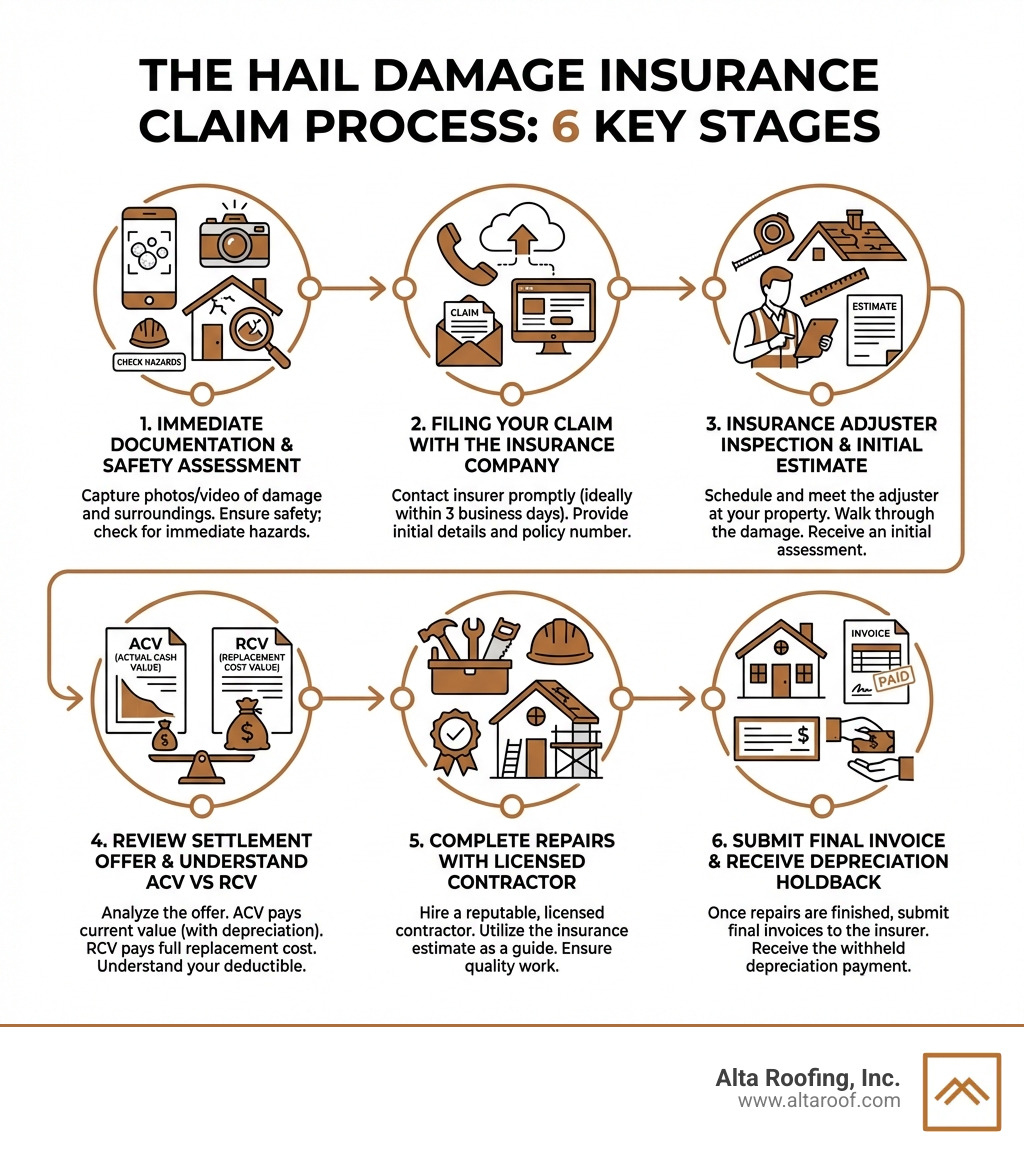
Quick Overview: The Hail Damage Insurance Claim Process
- Document the damage - Take photos and videos immediately after the storm
- Contact your insurance company - Report the claim within 3 business days
- Schedule an adjuster inspection - Meet with the insurance adjuster at your property
- Review the settlement offer - Understand ACV vs. RCV and your deductible
- Get contractor estimates - Compare independent repair quotes with the adjuster's assessment
- Complete repairs - Hire a licensed contractor to restore your property
- Submit final invoice - Receive your depreciation holdback after work is completed
Weather in Colorado can turn severe without warning. Sunny skies quickly transform into thunderstorms that drop hailstones ranging from pea-sized pellets to stones the size of tennis balls. Most hail storms last only 5-6 minutes, but the damage they cause can be extensive and costly. Hail can dent your roof, crack windows, damage siding, and create openings that allow water and pests into your home.
The good news? Hail damage claims are considered no-fault because natural disasters are beyond your control. This means filing a claim typically won't increase your insurance premium. However, the claim process itself requires careful attention to deadlines, documentation, and policy details to maximize your payout.
Many Colorado homeowners struggle with the complexity of coordinating insurance adjusters, understanding policy language, and managing contractors. Without proper guidance, you might accept a settlement that doesn't fully cover your repairs, or worse, have your claim denied due to missing documentation or procedural errors.
I'm Barry Goers, founder of Tarben Ventures Ltd., with experience in the construction industry and helping property owners steer complex restoration projects. Throughout my career, I've seen how understanding the hail damage insurance claim process empowers homeowners to protect their investments and secure fair compensation. This guide will walk you through every step, from those critical first 48 hours after the storm to receiving your final settlement check.
After the Storm: Your First 48 Hours
The hailstones have stopped falling, the wind has died down, and the sun might even be peeking through the clouds. But don't let the calm fool you – the critical work for your hail damage insurance claim process has just begun. These first 48 hours are crucial for ensuring your safety, preventing further damage, and thoroughly documenting everything.
First and foremost, your safety and the safety of your family are paramount. Before you even think about inspecting your roof, check for immediate hazards. Are there downed power lines? Any unstable structures around your home? If you suspect any immediate dangers, evacuate your family and contact emergency services.
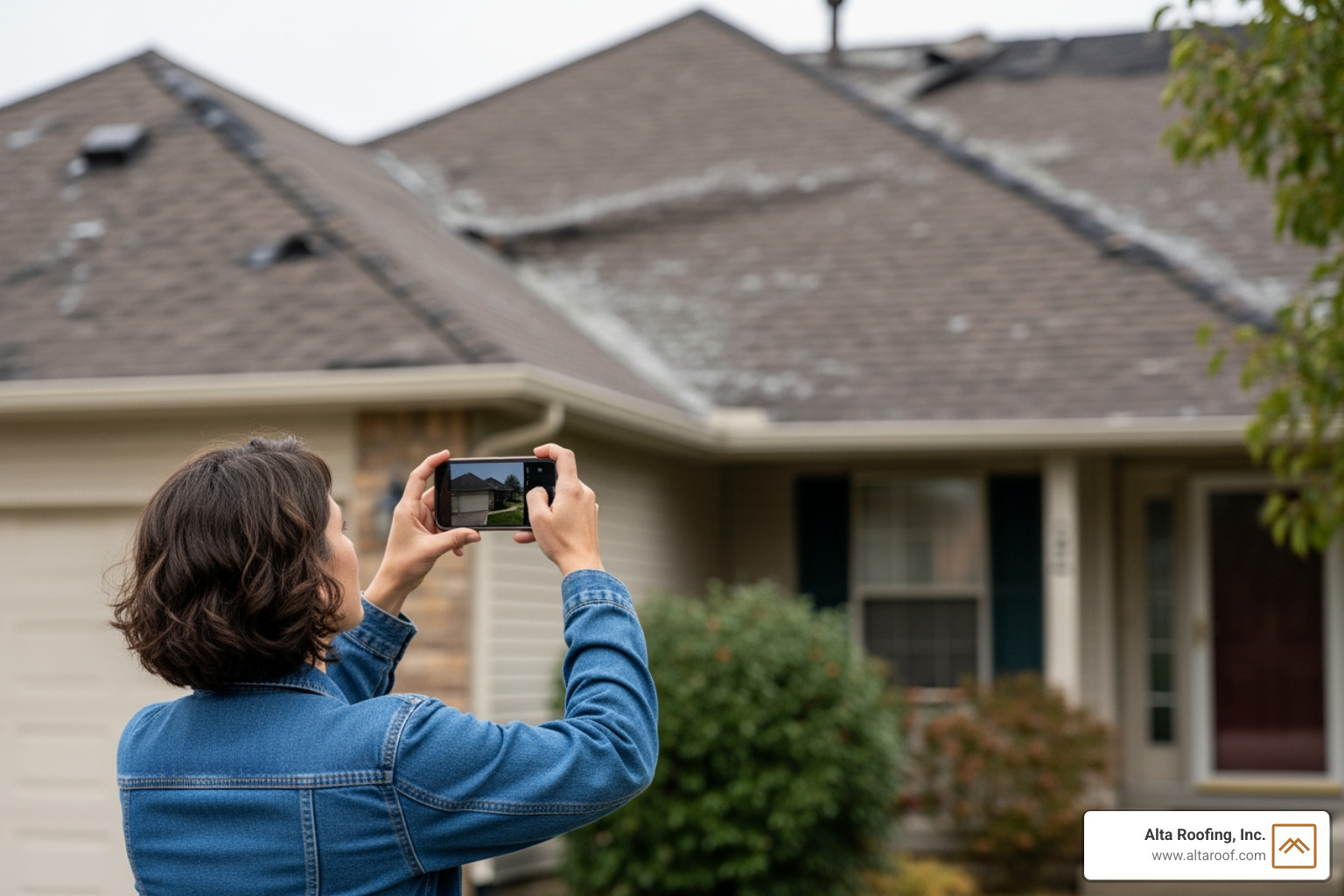
Once it's safe to venture outside, it's time to become a meticulous detective. We recommend starting your documentation process immediately. This means taking clear photos and videos of all hail damage and any affected personal property. Be sure to note the date and time of the hailstorm—this detail is vital for your claim. Documenting damage promptly helps prove that the damage was caused by the specific storm you're reporting, preventing potential denials later on due to perceived neglect or wear and tear.
Best Practices for Documenting Hail Damage
Thorough documentation is the bedrock of a successful hail damage insurance claim process. Here's how to do it right:
- Take photos and videos: Use a high-resolution camera or smartphone. Capture overall shots of your property and close-ups of specific damage.
- Use a ruler or coin for scale: For close-up shots of dents, cracks, or granule loss, place a ruler, coin, or even a pen next to the damage. This helps the adjuster understand the size and severity.
- Note date and time: Keep a simple log or use your phone's timestamp feature to record when the photos/videos were taken and when the storm occurred.
- Capture damage from multiple angles: Don't just take one shot. Get different perspectives to fully illustrate the extent of the damage.
- Photograph gutters, siding, and windows: Hail doesn't just hit the roof. Check your gutters for dents, siding for impact marks, and windows for cracks.
- Keep a communication log: From the moment you contact your insurance company to every interaction with adjusters or contractors, write down names, dates, times, and a summary of the conversation. This record can be invaluable if disputes arise.
A detailed inspection report from an experienced roofer often carries far more weight than a homeowner's subjective assessment. While you're documenting from the ground, we can provide a professional inspection to identify damage that might not be visible to the untrained eye.
Essential Items for a Damage Documentation Kit:
- Smartphone or camera
- Notepad and pen
- Measuring tape or ruler
- Chalk (for circling hail marks on shingles or pavement)
- Flashlight (for inspecting dark areas like attics if safe)
Making Temporary Repairs to Prevent Further Damage
After documenting, your next step is to prevent further damage to your home. This is often referred to as "mitigation," and it's a responsibility outlined in your insurance policy. You must take reasonable steps to protect your property from additional harm, but do not make permanent repairs before the insurance adjuster inspects the damage.
Here are some temporary measures you can take:
- Tarping the roof: If your roof has obvious holes or missing shingles, a temporary tarp can prevent water from entering your home.
- Boarding up windows: Cracked or broken windows should be boarded up to secure your home and keep out the elements.
- Removing standing water: If water has entered your home, remove standing water and use fans to dry out affected areas to prevent mold growth.
- Saving all receipts: Keep meticulous records of all expenses related to these temporary repairs, including materials and any labor you paid for. These costs are typically reimbursable under your policy.
At Alta Roofing, Inc., we specialize in comprehensive storm damage restoration and can help you with these crucial temporary repairs to prevent further damage. We also offer full-service support throughout the entire claim process.
More info about our storm damage services
The Step-by-Step Hail Damage Insurance Claim Process
Now that you've secured your property and documented the damage, it's time to officially start your hail damage insurance claim process. This might seem like the most intimidating part, but with a clear roadmap, it's manageable. The hail damage roof insurance claim process can seem daunting, but it's usually worth your time and energy.
The first step is to contact your insurance provider. We recommend doing this as soon as possible after the storm, ideally within three business days. While many policies allow up to a year, or even two years in some states, waiting too long can make it harder to prove the damage was caused by the specific hailstorm you're reporting. This delay could lead to denials due to perceived neglect.
When you contact your insurer, have your policy number, the date of the incident, and a brief description of the damage ready. Most insurance companies offer multiple ways to file a claim: by phone, through their website, or via a mobile app. Choose the method that's most convenient for you.
Once you file your claim, your insurance company will likely ask you to complete a "proof of loss" form. This is a crucial document that lists all damaged or lost property or items, along with the estimated value or cost of the damage or loss. You'll need to sign and swear that the statements on this form are true. Be accurate, as untrue statements can void your insurance. Typically, you'll need to complete and return this form within 30 days.

Key steps in the hail damage roof insurance claim process
Navigating a hail damage insurance claim process for your roof can be complex, but here's a breakdown of the key steps we guide our Colorado clients through:
- Contacting your insurer: As mentioned, this is your first official step. Provide them with all the details you've gathered.
- Scheduling the adjuster visit: Your insurer will assign an adjuster to assess the damage. This person works for the insurance company. We highly recommend having your chosen roofing contractor present during this inspection. An experienced roofer, like us at Alta Roofing, can point out all instances of damage that an adjuster might miss, ensuring nothing is overlooked.
- Meeting the adjuster: Be present during the inspection. Walk through the property with the adjuster, highlighting the damage you've documented. Share your photos and videos.
- Reviewing the adjuster's report: After their visit, the adjuster will provide a report and an estimate for repairs. Review this carefully. This is where our expertise becomes invaluable. We can help you understand the report, compare it to our own detailed inspection, and identify any discrepancies or undervalued items.
At Alta Roofing, Inc., we pride ourselves on being your single point of contact throughout this journey. We handle insurance claims and coordinate all necessary trades, particularly for homeowners in Colorado Springs and across our service areas.
Guide to Hail Damage Roof Insurance Claims
The Role of the Insurance Adjuster
The insurance adjuster plays a pivotal role in your hail damage insurance claim process. They are employed by your insurance company to investigate your claim, assess the damage, and determine the cost of repairs. Their job is to ensure the claim is valid and that the proposed repairs align with your policy coverage.
Here's what they typically do:
- Damage assessment: They will inspect your property, often focusing on the roof, siding, and any other structures impacted by hail. They look for direct evidence of hail impact.
- Estimating software: Most adjusters use specialized software like Xactimate (used by about 80% of insurance companies) or Symbility (used by the other 20%) to generate their repair estimates. These programs standardize pricing for materials and labor.
- Policy interpretation: They interpret your policy to determine what is covered, what exclusions apply, and how your deductible will factor into the payout.
- Settlement offer: Based on their assessment and your policy, they will propose a settlement amount.
While adjusters are professionals, they can sometimes miss subtle damage or offer an estimate that doesn't fully cover the actual cost of restoration, especially if you have an older roof. This is where having an experienced roofing contractor on your side, like Alta Roofing, makes all the difference. We can review their assessment, provide our own detailed estimate, and advocate for your best interests.
How to Know When It's Time to Replace Your Roof
Understanding Your Settlement: ACV, RCV, and Deductibles
Deciphering your insurance settlement can feel like reading a foreign language, but understanding the key terms is essential for maximizing your payout during the hail damage insurance claim process. The amount your insurance pays depends on several factors, including your policy type, the extent of the damage, and your deductible.
Hail damage claims are generally considered "no-fault" because they stem from natural disasters beyond your control. This means they typically won't impact your premium. However, the payout itself is carefully calculated based on your policy's terms.
Actual Cash Value (ACV) vs. Replacement Cost Value (RCV)
This is one of the most critical distinctions in your homeowner's policy:
- Actual Cash Value (ACV): An ACV policy pays for the cost of repairing or replacing damaged property minus depreciation. Depreciation is the reduction in value due to age, wear and tear, and obsolescence. If your roof is 15 years old, an ACV policy will pay you the value of a 15-year-old roof, not a brand-new one. This means you'll receive an initial check for the depreciated value, and the remainder of the replacement cost will come out of your pocket.
- Replacement Cost Value (RCV): An RCV policy pays for the cost of repairing or replacing damaged property with new materials of similar kind and quality, without deduction for depreciation. This is generally the preferred coverage for homeowners.
Most RCV policies use a "two-check process" for payouts:
- First Check (ACV): You'll receive an initial payment based on the actual cash value of the damage (replacement cost minus depreciation), minus your deductible.
- Second Check (Recoverable Depreciation): Once repairs are completed and we submit the final invoice, your insurance company will release the "recoverable depreciation"—the amount initially held back for depreciation. This second check covers the remaining cost of repairs, bringing you up to the full replacement cost.
If your policy limit is $15,000 and repairs cost $20,000, you'll still pay the $5,000 difference out of pocket. It's vital to understand your coverage limits.
| Policy Type | Payout Method | Out-of-Pocket for Depreciation |
|---|---|---|
| Actual Cash Value | Repair/replacement cost minus depreciation | Yes |
| Replacement Cost Value | Full repair/replacement cost (no depreciation deduction) | No (after two-check process) |
How Deductibles Work for Hail Claims
Your deductible is the amount you pay out of pocket before your insurance coverage kicks in. For hail damage claims on homes, deductibles can vary significantly:
- Standard Deductible: This is a fixed dollar amount, such as $1,000 or $2,500. If your repairs cost $8,000 and your deductible is $1,000, your insurer would pay $7,000.
- Percentage Deductible: In hail-prone areas like Colorado, some homeowners' policies have a percentage deductible, typically 1% to 5% of your home's dwelling coverage limit. For example, if your home is insured for $300,000 with a 1% hail deductible, you'd pay the first $3,000 of covered damage.
The deductible is subtracted from the total approved repair cost. We will work with you to understand your specific deductible and how it applies to your claim.
When not to file a claim: If the estimated repair costs are minor or less than your deductible, it might not be worth filing a claim. For instance, if repairs are estimated at $5,000 and your deductible is $5,000, filing a claim might not benefit you financially. We can help you assess the damage and determine if filing a claim is the best course of action.
Understanding your insurance policy
When Things Go Wrong: Denials, Low Offers, and Total Loss
Even with careful documentation and prompt filing, the hail damage insurance claim process can sometimes hit a snag. Denials, low settlement offers, or even a total loss declaration can be frustrating, but we're here to help you steer these challenges.
A common reason for disputes or denials involves exclusions. Many policies now include specific limitations:
- Cosmetic damage clauses: Some policies may exclude coverage for purely cosmetic damage, such as minor dents on a metal roof or slight discoloration on siding, if the functionality or integrity of the material is not compromised.
- Wear and tear: Insurance covers sudden, accidental damage. It does not cover damage resulting from normal wear and tear, lack of maintenance, or pre-existing conditions. If your roof was already old and deteriorated, the insurer might argue that hail damage was minimal compared to the existing wear.
What to Do If Your Hail Damage Claim is Denied
A denied claim isn't necessarily the final word. Here's what we recommend:
- Review the denial letter: Understand the specific reason for the denial. Is it due to an exclusion, insufficient damage, or a procedural issue?
- Appeal the decision: You have the right to appeal. Gather any additional evidence you have, such as our detailed inspection reports, contractor estimates, or photos, that directly refutes the reason for denial.
- Provide new evidence: If your contractor (like us!) found significant damage that the adjuster missed, submit that evidence. We can help you build a compelling case.
- Consult a roofing expert: If you've been denied due to "insufficient damage" or "wear and tear," an experienced roofing company like Alta Roofing can provide an expert assessment. Our detailed reports and ability to speak the adjuster's language can often lead to a reversal of the denial. We've seen it happen!
We're proud of Our Work in successfully assisting homeowners with complex claims and getting them the fair compensation they deserve.
How to Negotiate with an Insurance Adjuster
Negotiation is often a key part of the hail damage insurance claim process. Here’s how we recommend approaching it:
- Contractor estimates: Obtain detailed, written estimates from reputable local contractors, like Alta Roofing. These estimates should clearly outline all necessary repairs and their costs. If your estimate is higher than the adjuster's, it's a strong negotiation tool.
- Presenting your documentation: Organize all your photos, videos, and notes. Show the adjuster or claims manager the discrepancies between their assessment and your contractor's findings.
- Sticking to facts: Avoid emotional arguments. Focus on the observable damage, the terms of your policy, and the professional estimates. Don't guess or admit fault; simply present the facts relevant to the claim.
- Escalating to a manager: If you're not making progress with the initial adjuster, ask to speak with their supervisor or a claims manager. Sometimes a fresh pair of eyes can make a difference. If you still disagree, you can consider hiring a public adjuster who works for you, not the insurance company.
What Happens if Your Property is a Total Loss?
In severe cases, particularly with older homes or extensive damage, your property might be declared a "total loss" due to hail damage. This occurs when the cost of repairs exceeds the property's actual cash value (ACV) or a certain percentage of its value, as defined by your policy.
If your home is declared a total loss:
- Settlement calculation: Your insurer will pay you the property's ACV (or RCV, depending on your policy), minus your deductible. This settlement is intended to allow you to rebuild or purchase a comparable property.
- Mortgage company involvement: If you have an outstanding mortgage, the settlement check will likely be made out to both you and your mortgage lender. The lender will often hold the funds in an escrow account and release them as repairs are completed, ensuring their investment is protected. We can help coordinate with your lender during this process.
Frequently Asked Questions about Hail Damage Claims
We often hear similar questions from homeowners navigating the hail damage insurance claim process. Here are some common ones:
Will filing a hail damage claim increase my insurance premium?
Generally, no. Hail damage claims are considered "no-fault" because they result from natural disasters, which are beyond your control. Filing a claim for a natural event like a hailstorm typically won't cause your individual premium to increase. However, if an area experiences a high frequency of severe storms, overall premiums for everyone in that region might eventually rise to cover the increased risk.
Leaving significant hail damage unrepaired can lead to problems. If you don't fix existing damage and another storm hits, your insurer might deny future claims or limit coverage for that specific damage, arguing it was pre-existing or due to neglect.
How long do I have to file a hail damage claim?
The timeframe to file a hail damage insurance claim varies by state and by individual insurance policy. In most cases, you have up to one year to file a claim for hail damage, and some states even extend that to two years.
However, we strongly advise filing your claim as soon as possible after the storm. The longer you wait, the harder it can be to prove that the damage was caused by a specific weather event, potentially leading to a denial. For example, the Colorado Division of Insurance recommends reporting damage promptly.
After a Hail Storm - Insurance FAQs - Colorado Division of Insurance
What kind of damage can hailstorms cause?
Hailstorms can release a variety of damaging effects on your property, depending on the size of the hailstones and the wind's intensity.
- Roof damage: This is the most common and often the most severe. Hail can cause:
- Dents: Impact marks on shingles, vents, and metal components.
- Granule loss: Hail can knock the protective granules off asphalt shingles, exposing the asphalt matting to harmful UV rays and accelerating deterioration.
- Cracks: Shingles can crack, especially older or brittle ones, compromising the roof's integrity.
- Broken shingles: Severe impacts can break shingles, creating entry points for water.
- Water leaks: Even small damage can lead to leaks, allowing water into your attic and home, which can cause mold and structural issues.
- Pest entry: Holes or compromised areas can also allow pests into your home.
- Siding and gutter damage: Vinyl siding can crack or shatter, while metal siding and gutters can be dented.
- Broken windows: Larger hailstones can crack or shatter windows.
- Damage to exterior structures: Sheds, fences, decks, and even outdoor air conditioning units can sustain significant hail damage.
Conclusion
Navigating the hail damage insurance claim process can feel like a daunting task, but with the right knowledge and a trusted partner, it doesn't have to be. We've walked through the crucial steps, from immediate post-storm actions and meticulous documentation to understanding your policy, working with adjusters, and addressing potential challenges like denials or total loss declarations.
Colorado experiences its fair share of hailstorms, making robust preparation and a clear understanding of the claims process essential for homeowners in Denver, Aurora, Colorado Springs, and all our service areas. Proactive protection, such as regular roof inspections and understanding your policy before a storm hits, can save you a lot of stress and expense down the road.
At Alta Roofing, Inc., we specialize in roofing and storm restoration, and our unique selling proposition is handling insurance claims and coordinating all necessary trades. We act as your single point of contact, simplifying the entire process for homeowners right here in Colorado Springs, Aurora, Denver, and beyond. We bring our expertise to every step, ensuring you receive a fair and comprehensive settlement to restore your home to its pre-storm condition.
Don't let hail damage rain on your parade. Let us help you maximize your insurance payout and restore your peace of mind.
